2,281 posters, 63 videos, 56 audios, 43 topics, 18 sessions, 6,174 authors, 2,323 institutions
ePostersLive by SciGen Technologies S.A. All rights reserved.
RCOG World Congress 2025
June 23 - 25, 2025 | ExCeL London, UK
EP.1999
Changing trends following Egg Freezing :10years single center Indian study.
Poster Presenter
Part of Topic
Reproductive medicine/assisted reproduction
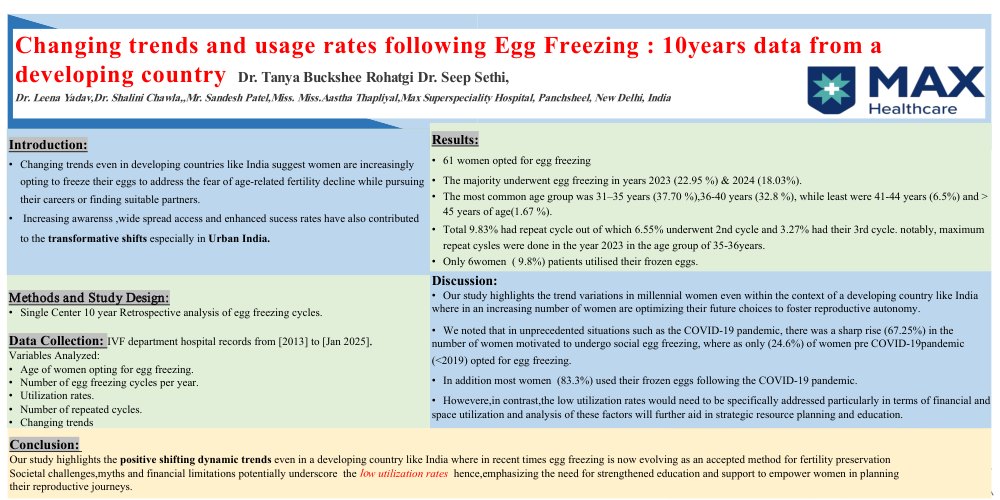
Changing trends and usage rates following Egg Freezing : 10years data from a developing country Dr. Tanya Buckshee Rohatgi Dr. Seep Sethi,Dr. Leena Yadav,Dr. Shalini Chawla,,Mr. Sandesh Patel,Miss. Miss.Aastha Thapliyal,Max Superspeciality Hospital, Panchsheel, New Delhi, India
Introduction: Changing trends even in developing countries like India suggest women are increasingly opting to freeze their eggs to address the fear of age-related fertility decline while pursuing their careers or finding suitable partners. Increasing awarenss ,wide spread access and enhanced sucess rates have also contributed to the transformative shifts especially in Urban India.
Methods and Study Design: Single Center 10 year Retrospective analysis of egg freezing cycles. Data Collection: IVF department hospital records from [2013] to [Jan 2025]. Variables Analyzed:
Age of women opting for egg freezing.
Number of egg freezing cycles per year.
Utilization rates.
Number of repeated cycles.
Changing trends
Results: 61 women opted for egg freezing The majority underwent egg freezing in years 2023 (22.95 %) & 2024 (18.03%). The most common age group was 31–35 years (37.70 %),36-40 years (32.8 %), while least were 41-44 years (6.5%) and > 45 years of age(1.67 %). Total 9.83% had repeat cycle out of which 6.55% underwent 2nd cycle and 3.27% had their 3rd cycle. notably, maximum repeat cysles were done in the year 2023 in the age group of 35-36years. Only 6women ( 9.8%) patients utilised their frozen eggs.
Discussion: Our study highlights the trend variations in millennial women even within the context of a developing country like India where in an increasing number of women are optimizing their future choices to foster reproductive autonomy. We noted that in unprecedented situations such as the COVID‐19 pandemic, there was a sharp rise (67.25%) in the number of women motivated to undergo social egg freezing, where as only (24.6%) of women pre COVID-19pandemic (<2019) opted for egg freezing. In addition most women (83.3%) used their frozen eggs following the COVID-19 pandemic. Howevere,in contrast,the low utilization rates would need to be specifically addressed particularly in terms of financial and space utilization and analysis of these factors will further aid in strategic resource planning and education.
Conclusion: Our study highlights the positive shifting dynamic trends even in a developing country like India where in recent times egg freezing is now evolving as an accepted method for fertility preservation Societal challenges,myths and financial limitations potentially underscore the low utilization rates hence,emphasizing the need for strengthened education and support to empower women in planning their reproductive journeys.