2,281 posters, 63 videos, 56 audios, 43 topics, 18 sessions, 6,174 authors, 2,323 institutions
ePostersLive by SciGen Technologies S.A. All rights reserved.
RCOG World Congress 2025
June 23 - 25, 2025 | ExCeL London, UK
EP.1989
The impact of vaping on ovarian reserve and fertility. A systematic review.
Poster Presenter
Authors
Sarah Petch, Ciara Nolan, Helen O'Neill, Louise Glover, David Crosby
Affiliations
Part of Topic
Reproductive medicine/assisted reproduction
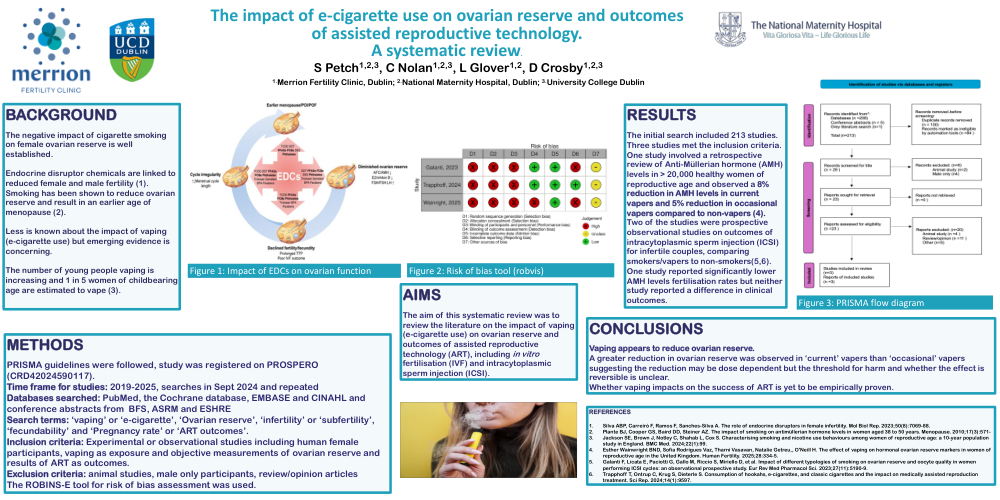
The impact of e-cigarette use on ovarian reserve and outcomes of assisted reproductive technology. A systematic review.
BACKGROUND
The negative impact of cigarette smoking on female ovarian reserve is well established.
Endocrine disruptor chemicals are linked to reduced female and male fertility (1).
Smoking has been shown to reduce ovarian reserve and result in an earlier age of menopause (2).
Less is known about the impact of vaping (e-cigarette use) but emerging evidence is concerning.
The number of young people vaping is increasing and 1 in 5 women of childbearing age are estimated to vape (3).
METHODS
PRISMA guidelines were followed, study was registered on PROSPERO (CRD42024590117).
Time frame for studies: 2019-2025, searches in Sept 2024 and repeated
Databases searched: PubMed, the Cochrane database, EMBASE and CINAHL and conference abstracts from BFS, ASRM and ESHRE
Search terms: ‘vaping’ or ‘e-cigarette’, ‘Ovarian reserve’, ‘infertility’ or ‘subfertility’, ‘fecundability’ and ‘Pregnancy rate’ or ‘ART outcomes’.
Inclusion criteria: Experimental or observational studies including human female participants, vaping as exposure and objective measurements of ovarian reserve and results of ART as outcomes.
Exclusion criteria: animal studies, male only participants, review/opinion articles
The ROBINS-E tool for risk of bias assessment was used.
AIMS
The aim of this systematic review was to review the literature on the impact of vaping (e-cigarette use) on ovarian reserve and outcomes of assisted reproductive technology (ART), including in vitro fertilisation (IVF) and intracytoplasmic sperm injection (ICSI).
RESULTS
The initial search included 213 studies. Three studies met the inclusion criteria.
One study involved a retrospective review of Anti-Müllerian hormone (AMH) levels in > 20,000 healthy women of reproductive age and observed a 8% reduction in AMH levels in current vapers and 5% reduction in occasional vapers compared to non-vapers (4).
Two of the studies were prospective observational studies on outcomes of intracytoplasmic sperm injection (ICSI) for infertile couples, comparing smokers/vapers to non-smokers(5,6).
One study reported significantly lower AMH levels fertilisation rates but neither study reported a difference in clinical outcomes.
CONCLUSIONS
Vaping appears to reduce ovarian reserve.
A greater reduction in ovarian reserve was observed in ‘current’ vapers than ‘occasional’ vapers suggesting the reduction may be dose dependent but the threshold for harm and whether the effect is reversible is unclear.
Whether vaping impacts on the success of ART is yet to be empirically proven.
REFERENCES