2,281 posters, 63 videos, 56 audios, 43 topics, 18 sessions, 6,174 authors, 2,323 institutions
ePostersLive by SciGen Technologies S.A. All rights reserved.
RCOG World Congress 2025
June 23 - 25, 2025 | ExCeL London, UK
PP.0119
The quality of IVF add-on information on UK fertility clinic websites.
Poster Presenter
Part of Topic
Reproductive medicine/assisted reproduction
The quality of information about IVF treatment add-ons on UK fertility clinic websites: a systematic website review
Introduction
• In vitro fertilisation (IVF) is an assisted reproductive technology (ART) first successfully utilised in 1978
• Since then, as well as improvements in the standard IVF techniques, new additional treatments which can be used alongside IVF, known as ‘add-ons’ have been developed
• The Human Fertilisation & Embryology Authority (HFEA) have compiled a list of add-ons based on certain criteria including the presence of published scientific studies demonstrating improvement in outcomes, but a lack of evidence of effectiveness for clinical use
• The HFEA have developed a ‘traffic light’ system to demonstrate the varying evidence base supporting these treatments, where each add-on is assigned a colour based on the level of evidence and overall observed outcomes
• UK fertility clinics are able to offer these treatments, and therefore many clinics advertise add-ons on their websites with varying levels of information about them
Objective
This study aims to systematically assess the quality of information found on UK fertility clinic websites regarding any add-on treatments offered.
Methods
• Used HFEA website ‘Fertility clinic search’ page to compile list of all HFEA-licensed UK fertility clinics
• List was initially screened to remove duplicates and ‘spoke’ clinics
• Identified official clinic websites through Google search
• Excluded biobanks, clinics not offering IVF, and consultant websites
• Non-functional websites also excluded
• Microsoft Excel data extraction tool used to capture key clinic information (private vs NHS, clinic locations, NHS-funded care available, which add-ons are offered)
• Quality of add-on information was assessed using modified DISCERN tool
• Information was scored 1-5 based on criteria for 5 domains
• Readability of information was assessed using the Flesch Kincaid Reading Ease test, calculated by an online readability tool
• For each included website, primary outcomes were clinic demographics (primary method of funding, geographical locations) and quality and readability scores
• Identification of patterns/relationships between quality/readability of website information and clinic demographics
• Tested for significant difference between groups of clinics (e.g. NHS vs private)
• Shapiro-Wilk test for was applied to all data sets
• Mann-Whitney U test onormalityr independent sample t-test was then used to compare data and assess significance
• Spearman’s rank used to test for correlation between quality & readability scores
Results
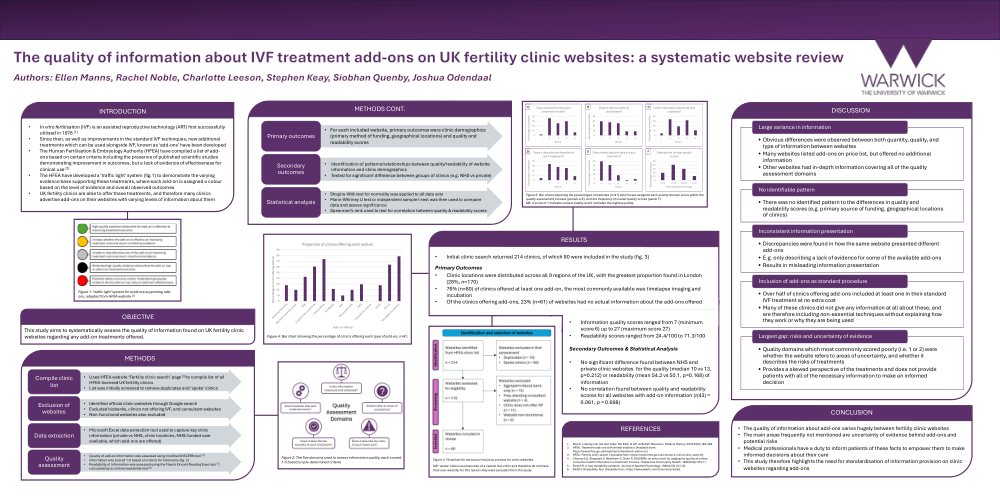
•Initial clinic search returned 214 clinics, of which 80 were included in the study
Primary Outcomes
•Clinic locations were distributed across all 9 regions of the UK, with the greatest proportion found in London (28%, n=170)
•76% (n=80) of clinics offered at least one add-on, the most commonly available was timelapse imaging and incubation
•Of the clinics offering add-ons, 23% (n=61) of websites had no actual information about the add-ons offered
•Information quality scores ranged from 7 (minimum score 6) up to 27 (maximum score 27)
•Readability scores ranged from 24.4/100 to 71.3/100
Secondary Outcomes & Statistical Analysis
•No significant difference found between NHS and private clinic websites for the quality (median 10 vs 13, p=0.212) or readability (mean 54.2 vs 50.1, p=0.168) of information
•No correlation found between quality and readability scores for all websites with add-on information (r(43) = 0.061, p = 0.698)
Discusison
• Obvious differences were observed between both quantity, quality, and type of information between websites
• Many websites listed add-ons on price list, but offered no additional information
• Other websites had in-depth information covering all of the quality assessment domains
• There was no identified pattern to the differences in quality and readability scores (e.g. primary source of funding, geographical locations of clinics)
• Discrepancies were found in how the same website presented different add-ons
• E.g. only describing a lack of evidence for some of the available add-ons
• Results in misleading information presentation
• Over half of clinics offering add-ons included at least one in their standard IVF treatment at no extra cost
• Many of these clinics did not give any information at all about these, and are therefore including non-essential techniques without explaining how they work or why they are being used
• Quality domains which most commonly scored poorly (i.e. 1 or 2) were whether the website refers to areas of uncertainty, and whether it describes the risks of treatments
• Provides a skewed perspective of the treatments and does not provide patients with all of the necessary information to make an informed decision
Conclusion
• The quality of information about add-ons varies hugely between fertility clinic websites
• The main areas frequently not mentioned are uncertainty of evidence behind add-ons and potential risks
• Medical professionals have a duty to inform patients of these facts to empower them to make informed decisions about their care
• This study therefore highlights the need for standardisation of information provision on clinic websites regarding add-ons