2,281 posters, 63 videos, 56 audios, 43 topics, 18 sessions, 6,174 authors, 2,323 institutions
ePostersLive by SciGen Technologies S.A. All rights reserved.
RCOG World Congress 2025
June 23 - 25, 2025 | ExCeL London, UK
EP.1977
“Risk factors of abnormal semen parameters at specialist hospital in the Gambia”
Part of Topic
Reproductive medicine/assisted reproduction
A study on risk factors of abnormal semen parameters at a specialist hospital in the Gambia”.
Authors: M. Anyanwu1, 2, Anyanwu, M,.1, 2, 3 , Suwareh, K.,1, 2 Uzokwe V,1, Dibba F.,1,Okoo M4, Donkor S4 Odeku T I1,5, Nwangaga I1,5
1. Edward Francis Small Teaching Hospital Banjul The Gambia School of Medicine and Allied Health Sciences University of The Gambia 3. Medical Research Laboratories The Gambia. 4. ReproCare clinic and diagnosis Abuja.
INTRODUCTION: Male factor infertility is seen as an alteration in sperm concentration (Oligo) and/or motility (Astheno) and/or morphology (Terato) in at least one sample of two sperm analyzes, collected 1 and 4 weeks apart (WHO 2010).
The diagnosis of male factor depends on the combination of two samples taken at least 4 weeks apart and sperm parameters below the WHO normal values. (WHO 2010).
Normal semen parameters have shown overwhelming decline in the last 50 years all over the world. The trend of decline is more pronounced in the western region of sub-Saharan African.
In view of the rapid deterioration observed in our practice between 2017 (8.9%) and in 2023 (45.4%), we decided to conduct research to explore on possible risk factors.
METHODOLOGY: Longitudinal study on semen parameters from January to March 2024. The variables were divided into three thematic areas which includes sociodemographic characteristics, Lifestyle implications and chronic medical/surgical conditions. Data was entered into a computer database and analyzed with SPSS version 26. Univariable logistic regression analysis of risk factors with test of significance at p-value of <0.05 was performed.
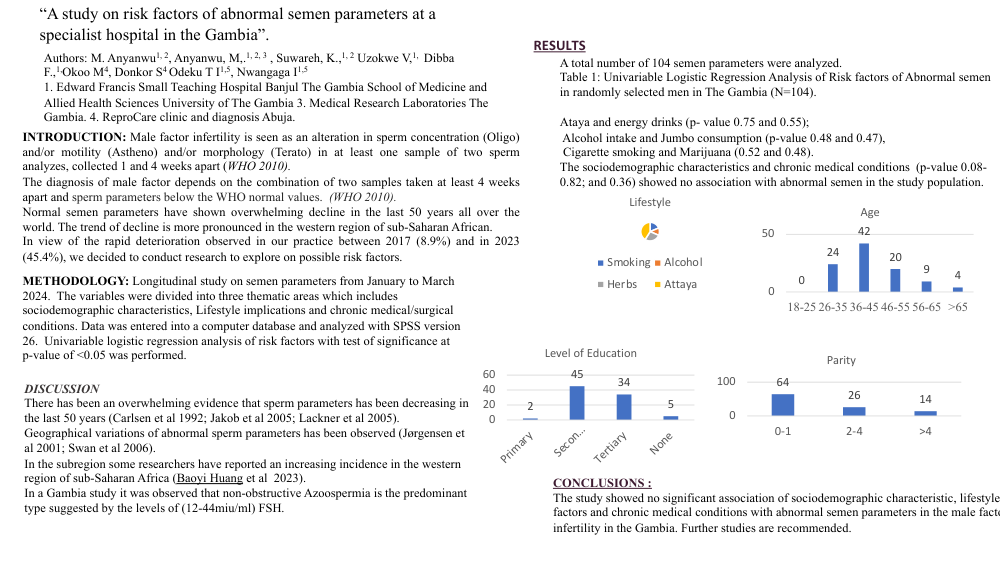
RESULTS: A total number of 104 semen parameters were analyzed.
Table 1: Univariable Logistic Regression Analysis of Risk factors of Abnormal semen in randomly selected men in The Gambia (N=104).
Ataya and energy drinks (p- value 0.75 and 0.55);
Alcohol intake and Jumbo consumption (p-value 0.48 and 0.47),
Cigarette smoking and Marijuana (0.52 and 0.48).
The sociodemographic characteristics and chronic medical conditions (p-value 0.08-0.82; and 0.36) showed no association with abnormal semen in the study population
CONCLUSIONS :
The study showed no significant association of sociodemographic characteristic, lifestyle factors and chronic medical conditions with abnormal semen parameters in the male factor infertility in the Gambia. Further studies are recommended