2,281 posters, 63 videos, 56 audios, 43 topics, 18 sessions, 6,174 authors, 2,323 institutions
ePostersLive by SciGen Technologies S.A. All rights reserved.
RCOG World Congress 2025
June 23 - 25, 2025 | ExCeL London, UK
EP.1974
Effectiveness of standard vs extended dose Letrozole for ovulation induction in PCOS
Poster Presenter
Authors
Affiliations
Part of Topic
Reproductive medicine/assisted reproduction
Comparison of effectiveness of standard vs long Letrozole protocol for ovulation induction in women with PCOS
INTRODUCTION:
The polycystic ovarian syndrome (PCOS) is a heterogeneous group of disorders with varied expression in different individuals. It can comprise of significant metabolic, reproductive and endocrine dysfunctions in the patients.1 Anovulation due to PCOS is multifactorial and its pathophysiology revolves around the insulin resistance and reduced expression of sex hormone binding globulin.2 PCOS affects 8-13% of reproductive age group.3 The ESHRE criteria for the diagnosis of PCOS, also known as Rotterdam criteria includes
- Oligo or anovulation.
- Clinical and/or biochemical signs of hyperandrogenism.
- Polycystic ovaries on ultrasound.4
The anovulation due to PCOS can be managed by various agents. Commonly used is clomiphene citrate but recent consensus according to ESHRE is to use letrozole as first line for anovulation.5
Letrozole is a selective, reversible competitive inhibitor of the aromatase enzyme. It is used in early follicular phase where it acts locally to increase sensitivity of ovaries to FSH. It also reduces the negative feedback at hypothalamic pituitary level and is superior to clomiphene due to mono-follicular development and positive effect on endometrial thickness.6
Letrozole has been used in different doses for ovulation induction and while a short course is routinely used, it is debated that a longer duration may achieve better results.7
OBJECTIVE: To compare the efficacy of standard dose Letrozole with extended dose Letrozole protocol for induction of ovulation in women with PCOS.
STUDY DESIGN: Prospective randomized comparative study
PLACE OF STUDY: Sir Ganga Ram Hospital, Lahore, Pakistan
DURATION OF STUDY: one year 23/07/2023 to 22/06/2024
SAMPLE SIZE: Sample size of 174 was calculated with 5 % margin of error and 95% confidence interval by expecting 13% of PCOS effecting females.
SAMPLE TECHNIQUE:
INCLUSION CRITERIA:
- Women of 18-35 years of age.
- Diagnosed case of PCOS on biochemical/ultrasound.
- Subfertility for one year or more.
EXCLUSION CRITERIA:
- Women with evidence of tubal blockage on HSG/laparoscopy.
- If husband had abnormal semen analysis
- having benign ovarian/uterine tumors, metabolic or endocrine disorder
- Patients having other coexistent cause of infertility like endometriosis or fibroid
DATA COLLECTION PROCEDURE: After approval from ERB a total of 200 patients were enrolled in the study who fulfilled the selection criteria. There demographic and clinical data was recorded on study proforma. They were randomised into two groups by computer generated numbers. Group A received the standard dose of letrozole 2.5 mg once daily for 5 days from second to sixth day of the menstrual cycle. Transvaginal ultrasound was done on day 12th to see mature follicle. If a follicle of 18 mm is found trigger of Inj HCG 5000 IU intramuscularly was given and the couple was advised for intercourse in the next 24-36 hours and then on alternate days. Ovulation was confirmed by serum progesterone level on day 21. The level of 10ng/ml or more was taken as positive ovulation.
If a follicle of 15-16 mm was found only then scan was repeated on day 14 and upon finding 18mm or more follicle trigger was given and rest of the protocol was followed.
If no follicle greater than 10-11 mm was found on day 12 then in next cycle double dose of Letrozole was given 5 mg once daily from D2 to D6 of the cycle and same monitoring was done. If still no mature follicle seen then dose was increased in third cycle to 7.5 mg once daily and rest of the same protocol of monitoring was followed. If still no mature follicle was found, patient was considered as treatment failure and was managed further per unit protocol.
Group B received long dose Letrozole i.e 2.5 mg daily from day 2 to day 10 of the cycle and TVS done on day 12 if a mature follicle of 18 mm or more was found trigger shot of Inj HCG 5000IU was given and rest of the monitoring protocol was followed as Group A. If no mature follicle was seen the dose was increased to 5 mg in next 2 cycles and if still no mature follicle was seen she was considered as treatment failure and managed further as unit protocol.
The primary outcome was the development of one or two follicles of 18 to 22 mm and ovulation proven by serum progesterone on D21 10ng/ml.
The secondary outcomes were the incidence of ovarian hyperstimulation syndrome (OHSS) and clinically proven pregnancy by serum bHCG.
DATA ANALYSIS: The data was entered and analyzed using SPSS 24.0. Mean ± SD was given for quantitative variables (age, gestational age, BMI, duration of infertility). Frequency and percentage were given for qualitative variables like place of living (rural/urban), monthly income (<20000/220001-40000/>40000), family history of PCOS, lifestyle (simple/sedentary) and education status (illiterate/middle/matric & above) previous history of infertility treatment etc). Independent ‘t’ test was applied to compare ovulation in both groups taking p≤0.05 as significant.
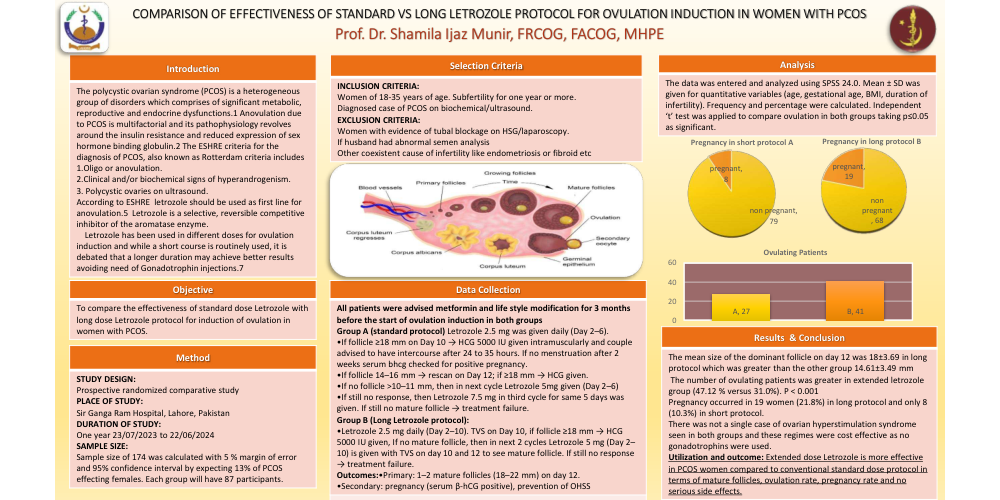
Results: The mean size of the dominant follicle on day 12 was 18±3.69 in long protocol which was greater than the other group 14.61±3.49 mm. The number of ovulating patients was greater in long letrozole group (47.12 % versus 31.0%). P < 0.001
Pregnancy occurred in 19 women (21.8%) in long protocol and only 8 (10.3%) in short protocol.
There was not a single case of ovarian hyperstimulation syndrome seen in both groups and these regimes were cost effective as no gonadotrophins were used.
Utilization and outcome: Long dose Letrozole is more effective in PCOS women compared to conventional standard dose protocol in terms of mature follicles, ovulation rate, pregnancy rate and no serious side effects.
REFERENCES:
- Teede HJ, Misso ML, Costello MF, Dokras A, Laven J, Moran L, Piltonen T, Norman RJ. Recommendations from the international evidence-based guideline for the assessment and management of polycystic ovary syndrome. Human Reproduction. 2018;1(33):1602-18.
- Azziz R. Polycystic ovary syndrome. Obstet Gynecol 2018;132:321-336.
- Bozdag G. The prevalence and phenotypic features of polycystic ovary syndrome: a systematic review and meta-analysis. Hum Reprod. 2016; 31(12):2841-55.
- Rotterdam ESHRE/ ASRM-Sponsored PCOS Consensus Workshop Group. Revised 2003 consensus on diagnostic criteria and long term health risks related to polycystic ovary syndrome. Hum Reprod.2004; 19, 41-47.
- Bozdag G. The prevalence and phenotypic features of polycystic ovary syndrome: a systematic review and meta-analysis. Hum Reprod. 2016; 31(12):2841-55.
- CREPCOS, ESHRE, ASRM, International evidence-based guideline for the assessment and management of polycystic ovary syndrome 2018.
- Rachel S. Mandelbaum et al. A comparison of letrozole regimens for ovulation induction in women with polycystic ovary syndrome. F&S Reports volume 5, Issue 2, June 2024, Pages 170-175.