2,281 posters, 63 videos, 56 audios, 43 topics, 18 sessions, 6,174 authors, 2,323 institutions
ePostersLive by SciGen Technologies S.A. All rights reserved.
RCOG World Congress 2025
June 23 - 25, 2025 | ExCeL London, UK
EP.1971
Male fertility bioethics
Poster Presenter
Authors
Nkoyenum Olisa, Sarah Martin de silva, Lisa Campo-Engelstein
Affiliations
Part of Topic
Reproductive medicine/assisted reproduction
Video
Audio
Title: Male Fertility Bioethics: Bridging Clinical Gaps and Ethical Imperatives
Introduction Despite contributing to nearly half of all infertility cases, male infertility remains understudied and underprioritized in clinical and ethical discourse (Agarwal et al., 2021). Poor sperm quality is a predominant factor, yet the diagnostic and treatment focus often disproportionately targets women. As scientific advancements continue, the associated ethical challenges—particularly concerning male infertility—demand increased awareness and systematic attention (Campo-Engelstein, 2022).
Aim This study aims to examine and address the gender imbalance in assisted reproductive technology (ART), challenge the ethical implications of altruistic sperm donation, and highlight the urgent need for improved scientific understanding and clinical pathways in male reproductive health.
Materials and Methods A pilot international questionnaire was distributed to reproductive health clinicians through professional and social media networks. The survey assessed practices in male infertility diagnosis, treatment strategies, ethical awareness, and knowledge gaps.
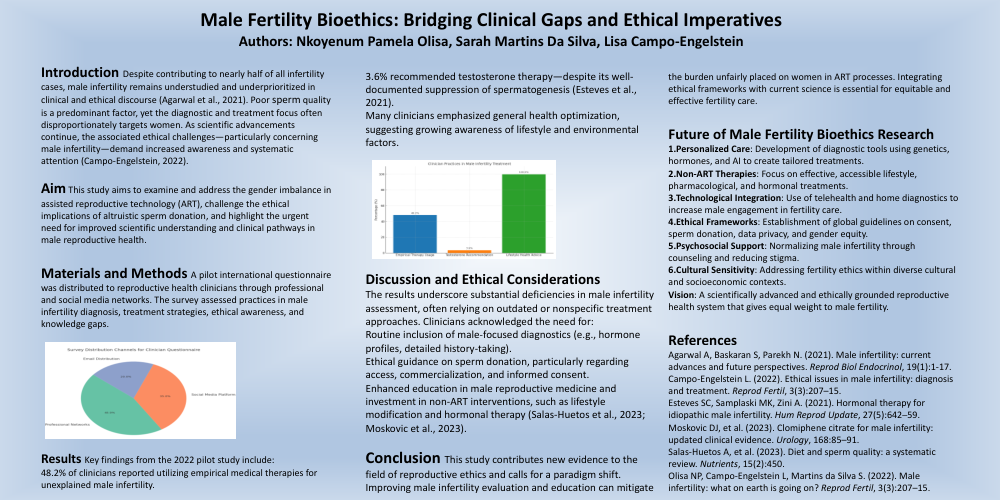
Results Key findings from the 2022 pilot study include:
-
48.2% of clinicians reported utilizing empirical medical therapies for unexplained male infertility.
-
3.6% recommended testosterone therapy—despite its well-documented suppression of spermatogenesis (Esteves et al., 2021).
-
Many clinicians emphasized general health optimization, suggesting growing awareness of lifestyle and environmental factors.
Discussion and Ethical Considerations The results underscore substantial deficiencies in male infertility assessment, often relying on outdated or nonspecific treatment approaches. Clinicians acknowledged the need for:
-
Routine inclusion of male-focused diagnostics (e.g., hormone profiles, detailed history-taking).
-
Ethical guidance on sperm donation, particularly regarding access, commercialization, and informed consent.
-
Enhanced education in male reproductive medicine and investment in non-ART interventions, such as lifestyle modification and hormonal therapy (Salas-Huetos et al., 2023; Moskovic et al., 2023).
Conclusion This study contributes new evidence to the field of reproductive ethics and calls for a paradigm shift. Improving male infertility evaluation and education can mitigate the burden unfairly placed on women in ART processes. Integrating ethical frameworks with current science is essential for equitable and effective fertility care.
Future of Male Fertility Bioethics Research
-
Personalized Care: Development of diagnostic tools using genetics, hormones, and AI to create tailored treatments.
-
Non-ART Therapies: Focus on effective, accessible lifestyle, pharmacological, and hormonal treatments.
-
Technological Integration: Use of telehealth and home diagnostics to increase male engagement in fertility care.
-
Ethical Frameworks: Establishment of global guidelines on consent, sperm donation, data privacy, and gender equity.
-
Psychosocial Support: Normalizing male infertility through counseling and reducing stigma.
-
Cultural Sensitivity: Addressing fertility ethics within diverse cultural and socioeconomic contexts.
References
-
Agarwal A, Baskaran S, Parekh N. (2021). Male infertility: current advances and future perspectives. Reprod Biol Endocrinol, 19(1):1-17.
-
Campo-Engelstein L. (2022). Ethical issues in male infertility: diagnosis and treatment. Reprod Fertil, 3(3):207–15.
-
Esteves SC, Samplaski MK, Zini A. (2021). Hormonal therapy for idiopathic male infertility. Hum Reprod Update, 27(5):642–59.
-
Moskovic DJ, et al. (2023). Clomiphene citrate for male infertility: updated clinical evidence. Urology, 168:85–91.
-
Salas-Huetos A, et al. (2023). Diet and sperm quality: a systematic review. Nutrients, 15(2):450.
-
Olisa NP, Campo-Engelstein L, Martins da Silva S. (2022). Male infertility: what on earth is going on? Reprod Fertil, 3(3):207–15.