2,281 posters, 63 videos, 56 audios, 43 topics, 18 sessions, 6,174 authors, 2,323 institutions
ePostersLive by SciGen Technologies S.A. All rights reserved.
RCOG World Congress 2025
June 23 - 25, 2025 | ExCeL London, UK
EP.1970
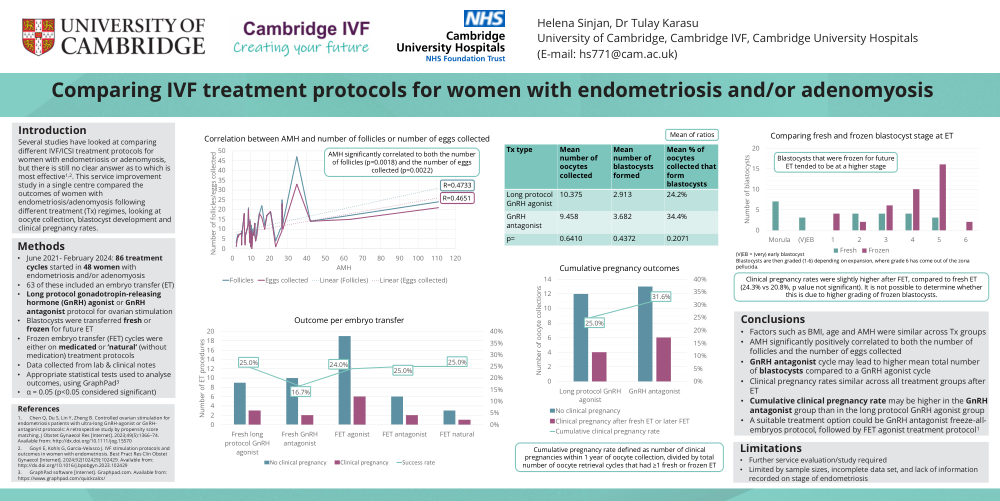
Comparing IVF treatment protocols for women with endometriosis and/or adenomyosis
Poster Presenter
Authors
Affiliations
Part of Topic
Reproductive medicine/assisted reproduction
Comparing IVF treatment protocols for women with endometriosis and/or adenomyosis
Helena Sinjan, Dr Tulay Karasu
University of Cambridge, Cambridge IVF, Cambridge University Hospitals
(E-mail: hs771@cam.ac.uk)
Introduction
Several studies have looked at comparing different IVF/ICSI treatment protocols for women with endometriosis or adenomyosis, but there is still no clear answer as to which is most effective1,2. This service improvement study in a single centre compared the outcomes of women with endometriosis/adenomyosis following different treatment (Tx) regimes, looking at oocyte collection, blastocyst development and clinical pregnancy rates.
Methods
Conclusions
Limitations
References
1. Chen Q, Du S, Lin Y, Zheng B. Controlled ovarian stimulation for endometriosis patients with ultra-long GnRH-agonist or GnRH-antagonist protocols: A retrospective study by propensity score matching. J Obstet Gynaecol Res [Internet]. 2023;49(5):1366–74. Available from: http://dx.doi.org/10.1111/jog.15570
2. Goyri E, Kohls G, Garcia-Velasco J. IVF stimulation protocols and outcomes in women with endometriosis. Best Pract Res Clin Obstet Gynaecol [Internet]. 2024;92(102429):102429. Available from: http://dx.doi.org/10.1016/j.bpobgyn.2023.102429
3. GraphPad software [Internet]. Graphpad.com. Available from: https://www.graphpad.com/quickcalcs/