2,281 posters, 63 videos, 56 audios, 43 topics, 18 sessions, 6,174 authors, 2,323 institutions
ePostersLive by SciGen Technologies S.A. All rights reserved.
RCOG World Congress 2025
June 23 - 25, 2025 | ExCeL London, UK
EP.1966
Retrospective cohort study of secondary care subfertility referrals in the East Midlands
Poster Presenter
Part of Topic
Reproductive medicine/assisted reproduction
Retrospective study of secondary care subfertility referrals in an East Midlands teaching hospital
Introduction
Subfertility affects 1 in 7 UK couples. NHS funding eligibility is based on factors including female age, BMI, ovarian reserve, smoking, and prior parental status. There is limited data available regarding the current demographics of couples referred for fertility assessment and treatment. This study was undertaken to assess the demographics of the population referred to the fertility clinic and their funding eligibility, with specific consideration to the diverse local population.
Methodology
A retrospective cohort study was undertaken which included 880 referrals to the secondary care fertility clinics from 1st August 2022 to 31st July 2023. Demographic information was obtained from the local databases. Women who were single, seeking other gynaecological treatment, or already pregnant were excluded from the study. Analysis was done using SPSS software.
Results
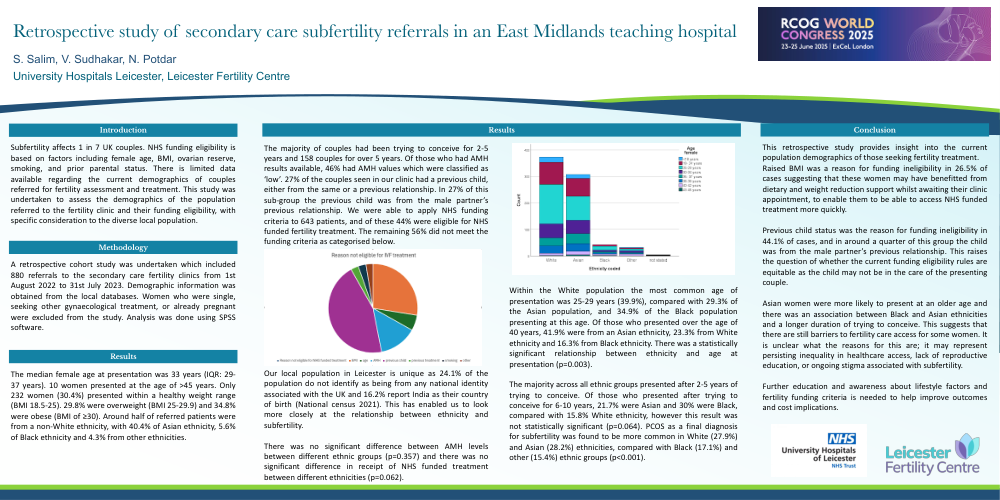
The median female age at presentation was 33 years (IQR: 29-37 years). 10 women presented at the age of >45 years. Only 232 women (30.4%) presented within a healthy weight range (BMI 18.5-25). 29.8% were overweight (BMI 25-29.9) and 34.8% were obese (BMI of ≥30). Around half of referred patients were from a non-White ethnicity, with 40.4% of Asian ethnicity, 5.6% of Black ethnicity and 4.3% from other ethnicities.
The majority of couples had been trying to conceive for 2-5 years and 158 couples for over 5 years. Of those who had AMH results available, 46% had AMH values which were classified as ‘low’. 27% of the couples seen in our clinic had a previous child, either from the same or a previous relationship. In 27% of this sub-group the previous child was from the male partner’s previous relationship. We were able to apply NHS funding criteria to 643 patients, and of these 44% were eligible for NHS funded fertility treatment. The remaining 56% did not meet the funding criteria as categorised below.
Our local population in Leicester is unique as 24.1% of the population do not identify as being from any national identity associated with the UK and 16.2% report India as their country of birth (National census 2021). This has enabled us to look more closely at the relationship between ethnicity and subfertility.
There was no significant difference between AMH levels between different ethnic groups (p=0.357) and there was no significant difference in receipt of NHS funded treatment between different ethnicities (p=0.062).
Within the White population the most common age of presentation was 25-29 years (39.9%), compared with 29.3% of the Asian population, and 34.9% of the Black population presenting at this age. Of those who presented over the age of 40 years, 41.9% were from an Asian ethnicity, 23.3% from White ethnicity and 16.3% from Black ethnicity. There was a statistically significant relationship between ethnicity and age at presentation (p=0.003).
The majority across all ethnic groups presented after 2-5 years of trying to conceive. Of those who presented after trying to conceive for 6-10 years, 21.7% were Asian and 30% were Black, compared with 15.8% White ethnicity, however this result was not statistically significant (p=0.064). PCOS as a final diagnosis for subfertility was found to be more common in White (27.9%) and Asian (28.2%) ethnicities, compared with Black (17.1%) and other (15.4%) ethnic groups (p<0.001).
Conclusion
This retrospective study provides insight into the current population demographics of those seeking fertility treatment.
Raised BMI was a reason for funding ineligibility in 26.5% of cases suggesting that these women may have benefitted from dietary and weight reduction support whilst awaiting their clinic appointment, to enable them to be able to access NHS funded treatment more quickly.
Previous child status was the reason for funding ineligibility in 44.1% of cases, and in around a quarter of this group the child was from the male partner’s previous relationship. This raises the question of whether the current funding eligibility rules are equitable as the child may not be in the care of the presenting couple.
Asian women were more likely to present at an older age and there was an association between Black and Asian ethnicities and a longer duration of trying to conceive. This suggests that there are still barriers to fertility care access for some women. It is unclear what the reasons for this are; it may represent persisting inequality in healthcare access, lack of reproductive education, or ongoing stigma associated with subfertility.
Further education and awareness about lifestyle factors and fertility funding criteria is needed to help improve outcomes and cost implications.