2,281 posters, 63 videos, 56 audios, 43 topics, 18 sessions, 6,174 authors, 2,323 institutions
ePostersLive by SciGen Technologies S.A. All rights reserved.
RCOG World Congress 2025
June 23 - 25, 2025 | ExCeL London, UK
EP.1965
Women's Perspectives on Oocyte Cryopreservation: Sociocultural and Medical Factors in Saudi
Part of Topic
Reproductive medicine/assisted reproduction
Title: Women's Attitudes and Decision-Making Factors Regarding Oocyte Cryopreservation in Saudi Arabia: A Mixed-Methods Analysis of Sociocultural and Medical Perspectives
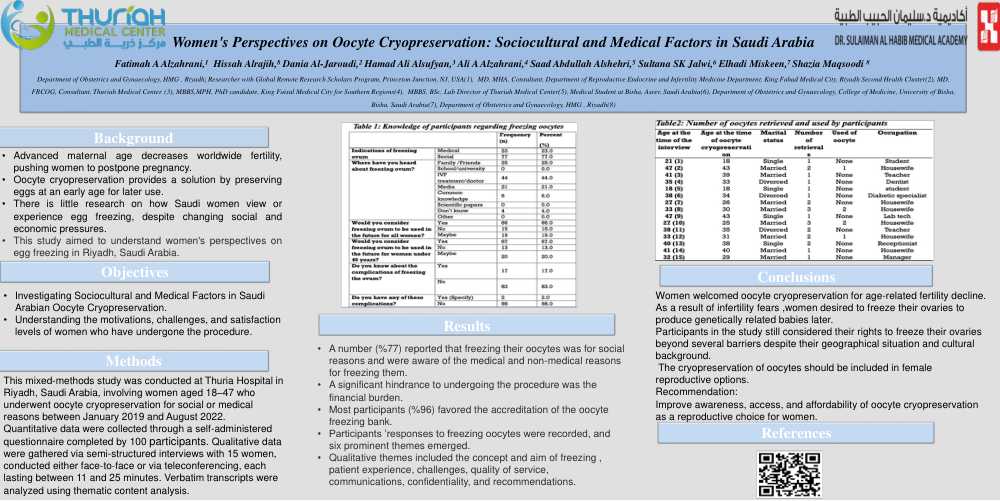
Objective: To investigate the sociocultural and medical factors affecting women's decisions regarding oocyte cryopreservation in Saudi Arabia, with focus on understanding the motivations, challenges, and satisfaction levels among women aged 18-47 who underwent the procedure.
Design: A mixed-methods study combining quantitative survey analysis with in-depth qualitative interviews, conducted at a private medical center in Saudi Arabia.
Method: The study enrolled a total of 100 women who underwent oocyte cryopreservation. Data collection involved self-administered questionnaires for quantitative analysis and semi-structured interviews with the participants. Each interview lasted approximately 25 minutes, was transcribed verbatim, and underwent thematic analysis. Quantitative data were analyzed using STATA SE Version 18, our analysis focused on satisfaction rates and associated factors.
Results: Of the participants, 77% (n=77) underwent oocyte freezing primarily for social reasons. Statistical analysis revealed high satisfaction rates (p<0.005), especially among women citing social motivations. Key themes trended around process expectations, with factors such as pre-existing medical complications and clinical experience significantly influencing satisfaction levels. Qualitative analysis identified concerns regarding future fertility preservation, financial implications and considerations, and sociocultural matters. Our cohort has demonstrated avarying level of procedural knowledge, 17% of the individuals have reported awareness of possible complications. Information sources were diverse, 44% of the participants obtained their information from a healthcare specialized practitioner, 25% obtaining knowledge from family/friends, and 21% from social media platforms. Pre-procedure medical counseling was reported by 90% of participants, indicating strong healthcare provider engagement. Family and social connections had a significant role in the decision-making process, as 25% of participants citing family/friends as their primary information source.
Conclusions: Our analysis provides considerable insights into the relationship between sociocultural factors and medical decision-making in oocyte cryopreservation within Saudi Arabia. The findings call for the need of culturally sensitive counseling approaches and suggest that policy reforms could improve the accessibility while addressing financial barriers. Based on our analysis findings, we recommend that further studies should work on developing targeted support systems that consider both medical and sociocultural aspects of fertility preservation in the Saudi context, while also counting the need for improved financial support systems and complete patient education programs.