2,281 posters, 63 videos, 56 audios, 43 topics, 18 sessions, 6,174 authors, 2,323 institutions
ePostersLive by SciGen Technologies S.A. All rights reserved.
RCOG World Congress 2025
June 23 - 25, 2025 | ExCeL London, UK
EP.0192
Ectopic Pregnancy: The Hidden Threat in Pregnancy of Unknown Location
Poster Presenter
Authors
Affiliations
Part of Topic
Early pregnancy complications/early pregnancy and acute gynaecology
Ectopic Pregnancy: The Hidden Threat in Pregnancy of Unknown Location
Objective: To highlight the need for a high index of suspicion for ectopic pregnancies (EP) in
pregnancies of unknown locations (PUL) and to remain vigilant for the risk of EP rupture in
medical management.
Case Report: A 23 year-old primiparous lady presented to the early pregnancy unit (EPU) with
per-vaginal spotting following 6 weeks and 2 days of amenorrhoea. A pregnancy was not
demonstrated on transvaginal ultrasound (TVUS) and serum beta-human chorionic
gonodotrophin (β-hCG) was 746.4IU/L. A repeat β-hCG after 48 hours was 1543.6IU/L,
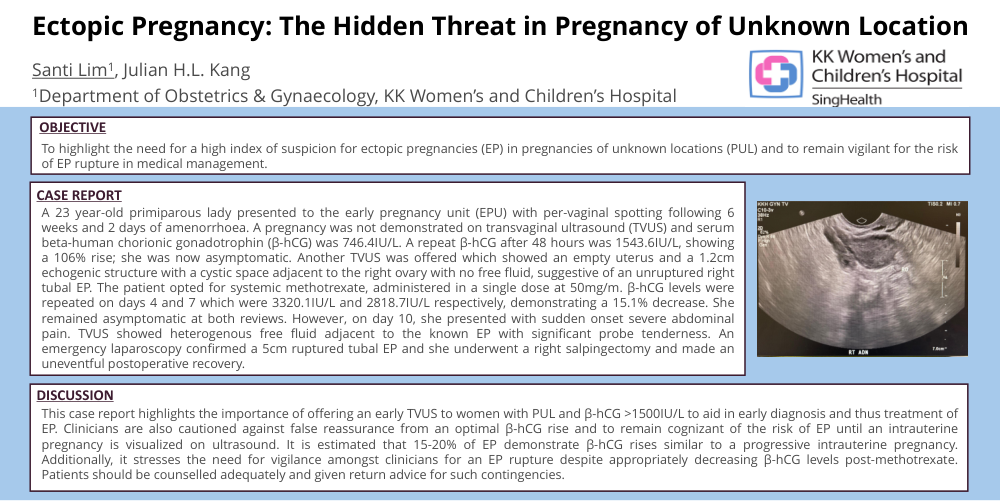
showing a 106% rise; she was now asymptomatic. Another TVUS was offered which showed
an empty uterus and a 1.2cm echogenic structure with a cystic space adjacent to the right
ovary with no free fluid, suggestive of an unruptured right tubal EP . The patient opted for
systemic methotrexate, administered in a single dose at 50mg/m . β-hCG levels were
repeated on days 4 and 7 which were 3320.1IU/L and 2818.7IU/L respectively, demonstrating
a 15.1% decrease. She remained asymptomatic at both reviews. However, on day 10, she
presented with sudden onset severe abdominal pain. TVUS showed heterogenous free fluid
adjacent to the known EP with significant probe tenderness. An emergency laparoscopy
confirmed a 5cm ruptured tubal EP and she underwent a right salpingectomy and made an
uneventful postoperative recovery.
Discussion: This case report highlights the importance of offering an early TVUS to women
with PUL and β-hCG >1500IU/L to aid in early diagnosis and thus treatment of EP . Clinicians
are also cautioned against false reassurance from an optimal β-hCG rise and to remain
cognizant of the risk of EP until an intrauterine pregnancy is visualized on ultrasound. It is
estimated that 15-20% of EP demonstrate β-hCG rises similar to a progressive intrauterine
pregnancy. Additionally, it stresses the need for vigilance amongst clinicians for an EP rupture
despite appropriately decreasing β-hCG levels post-methotrexate. Patients should be
counselled adequately and given return advice for such contingencies.