2,281 posters, 63 videos, 56 audios, 43 topics, 18 sessions, 6,174 authors, 2,323 institutions
ePostersLive by SciGen Technologies S.A. All rights reserved.
RCOG World Congress 2025
June 23 - 25, 2025 | ExCeL London, UK
EP.0183
ECTOPIC PREGNANCY IN NON-COMMUNICATING HORN OF A UNICORNUATE UTERUS
Poster Presenter
Authors
Affiliations
Part of Topic
Early pregnancy complications/early pregnancy and acute gynaecology
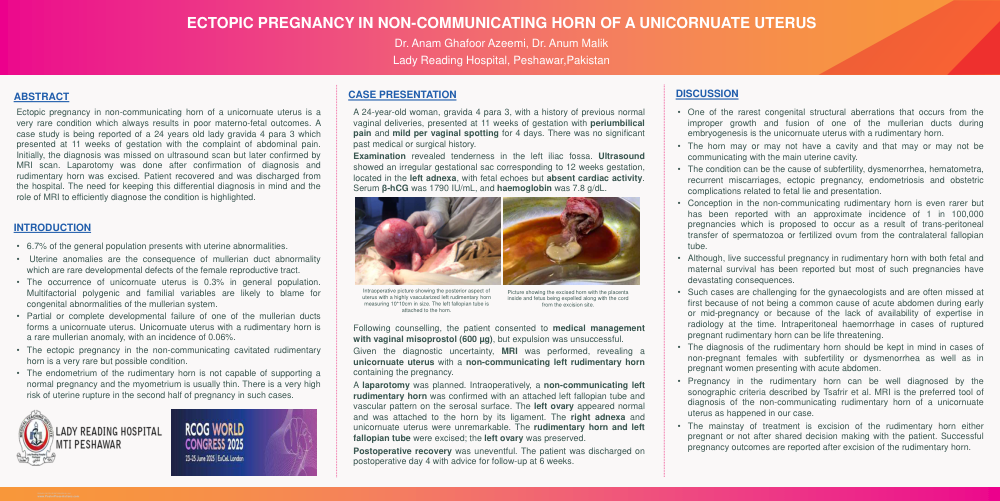
ECTOPIC PREGNANCY IN NON-COMMUNICATING HORN OF A UNICORNUATE UTERUS Dr. Anam Ghafoor Azeemi, Dr. Anum Malik Lady Reading Hospital, Peshawar,Pakistan ABSTRACT Ectopic pregnancy in non-communicating horn of a unicornuate uterus is a very rare condition which always results in poor materno-fetal outcomes. A case study is being reported of a 24 years old lady gravida 4 para 3 which presented at 11 weeks of gestation with the complaint of abdominal pain. Initially, the diagnosis was missed on ultrasound scan but later confirmed by MRI scan. Laparotomy was done after confirmation of diagnosis and rudimentary horn was excised. Patient recovered and was discharged from the hospital. The need for keeping this differential diagnosis in mind and the role of MRI to efficiently diagnose the condition is highlighted. INTRODUCTION • 6.7%of the general population presents with uterine abnormalities. • Uterine anomalies are the consequence of mullerian duct abnormality which are rare developmental defects of the female reproductive tract. • The occurrence of unicornuate uterus is 0.3% in general population. Multifactorial polygenic and familial variables are likely to blame for congenital abnormalities of the mullerian system. • Partial or complete developmental failure of one of the mullerian ducts forms a unicornuate uterus. Unicornuate uterus with a rudimentary horn is a rare mullerian anomaly, with an incidence of 0.06%. • The ectopic pregnancy in the non-communicating cavitated rudimentary horn is a very rare but possible condition. • The endometrium of the rudimentary horn is not capable of supporting a normal pregnancy and the myometrium is usually thin. There is a very high risk of uterine rupture in the second half of pregnancy in such cases. RESEARCH POSTER PRESENTATION DESIGN © 2025 CASE PRESENTATION A 24-year-old woman, gravida 4 para 3, with a history of previous normal vaginal deliveries, presented at 11 weeks of gestation with periumbilical pain and mild per vaginal spotting for 4 days. There was no significant past medical or surgical history. Examination revealed tenderness in the left iliac fossa. Ultrasound showed an irregular gestational sac corresponding to 12 weeks gestation, located in the left adnexa, with fetal echoes but absent cardiac activity. Serum β-hCG was 1790 IU/mL, and haemoglobin was 7.8 g/dL. Intraoperative picture showing the posterior aspect of uterus with a highly vascularized left rudimentary horn measuring 10*10cm in size. The left fallopian tube is attached to the horn. Picture showing the excised horn with the placenta inside and fetus being expelled along with the cord from the excision site. Following counselling, the patient consented to medical management with vaginal misoprostol (600 µg), but expulsion was unsuccessful. Given the diagnostic uncertainty, MRI was performed, revealing a unicornuate uterus with a non-communicating left rudimentary horn containing the pregnancy. A laparotomy was planned. Intraoperatively, a non-communicating left rudimentary horn was confirmed with an attached left fallopian tube and vascular pattern on the serosal surface. The left ovary appeared normal and was attached to the horn by its ligament. The right adnexa and unicornuate uterus were unremarkable. The rudimentary horn and left fallopian tube were excised; the left ovary was preserved. Postoperative recovery was uneventful. The patient was discharged on postoperative day 4 with advice for follow-up at 6 weeks. DISCUSSION • One of the rarest congenital structural aberrations that occurs from the improper growth and fusion of one of the mullerian ducts during embryogenesis is the unicornuate uterus with a rudimentary horn. • The horn may or may not have a cavity and that may or may not be communicating with the main uterine cavity. • The condition can be the cause of subfertility, dysmenorrhea, hematometra, recurrent miscarriages, ectopic pregnancy, endometriosis and obstetric complications related to fetal lie and presentation. • Conception in the non-communicating rudimentary horn is even rarer but has been reported with an approximate incidence of 1 in 100,000 pregnancies which is proposed to occur as a result of trans-peritoneal transfer of spermatozoa or fertilized ovum from the contralateral fallopian tube. • Although, live successful pregnancy in rudimentary horn with both fetal and maternal survival has been reported but most of such pregnancies have devastating consequences. • Such cases are challenging for the gynaecologists and are often missed at first because of not being a common cause of acute abdomen during early or mid-pregnancy or because of the lack of availability of expertise in radiology at the time. Intraperitoneal haemorrhage in cases of ruptured pregnant rudimentary horn can be life threatening. • The diagnosis of the rudimentary horn should be kept in mind in cases of non-pregnant females with subfertility or dysmenorrhea as well as in pregnant women presenting with acute abdomen. • Pregnancy in the rudimentary horn can be well diagnosed by the sonographic criteria described by Tsafrir et al. MRI is the preferred tool of diagnosis of the non-communicating rudimentary horn of a unicornuate uterus as happened in our case. • The mainstay of treatment is excision of the rudimentary horn either pregnant or not after shared decision making with the patient. Successful pregnancy outcomes are reported after excision of the rudimentary horn. www.PosterPresentations.com