2,281 posters, 63 videos, 56 audios, 43 topics, 18 sessions, 6,174 authors, 2,323 institutions
ePostersLive by SciGen Technologies S.A. All rights reserved.
RCOG World Congress 2025
June 23 - 25, 2025 | ExCeL London, UK
EP.0173
Management of Miscarriage: A Retrospective Audit of Patient Preference and Complication Rates
Poster Presenter
Authors
Affiliations
Part of Topic
Early pregnancy complications/early pregnancy and acute gynaecology
Management of Miscarriage: A Retrospective Audit of Patient Preference and Complication Rates After Diagnosis
Dr. Duleeka Dissanayake duleeka.dissanayake@hhft.nhs.uk
Dr. Renee Behrens renee.behrens@hhft.nhs.uk
Royal Hampshire County Hospital (RHCH), Winchester
Background
Miscarriage affects 1 in 4 pregnancies. Management options vary in invasiveness and risk. NICE recommends Expectant, Medical, and Surgical options, but patient choice and outcomes remain under-studied.
Objective
To assess patient preferences for miscarriage management and evaluate associated complication rates at RHCH between 2016–2023.
Methods
• Retrospective audit at RHCH EPAU & Gynaecology Ward• Period: 1 Jan 2016 – 31 Dec 2023• Excluded: Medical terminations• N = 1,224 patients - Delayed miscarriage: 717 (58.6%) - Complete miscarriage: 268 (21.9%) - Incomplete (<24w): 160 (13.1%) - RPOC (>24w): 79 (6.5%)ts:• Management Options: SMOM, MMOM, Expectant, MVA• Outcomes: Readmission, Infection, Haemorrhage, Uterine Perforation
Results
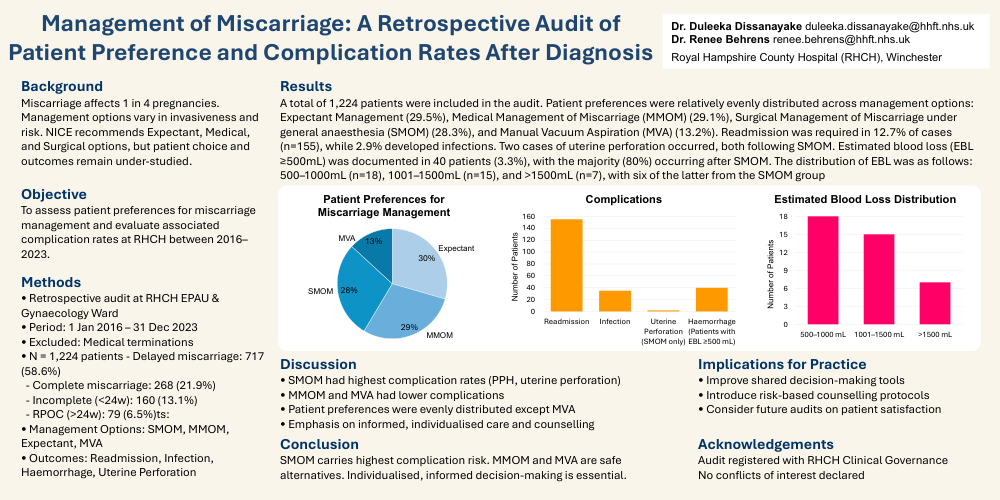
A total of 1,224 patients were included in the audit. Patient preferences were relatively evenly distributed across management options: Expectant Management (29.5%), Medical Management of Miscarriage (MMOM) (29.1%), Surgical Management of Miscarriage under general anaesthesia (SMOM) (28.3%), and Manual Vacuum Aspiration (MVA) (13.2%). Readmission was required in 12.7% of cases (n=155), while 2.9% developed infections. Two cases of uterine perforation occurred, both following SMOM. Estimated blood loss (EBL ≥500mL) was documented in 40 patients (3.3%), with the majority (80%) occurring after SMOM. The distribution of EBL was as follows: 500–1000mL (n=18), 1001–1500mL (n=15), and >1500mL (n=7), with six of the latter from the SMOM group
Discussion
• SMOM had highest complication rates (PPH, uterine perforation)• MMOM and MVA had lower complications• Patient preferences were evenly distributed except MVA• Emphasis on informed, individualised care and counselling
Conclusion
SMOM carries highest complication risk. MMOM and MVA are safe alternatives. Individualised, informed decision-making is essential.
• Improve shared decision-making tools
• Introduce risk-based counselling protocols
• Consider future audits on patient satisfaction
Acknowledgements
Audit registered with RHCH Clinical Governance
No conflicts of interest declared