2,281 posters, 63 videos, 56 audios, 43 topics, 18 sessions, 6,174 authors, 2,323 institutions
ePostersLive by SciGen Technologies S.A. All rights reserved.
RCOG World Congress 2025
June 23 - 25, 2025 | ExCeL London, UK
EP.0169
Laparoscopy in Pregnancy: Evaluating Safety and Risk Through a Middle-Eastern Lens
Poster Presenter
Part of Topic
Early pregnancy complications/early pregnancy and acute gynaecology
Objective:
Non-obstetric surgeries during pregnancy address medical or surgical conditions unrelated to pregnancy. Such procedures carry increased risks of adverse obstetric outcomes, including miscarriage, preterm delivery, and low birth weight. This study evaluates the surgical, obstetric, and fetal outcomes, as well as the safety and feasibility of open and laparoscopic surgeries for non-obstetric indications during pregnancy. It also examines the association between these surgeries and pregnancy outcomes through a retrospective cohort multicenter analysis.
Design:
This quantitative research employs a retrospective cohort multicenter analysis. Historical data is reviewed to assess outcomes of non-obstetric abdominal surgeries performed during pregnancy.
Method:
The study analyzes data from 80 pregnant patients who underwent non-obstetric abdominal surgeries, ensuring statistical power through sufficient record availability across three centers: Al-Ain Hospital, Tawam Hospital, and Corniche Hospital. Data was collected from the Mallafi electronic medical record system and institutional perinatal databases for surgeries performed between January 2008 and December 2023.
Descriptive statistics using SPSS summarize the data. Frequency distributions determine counts and percentages for categorical variables, while mean and standard deviation assess continuous variables. This analysis provides an overview of demographic characteristics, surgical details, and outcomes, presented in tables and graphs for clarity.
Results:
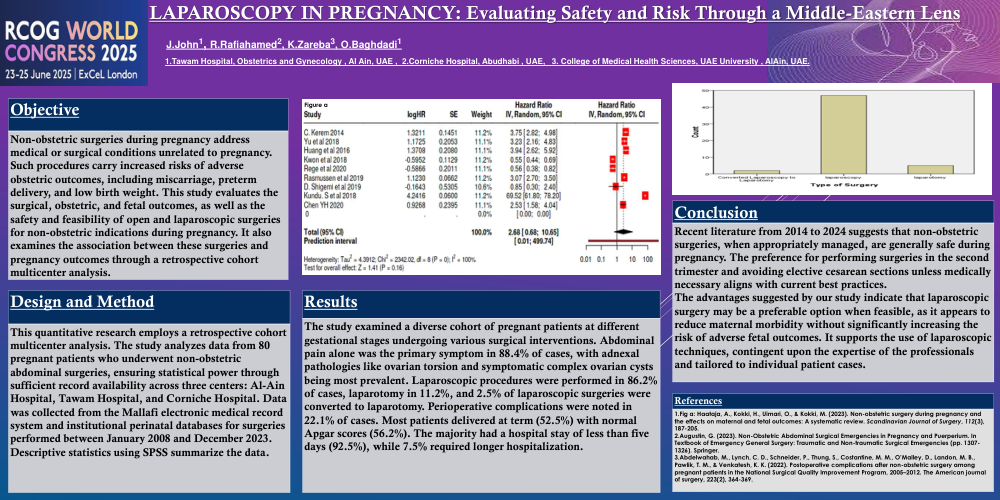
The study examined a diverse cohort of pregnant patients at different gestational stages undergoing various surgical interventions. Abdominal pain alone was the primary symptom in 88.4% of cases, with adnexal pathologies like ovarian torsion and symptomatic complex ovarian cysts being most prevalent. Laparoscopic procedures were performed in 86.2% of cases, laparotomy in 11.2%, and 2.5% of laparoscopic surgeries were converted to laparotomy. Perioperative complications were noted in 22.1% of cases. Most patients delivered at term (52.5%) with normal Apgar scores (56.2%). The majority had a hospital stay of less than five days (92.5%), while 7.5% required longer hospitalization.
Conclusions:
Recent literature from 2014 to 2024 suggests that non-obstetric surgeries, when appropriately managed, are generally safe during pregnancy. The preference for performing surgeries in the second trimester and avoiding elective cesarean sections unless medically necessary aligns with current best practices.
The advantages suggested by our study indicate that laparoscopic surgery may be a preferable option when feasible, as it appears to reduce maternal morbidity without significantly increasing the risk of adverse fetal outcomes. It supports the use of laparoscopic techniques, contingent upon the expertise of the professionals and tailored to individual patient cases.