2,281 posters, 63 videos, 56 audios, 43 topics, 18 sessions, 6,174 authors, 2,323 institutions
ePostersLive by SciGen Technologies S.A. All rights reserved.
RCOG World Congress 2025
June 23 - 25, 2025 | ExCeL London, UK
EP.0163
A review of management of ovarian torsion in a local district hospital
Poster Presenter
Authors
Affiliations
Part of Topic
Early pregnancy complications/early pregnancy and acute gynaecology
A review of management of ovarian torsion in a local district hospital
Objective
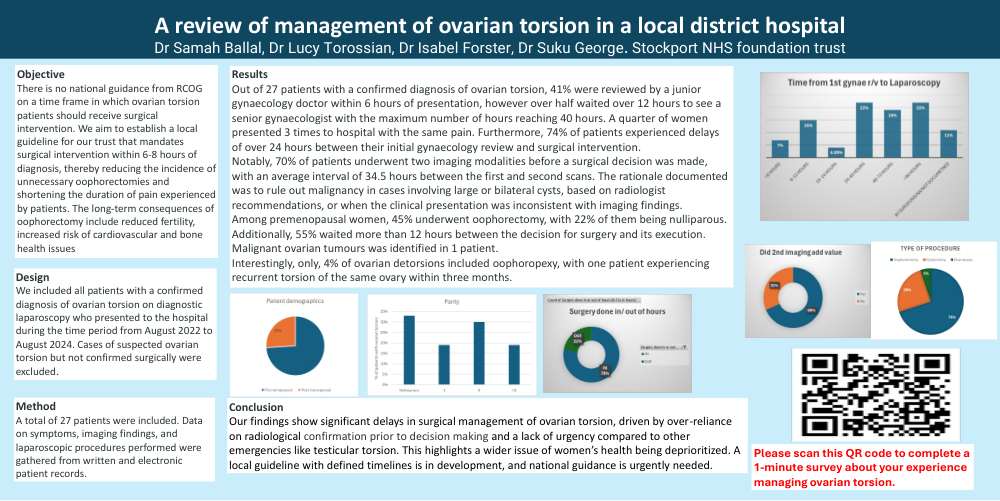
There is no national guidance from RCOG on a time frame in which ovarian torsion patients should receive surgical intervention. We aim to establish a local guideline for our trust that mandates surgical intervention within 6-8 hours of diagnosis, thereby reducing the incidence of unnecessary oophorectomies and shortening the duration of pain experienced by patients. The long-term consequences of oophorectomy include reduced fertility, increased risk of cardiovascular and bone health issues.
Design
We included all patients with a confirmed diagnosis of ovarian torsion on diagnostic laparoscopy who presented to the hospital during the time period from August 2022 to August 2024. Cases of suspected ovarian torsion but not confirmed surgically were excluded.
Method
A total of 27 patients were included. Data on symptoms, imaging findings, and laparoscopic procedures performed were gathered from written and electronic patient records.
Results
Out of 27 patients with a confirmed diagnosis of ovarian torsion, 41% were reviewed by a junior gynaecology doctor within 6 hours of presentation, however over half waited over 12 hours to see a senior gynaecologist with the maximum number of hours reaching 40 hours. A quarter of women presented 3 times to hospital with the same pain. Furthermore, 74% of patients experienced delays of over 24 hours between their initial gynaecology review and surgical intervention.
Notably, 70% of patients underwent two imaging modalities before a surgical decision was made, with an average interval of 34.5 hours between the first and second scans. The rationale documented was to rule out malignancy in cases involving large or bilateral cysts, based on radiologist recommendations, or when the clinical presentation was inconsistent with imaging findings.
Among premenopausal women, 45% underwent oophorectomy, with 22% of them being nulliparous. Additionally, 55% waited more than 12 hours between the decision for surgery and its execution. Malignant ovarian tumours was identified in 1 patient.
Interestingly, only, 4% of ovarian detorsions included oophoropexy, with one patient experiencing recurrent torsion of the same ovary within three months.
Conclusion
Our findings show significant delays in surgical management of ovarian torsion, driven by over-reliance on radiological confirmation prior to decision making and a lack of urgency compared to other emergencies like testicular torsion. This highlights a wider issue of women’s health being deprioritized. A local guideline with defined timelines is in development, and national guidance is urgently needed.