2,281 posters, 63 videos, 56 audios, 43 topics, 18 sessions, 6,174 authors, 2,323 institutions
ePostersLive by SciGen Technologies S.A. All rights reserved.
RCOG World Congress 2025
June 23 - 25, 2025 | ExCeL London, UK
EP.0161
Real emergencies through gynaeco-obstetric emergency consultations
Part of Topic
Early pregnancy complications/early pregnancy and acute gynaecology
Real emergencies through gynaeco-obstetric emergency consultations
Hadhami Rouiss, Faten Khadhraoui, Nesrine Souayah, Amira Lika(*), Ines Trabelsi(*), Chaouki Mbarki, Hajer Bettaieb
University of Tunis el Manar, Faculty of medicine, Gynecology and Obstetrics department, Ben Arous Regional Hospital, Tunis, Tunisia
(*)University of Tunis el Manar, Faculty of medicine, Department of anesthesiology and reanimation,, Ben Arous Regional Hospital, Tunis, Tunisia
Introduction :
Gynaecological emergencies are generally different from medical-surgical emergencies. Because of their specialised nature, patients cannot be treated by an emergency doctor and are immediately referred to gynaecological and obstetric emergencies. Most of the time, emergency rooms are overcrowded with patients who do not fall within the definition of a true emergency as defined in medical circles, which adds to the workload of medical and paramedical staff who have to manage the delivery room and obstetric emergencies simultaneously, beside ; this saturation of emergency rooms can lead to the risk of delayed treatment and often long waits.
Objective: to stratify emergencies according to their truth and to study the diagnoses used in the gynaecological emergency room.
Design: We conducted a prospective, single-centre, longitudinal descriptive study over 3 weeks from 9 October 2023 to 28 October 2023.
Method : We included all women who consulted the emergency department, with the exception of full-term parturients admitted for labour and patients under 14 years of age. The evaluation criteria were the the nature of the emergency in terms of the need for urgent treatment, surgery or hospitalisation.
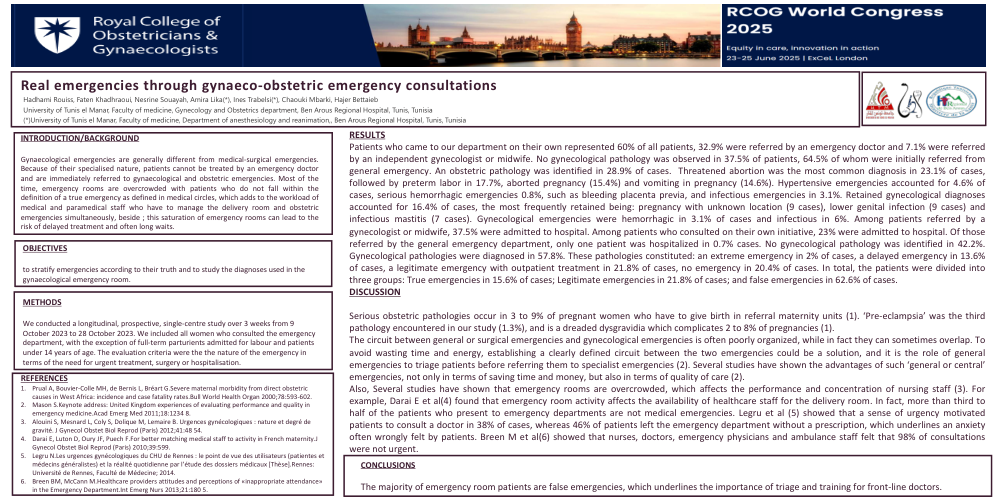
Results : Patients who came to our department on their own represented 60% of all patients, 32.9% were referred by an emergency doctor and 7.1% were referred by an independent gynaecologist or midwife. No gynaecological pathology was observed in 37.5% of patients, 64.5% of whom were initially referred from general emergency. An obstetric pathology was identified in 28.9% of cases. Threatened abortion was the most common diagnosis in 23.1% of cases, followed by preterm labor in 17.7%, aborted pregnancy (15.4%) and vomiting in pregnancy (14.6%). Hypertensive emergencies accounted for 4.6% of cases, serious haemorrhagic emergencies 0.8%, such as bleeding placenta previa, and infectious emergencies in 3.1%. Retained gynaecological diagnoses accounted for 16.4% of cases, the most frequently retained being: pregnancy with unknown location (9 cases), lower genital infection (9 cases) and infectious mastitis (7 cases). Gynaecological emergencies were haemorrhagic in 3.1% of cases and infectious in 6%. Among patients referred by a gynaecologist or midwife, 37.5% were admitted to hospital. Among patients who consulted on their own initiative, 23% were admitted to hospital. Of those referred by the general emergency department, only one patient was hospitalised in 0.7% cases. No gynaecological pathology was identified in 42.2%. Gynaecological pathologies were diagnosed in 57.8%. These pathologies constituted: an extreme emergency in 2% of cases, a delayed emergency in 13.6% of cases, a legitimate emergency with outpatient treatment in 21.8% of cases, no emergency in 20.4% of cases. In total, the patients were divided into three groups: True emergencies in 15.6% of cases; Legitimate emergencies in 21.8% of cases; and false emergencies in 62.6% of cases.
Discussion :
Serious obstetric pathologies occur in 3 to 9% of pregnant women who have to give birth in referral maternity units (1). ‘Pre-eclampsia’ was the third pathology encountered in our study (1.3%), and is a dreaded dysgravidia which complicates 2 to 8% of pregnancies (1).
The circuit between general or surgical emergencies and gynaecological emergencies is often poorly organised, while in fact they can sometimes overlap. To avoid wasting time and energy, establishing a clearly defined circuit between the two emergencies could be a solution, and it is the role of general emergencies to triage patients before referring them to specialist emergencies (2). Several studies have shown the advantages of such ‘general or central’ emergencies, not only in terms of saving time and money, but also in terms of quality of care (2).
Also, Several studies have shown that emergency rooms are overcrowded, which affects the performance and concentration of nursing staff (3). For example, Darai E et al(4) found that emergency room activity affects the availability of healthcare staff for the delivery room. In fact, more than third to half of the patients who present to emergency departments are not medical emergencies. Legru et al (5) showed that a sense of urgency motivated patients to consult a doctor in 38% of cases, whereas 46% of patients left the emergency department without a prescription, which underlines an anxiety often wrongly felt by patients. Breen M et al(6) showed that nurses, doctors, emergency physicians and ambulance staff felt that 98% of consultations were not urgent.
Conclusion: The majority of emergency room patients are false emergencies, which underlines the importance of triage and training for front-line doctors.
Références :
- Prual A, Bouvier-Colle MH, de Bernis L, Bréart G.Severe maternal morbidity from direct obstetric causes in West Africa: incidence and case fatality rates.Bull World Health Organ 2000;78:593-602.
- Mason S.Keynote address: United Kingdom experiences of evaluating performance and quality in emergency medicine.Acad Emerg Med 2011;18:1234 8.
- Alouini S, Mesnard L, Coly S, Dolique M, Lemaire B. Urgences gynécologiques : nature et degré de gravité. J Gynecol Obstet Biol Reprod (Paris) 2012;41:48 54.
- Darai E, Luton D, Oury JF, Puech F.For better matching medical staff to activity in French maternity.J Gynecol Obstet Biol Reprod (Paris) 2010;39:599.
- Legru N.Les urgences gynécologiques du CHU de Rennes : le point de vue des utilisateurs (patientes et médecins généralistes) et la réalité quotidienne par l’étude des dossiers médicaux [Thèse].Rennes: Université de Rennes, Faculté de Médecine; 2014.
- Breen BM, McCann M.Healthcare providers attitudes and perceptions of «inappropriate attendance» in the Emergency Department.Int Emerg Nurs 2013;21:180 5.