2,281 posters, 63 videos, 56 audios, 43 topics, 18 sessions, 6,174 authors, 2,323 institutions
ePostersLive by SciGen Technologies S.A. All rights reserved.
RCOG World Congress 2025
June 23 - 25, 2025 | ExCeL London, UK
EP.0160
REVIEW OF MANAGEMENT OF CAESAREAN SCAR PREGNANCIES (CSP) IN SOUTHEND HOSPITAL
Poster Presenter
Authors
Affiliations
Part of Topic
Early pregnancy complications/early pregnancy and acute gynaecology
REVIEW OF MANAGEMENT OF CAESAREAN SCAR PREGNANCIES (CSP) IN SOUTHEND HOSPITAL
Authors - Subhashini Rajaram (Clinical Fellow in Obstetrics and Gynaecology ), Sarojini Burugapalli (Consultant in Obstetrics and Gynaecology ), Munawar Hussain (Consultant in Obstetrics and Gynaecology )
Introduction and Objectives :
The prevalence of caesarean scar pregnancy is estimated to be approximately 1 in 2000 pregnancies. The rise in the number of reported cases in recent years is likely to be explained by the increased rate of caesarean sections and improvements in early diagnosis. Appropriate patient selection is important for optimal results. Major haemorrhage and hysterectomy are the main risks associated with CSP. Adequate counselling, availability of surgical expertise and blood transfusion should be a part of comprehensive management strategy.
The objective is to study the treatment appropriateness and the outcome.
Methods and Design :
Between February 2024 and January 2025, 5 cases of caesarean scar pregnancies were diagnosed using transvaginal ultrasound. Data collection and analysis were done using patient documents and records.
This is an observational retrospective cohort study
Results :
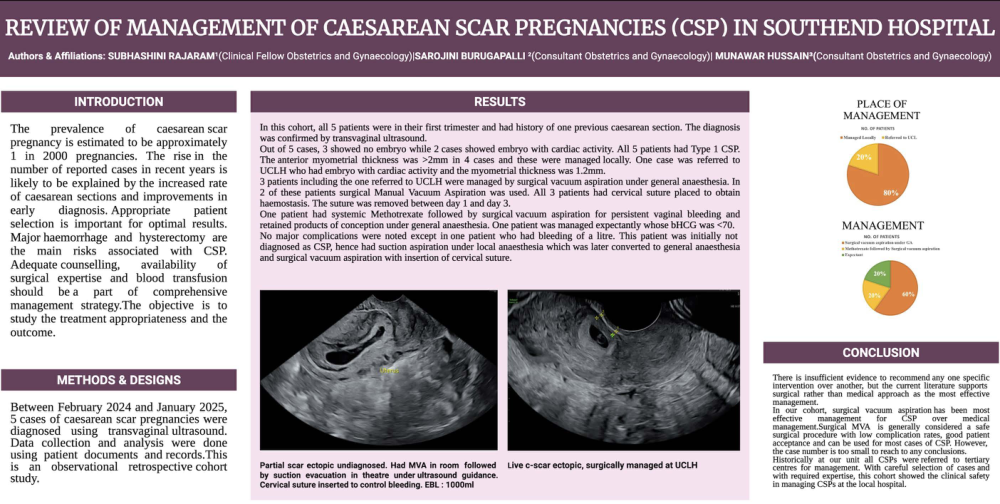
In this cohort, all 5 patients were in their first trimester and had history of one previous caesarean section. The diagnosis was confirmed by transvaginal ultrasound.
Out of 5 cases, 3 showed no embryo while 2 cases showed embryo with cardiac activity. All 5 patients had Type 1 CSP. The anterior myometrial thickness was >2mm in 4 cases and these were managed locally. One case was referred to UCLH who had embryo with cardiac activity and the myometrial thickness was 1.2mm.
3 patients including the one referred to UCLH were managed by surgical vacuum aspiration under general anaesthesia. In 2 of these patients surgical Manual Vacuum Aspiration was used. All 3 patients had cervical suture placed to obtain haemostasis. The suture was removed between day 1 and day 3. One patient had systemic Methotrexate followed by surgical vacuum aspiration for persistent vaginal bleeding and retained products of conception under general anaesthesia. One patient was managed expectantly whose bHCG was <70.
No major complications were noted except in one patient who had bleeding of a litre. This patient was initially not diagnosed as CSP, hence had suction aspiration under local anaesthesia which was later converted to general anaesthesia and surgical vacuum aspiration with insertion of cervical suture.
Conclusion :
There is insufficient evidence to recommend any one specific intervention over another, but the current literature supports surgical rather than medical approach as the most effective management.
In our cohort, surgical vacuum aspiration has been most effective management for CSP over medical management. Surgical MVA is generally considered a safe surgical procedure with low complication rates, good patient acceptance and can be used for most cases of CSP. However, the case number is too small to reach to any conclusions.
Historically, at our unit all CSPs were referred to tertiary centres for management. With careful selection of cases and with required expertise, this cohort showed the clinical safety in managing CSPs at the local hospital.