2,281 posters, 63 videos, 56 audios, 43 topics, 18 sessions, 6,174 authors, 2,323 institutions
ePostersLive by SciGen Technologies S.A. All rights reserved.
RCOG World Congress 2025
June 23 - 25, 2025 | ExCeL London, UK
EP.0158
Safety principles in early pregnancy ultrasound scanning and the importance of education.
Poster Presenter
Authors
Affiliations
Part of Topic
Early pregnancy complications/early pregnancy and acute gynaecology
Safety principles in early pregnancy ultrasound - the importance of education
OBJECTIVE
Ultrasound is a critical tool in early pregnancy assessment, used daily across the UK for various purposes, including reassurance and diagnosing complications. Whilst ultrasound is generally considered safe, there are concerns regarding its non-ionising nature and the subsequent embryonic effects.
Correct use of Mechanical Index (MI) and Thermal Index (TI) settings is integral in assessing and minimising any potential risks to the embryo associated with thermal and mechanical bio-effects during scans.
This project aimed to educate trainees about the safety of early pregnancy ultrasound, with a particular focus on the MI and TI settings.
DESIGN
Evidence from the British Medical Ultrasound Society (BMUS), BJOG, and RCOG supports the safety of early pregnancy ultrasound when performed with approproate settings, specifically with MI <0.7 and TI <1.
Risks to the developing embryo are minimal when established safety margins are implemented, but inappropriate settings may lead to thermal or cavitation effects.
Our survey revealed a knowledge gap among trainees regarding these safety thresholds. This highlights the need for targeted education to ensure all ultrasound operators understand and apply recommended safety practices.
METHOD
We surveyed trainees within our deanery to assess baseline knowledge of ultrasound safety, with a focus on MI and TI settings. The survey combined multiple-choice and free-text questions, covering:
- Training grade and ultrasound exposure
- Confidence in identifying and measuring intrauterine pregnancies
- Knowledge of early pregnancy definitions and diagnoses
- Understanding of ultrasound risks, Doppler use, and MI/TI settings
The results of our survey prompted us to plan educational sessions to enhance trainees' understanding and ensure that ultrasound practices align with recommended safety standards.
RESULTS
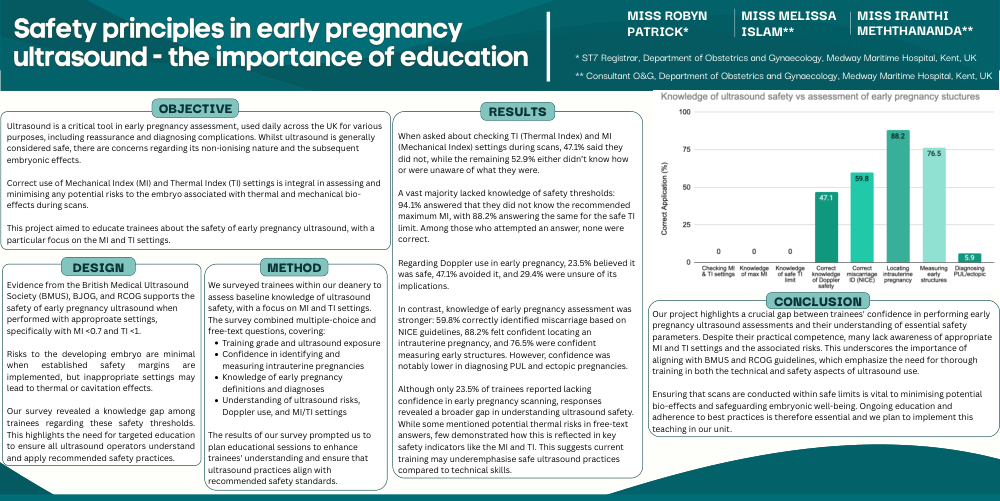
When asked about checking TI (Thermal Index) and MI (Mechanical Index) settings during scans, 47.1% said they did not, while the remaining 52.9% either didn’t know how or were unaware of what they were.
A vast majority lacked knowledge of safety thresholds: 94.1% answered that they did not know the recommended maximum MI, with 88.2% answering the same for the safe TI limit. Among those who attempted an answer, none were correct.
Regarding Doppler use in early pregnancy, 23.5% believed it was safe, 47.1% avoided it, and 29.4% were unsure of its implications.
In contrast, knowledge of early pregnancy assessment was stronger: 59.8% correctly identified miscarriage based on NICE guidelines, 88.2% felt confident locating an intrauterine pregnancy, and 76.5% were confident measuring early structures. However, confidence was notably lower in diagnosing PUL and ectopic pregnancies.
Although only 23.5% of trainees reported lacking confidence in early pregnancy scanning, responses revealed a broader gap in understanding ultrasound safety. While some mentioned potential thermal risks in free-text answers, few demonstrated how this is reflected in key safety indicators like the MI and TI. This suggests current training may underemphasise safe ultrasound practices compared to technical skills.
CONCLUSION
Our project highlights a crucial gap between trainees' confidence in performing early pregnancy ultrasound assessments and their understanding of essential safety parameters. Despite their practical competence, many lack awareness of appropriate MI and TI settings and the associated risks. This underscores the importance of aligning with BMUS and RCOG guidelines, which emphasize the need for thorough training in both the technical and safety aspects of ultrasound use.
Ensuring that scans are conducted within safe limits is vital to minimising potential bio-effects and safeguarding embryonic well-being. Ongoing education and adherence to best practices is therefore essential and we plan to implement this teaching in our unit.