2,281 posters, 63 videos, 56 audios, 43 topics, 18 sessions, 6,174 authors, 2,323 institutions
ePostersLive by SciGen Technologies S.A. All rights reserved.
RCOG World Congress 2025
June 23 - 25, 2025 | ExCeL London, UK
EP.0138
Abstract on Audit on Management of Ectopic Pregnancy.
Poster Presenter
Part of Topic
Early pregnancy complications/early pregnancy and acute gynaecology
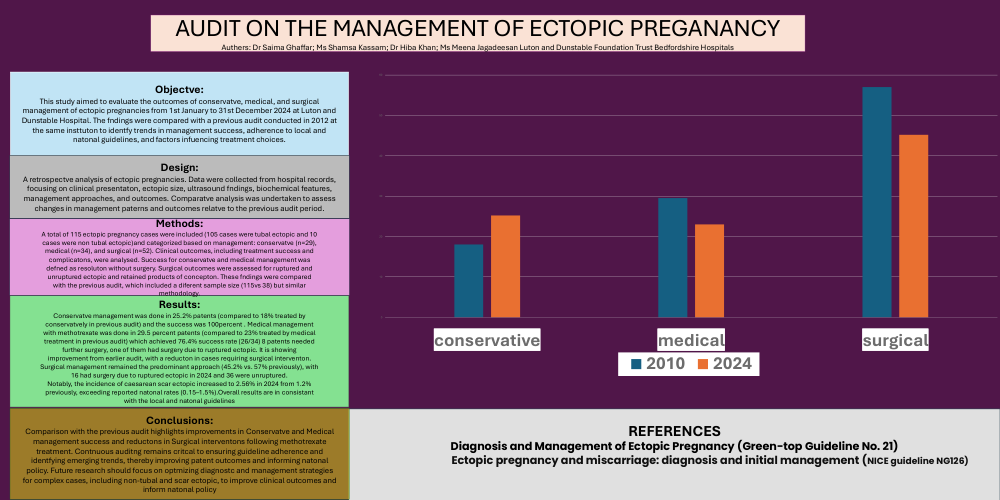
Abstract on Audit on Management of Ectopic Pregnancy Authers: Dr Saima Ghaffar; Ms Shamsa Kassam; Dr Hiba Khan; Ms Meena Jagadeesan Luton and Dunstable Foundation Trust Bedfordshire Hospitals
Objective: This study aimed to evaluate the outcomes of conservative, medical, and surgical management of ectopic pregnancies from 1st January to 31st December 2024 at Luton and Dunstable Hospital. The findings were compared with a previous audit conducted in 2012 at the same institution to identify trends in management success, adherence to local and national guidelines, and factors influencing treatment choices.
Design: A retrospective analysis of ectopic pregnancies. Data were collected from hospital records, focusing on clinical presentation, ectopic size, ultrasound findings, biochemical features, management approaches, and outcomes. Comparative analysis was undertaken to assess changes in management patterns and outcomes relative to the previous audit period.
Methods: A total of 115 ectopic pregnancy cases were included (105 cases were tubal ectopic and 10 cases were non tubal ectopic)and categorized based on management: conservative (n=29), medical (n=34), and surgical (n=52). Clinical outcomes, including treatment success and complications, were analysed. Success for conservative and medical management was defined as resolution without surgery. Surgical outcomes were assessed for ruptured and unruptured ectopic and retained products of conception. These findings were compared with the previous audit, which included a different sample size (115vs 38) but similar methodology.
Results: Conservative management was done in 25.2% patients (compared to 18% treated by conservatively in previous audit) and the success was 100percent . Medical management with methotrexate was done in 29.5 percent patients (compared to 23% treated by medical treatment in previous audit) which achieved 76.4% success rate (26/34) 8 patients needed further surgery, one of them had surgery due to ruptured ectopic. It is showing improvement from earlier audit, with a reduction in cases requiring surgical intervention. Surgical management remained the predominant approach (45.2% vs. 57% previously), with 16 had surgery due to ruptured ectopic in 2024 and 36 were unruptured. Notably, the incidence of caesarean scar ectopic increased to 2.56% in 2024 from 1.2% previously, exceeding reported national rates (0.15–1.5%).Overall results are in consistant with the local and national guidelines.
Conclusions: Comparison with the previous audit highlights improvements in Conservative and Medical management success and reductions in Surgical interventions following methotrexate treatment. Continuous auditing remains critical to ensuring guideline adherence and identifying emerging trends, thereby improving patient outcomes and informing national policy. Future research should focus on optimizing diagnostic and management strategies for complex cases, including non-tubal and scar ectopic, to improve clinical outcomes and inform national policy.