2,281 posters, 63 videos, 56 audios, 43 topics, 18 sessions, 6,174 authors, 2,323 institutions
ePostersLive by SciGen Technologies S.A. All rights reserved.
RCOG World Congress 2025
June 23 - 25, 2025 | ExCeL London, UK
EP.0136
Management and Outcomes of Non-Tubal Ectopic Pregnancy: A 42-Month Retrospective Study
Poster Presenter
Authors
Affiliations
Part of Topic
Early pregnancy complications/early pregnancy and acute gynaecology
Management and Outcomes of Non Tubal Ectopic Pregnancy: A 42 Month Retrospective Study
Objective:
To evaluate the presentation and outcomes of non tubal ectopic pregnancies at Frimley Park Hospital, covering the period from February 2021 to August 2024.
Design:
Retrospective Observational study
Method:
A retrospective data collection was conducted on all women with a non tubal ectopic pregnancy over 42 months at FPH. The process involved identifying cases of non tubal ectopic pregnancy from early pregnancy records and accessing detailed information through the EPIC, an electronic patient record system.
Results:
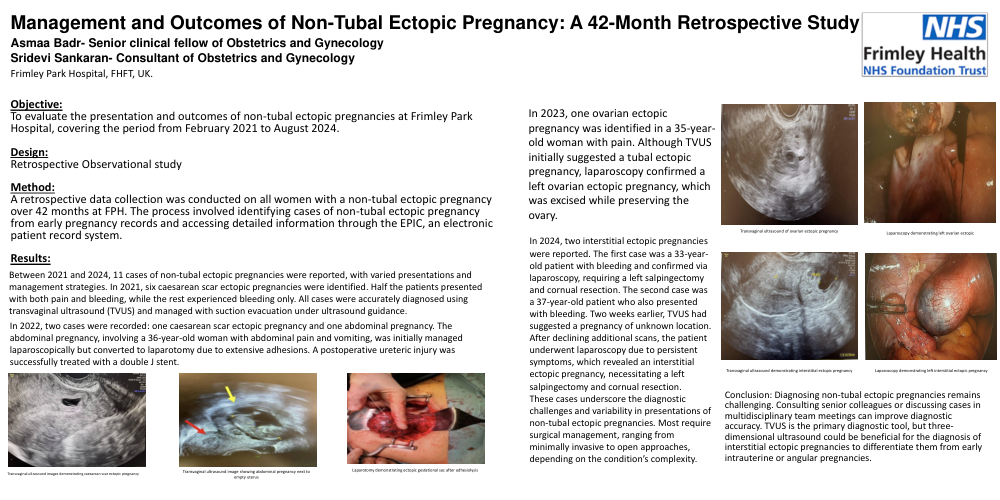
Between 2021 and 2024, 11 cases of non tubal ectopic pregnancies were reported, with varied presentations and management strategies. In 2021, six caesarean scar ectopic pregnancies were identified. Half the patients presented with both pain and bleeding, while the rest experienced bleeding only. All cases were accurately diagnosed using transvaginal ultrasound (TVUS) and managed with suction evacuation under ultrasound guidance. Transvaginal ultrasound images demonstrating caesarean scar ectopic pregnancy.
In 2022, two cases were recorded: one caesarean scar ectopic pregnancy and one abdominal pregnancy. The abdominal pregnancy, involving a 36 year old woman with abdominal pain and vomiting, was initially managed laparoscopically but converted to laparotomy due to extensive adhesions. A postoperative ureteric injury was successfully treated with a double J stent.
In 2023, one ovarian ectopic pregnancy was identified in a 35 year old woman with pain. Although TVUS initially suggested a tubal ectopic pregnancy, laparoscopy confirmed a left ovarian ectopic pregnancy, which was excised while preserving the ovary.
In 2024, two interstitial ectopic pregnancies were reported. The first case was a 33 year old patient with bleeding and confirmed via laparoscopy, requiring a left salpingectomy and cornual resection. The second case was a 37 year old patient who also presented with bleeding. Two weeks earlier, TVUS had suggested a pregnancy of unknown location. After declining additional scans, the patient underwent laparoscopy due to persistent symptoms, which revealed an interstitial ectopic pregnancy, necessitating a left salpingectomy and cornual resection.
These cases underscore the diagnostic challenges and variability in presentations of non tubal ectopic pregnancies. Most require surgical management, ranging from minimally invasive to open approaches, depending on the condition’s complexity.
Conclusion: Diagnosing non tubal ectopic pregnancies remains challenging. Consulting senior colleagues or discussing cases in multidisciplinary team meetings can improve diagnostic accuracy. TVUS is the primary diagnostic tool, but three dimensional ultrasound could be beneficial for the diagnosis of interstitial ectopic pregnancies to differentiate them from early intrauterine or angular pregnancies.