2,281 posters, 63 videos, 56 audios, 43 topics, 18 sessions, 6,174 authors, 2,323 institutions
ePostersLive by SciGen Technologies S.A. All rights reserved.
RCOG World Congress 2025
June 23 - 25, 2025 | ExCeL London, UK
EP.0131
Audit investigating Anti D immunoglobin protocol for haemolytic disease prophylaxis in pregnancy
Poster Presenter
Authors
Affiliations
Part of Topic
Early pregnancy complications/early pregnancy and acute gynaecology
Audit Investigating Anti D Immunoglobin Protocol For Haemolytic Disease Prophylaxis In Pregnancy
Background and Objectives:
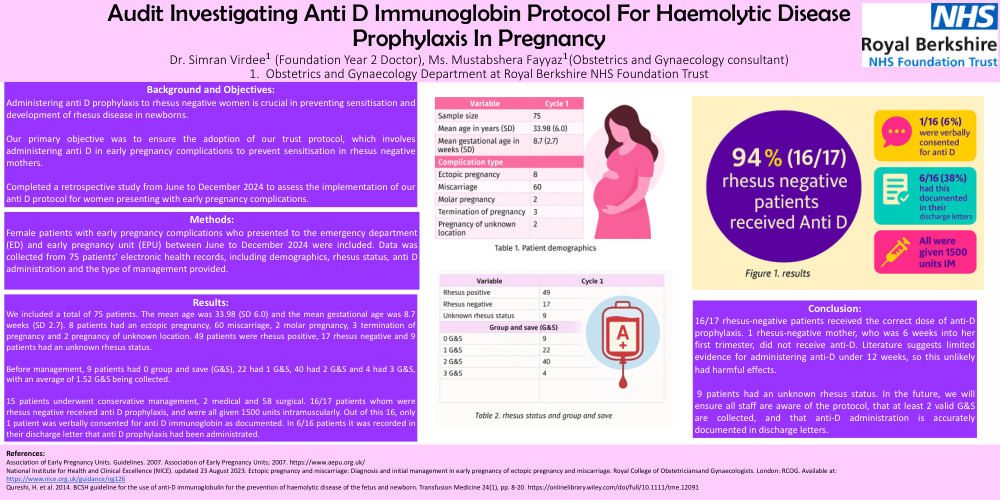
Administering anti D prophylaxis to rhesus negative women is crucial in preventing sensitisation and development of rhesus disease in newborns. Our primary objective was to ensure the adoption of our trust protocol, which involves administering anti D in early pregnancy complications to prevent sensitisation in rhesus negative mothers. Completed a retrospective study from June to December 2024 to assess the implementation of our anti D protocol for women presenting with early pregnancy complications.
Methods:
Female patients with early pregnancy complications who presented to the emergency department (ED) and early pregnancy unit (EPU) between June to December 2024 were included. Data was collected from 75 patients’ electronic health records, including demographics, rhesus status, anti D administration and the type of management provided.
Results:
We included a total of 75 patients. The mean age was 33.98 (SD 6.0) and the mean gestational age was 8.7 weeks (SD 2.7). 8 patients had an ectopic pregnancy, 60 miscarriage, 2 molar pregnancy, 3 termination of pregnancy and 2 pregnancy of unknown location. 49 patients were rhesus positive, 17 rhesus negative and 9 patients had an unknown rhesus status.
Before management, 9 patients had 0 group and save (G&S), 22 had 1 G&S, 40 had 2 G&S and 4 had 3 G&S, with an average of 1.52 G&S being collected.
15 patients underwent conservative management, 2 medical and 58 surgical. 16/17 patients whom were rhesus negative received anti D prophylaxis, and were all given 1500 units intramuscularly. Out of this 16, only 1 patient was verbally consented for anti D immunoglobin as documented. In 6/16 patients it was recorded in their discharge letter that anti D prophylaxis had been administrated.
Conclusion:
16/17 rhesus-negative patients received the correct dose of anti-D prophylaxis. 1 rhesus-negative mother, who was 6 weeks into her first trimester, did not receive anti-D. Literature suggests limited evidence for administering anti-D under 12 weeks, so this unlikely had harmful effects.
9 patients had an unknown rhesus status. In the future, we will ensure all staff are aware of the protocol, that at least 2 valid G&S are collected, and that anti-D administration is accurately documented in discharge letters.