2,281 posters, 63 videos, 56 audios, 43 topics, 18 sessions, 6,174 authors, 2,323 institutions
ePostersLive by SciGen Technologies S.A. All rights reserved.
RCOG World Congress 2025
June 23 - 25, 2025 | ExCeL London, UK
EP.1305
A Case Series of Uterine Arteriovenous Malformations Following Elective Caesarean Sections
Poster Presenter
Authors
Affiliations
Part of Topic
Imaging in obstetrics
A Case Series of Uterine Arteriovenous Malformations Following Elective Caesarean Sections
V Eves, B Davey, J Goodman
Objective:
Uterine arteriovenous malformation (UAVM) is a rare and life-threatening cause of secondary postpartum haemorrhage (PPH).
We describe two cases of UAVM following a primary elective caesarean section (ELCS). Each patient presented on two occasions with secondary PPH, which were initially diagnosed as retained products of conception (RPOC).
Case Report 1:
The first patient had an uncomplicated primary ELCS due to previous birth trauma. On day seven postnatal she presented with a secondary PPH. She was taken to theatre for an examination under anaesthetic, evacuation of suspected retained products of conception and insertion of a Bakri balloon. The total estimated blood loss (EBL) was 1900ml.
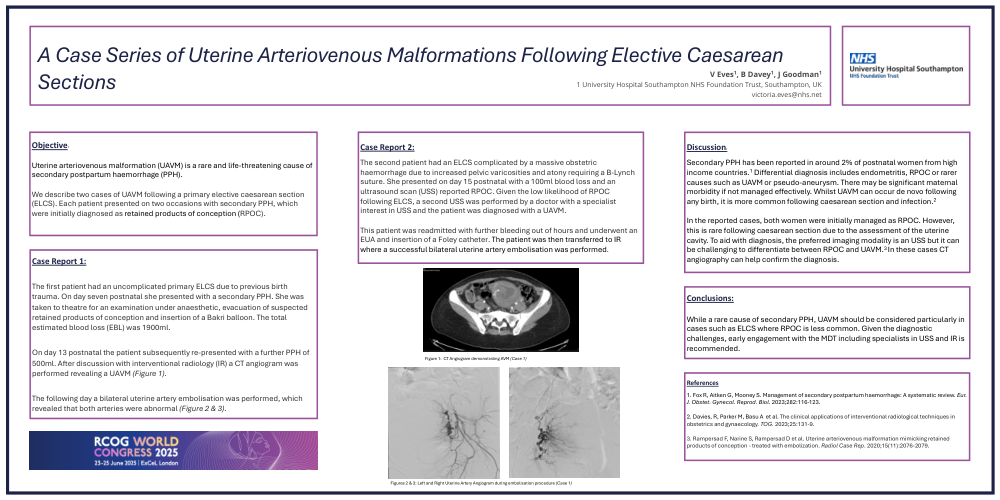
On day 13 postnatal the patient subsequently re-presented with a further PPH of 500ml. After discussion with interventional radiology (IR) a CT angiogram was performed revealing a UAVM (Figure 1).
The following day a bilateral uterine artery embolisation was performed, which revealed that both arteries were abnormal (Figure 2 & 3).
Case Report 2:
The second patient had an ELCS complicated by a massive obstetric haemorrhage due to increased pelvic varicosities and atony requiring a B-Lynch suture. She presented on day 15 postnatal with a 100ml blood loss and an ultrasound scan (USS) reported RPOC. Given the low likelihood of RPOC following ELCS, a second USS was performed by a doctor with a specialist interest in USS and the patient was diagnosed with a UAVM.
This patient was readmitted with further bleeding out of hours and underwent an EUA and insertion of a Foley catheter. The patient was then transferred to IR where a successful bilateral uterine artery embolisation was performed.
Discussion:
Secondary PPH has been reported in around 2% of postnatal women from high income countries.1 Differential diagnosis includes endometritis, RPOC or rarer causes such as UAVM or pseudo-aneurysm. There may be significant maternal morbidity if not managed effectively. Whilst UAVM can occur de novo following any birth, it is more common following caesarean section and infection.2
In the reported cases, both women were initially managed as RPOC. However, this is rare following caesarean section due to the assessment of the uterine cavity. To aid with diagnosis, the preferred imaging modality is an USS but it can be challenging to differentiate between RPOC and UAVM.3 In these cases CT angiography can help confirm the diagnosis.
Conclusions:
While a rare cause of secondary PPH, UAVM should be considered particularly in cases such as ELCS where RPOC is less common. Given the diagnostic challenges, early engagement with the MDT including specialists in USS and IR is recommended.