2,281 posters, 63 videos, 56 audios, 43 topics, 18 sessions, 6,174 authors, 2,323 institutions
ePostersLive by SciGen Technologies S.A. All rights reserved.
RCOG World Congress 2025
June 23 - 25, 2025 | ExCeL London, UK
EP.1293
Audit of Uterine Artery Doppler Referrals: Compliance with SBLv3 Standards
Poster Presenter
Part of Topic
Imaging in obstetrics
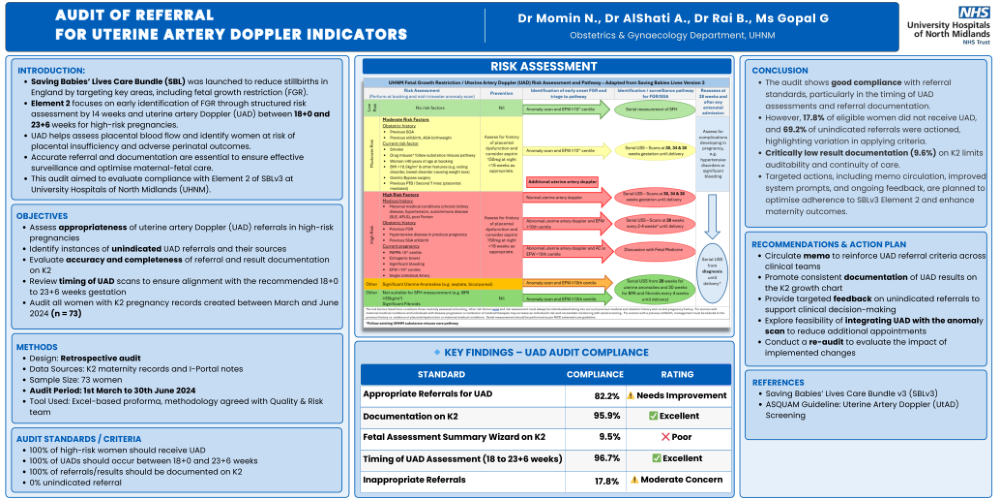
INTRODUCTION: Saving Babies' Lives Care Bundle (SBL) was launched to reduce stillbirths in England by targeting key areas, including fetal growth restriction (FGR). Element 2 focuses on early identification of FGR through structured risk assessment by 14 weeks and uterine artery Doppler (UAD) between 18+0 and 23+6 weeks for high-risk pregnancies. UAD helps assess placental blood flow and identify women at risk of placental insufficiency and adverse perinatal outcomes. Accurate referral and documentation are essential to ensure effective surveillance and optimise maternal-fetal care. This audit aimed to evaluate compliance with Element 2 of SBLv3 at University Hospitals of North Midlands (UHNM). ОBJECTIVES Assess appropriateness of uterine artery Doppler (UAD) referrals in high-risk pregnancies Identify instances of unindicated UAD referrals and their sources • Evaluate accuracy and completeness of referral and result documentation on K2 • Review timing of UAD scans to ensure alignment with the recommended 18+0 to 23+6 weeks gestation • Audit all women with K2 pregnancy records created between March and June 2024 (n = 73) Dr Momin N., Dr AIShati A., Dr Rai B., Ms Gopal G Obstetrics & Gynaecology Department, UHNM NHS University Hospitals of North Midlands NHS Trust RISK ASSESSMENT CONCLUSION pathway ks and atal The audit shows good compliance with referral standards, particularly in the timing of UAD assessments and referral documentation. eloping in However, 17.8% of eligible women did not receive UAD, and 69.2% of unindicated referrals were actioned, highlighting variation in applying criteria. pregnancy, significant Critically low result documentation (9.6%) on K2 limits auditability and continuity of care. Targeted actions, including memo circulation, improved system prompts, and ongoing feedback, are planned to optimise adherence to SBLv3 Element 2 and enhance maternity outcomes. for BM ery 4 weeks rial USS RECOMMENDATIONS & ACTION PLAN Circulate memo to reinforce UAD referral criteria across clinical teams Promote consistent documentation of UAD results on the K2 growth chart Provide targeted feedback on unindicated referrals to support clinical decision-making Explore feasibility of integrating UAD with the anomaly scan to reduce additional appointments Conduct a re-audit to evaluate the impact of implemented changes METHODS • Design: Retrospective audit • Data Sources: K2 maternity records and I-Portal notes • Sample Size: 73 women • Audit Period: 1st March to 30th June 2024 Tool Used: Excel-based proforma, methodology agreed with Quality & Risk team ◆ KEY FINDINGS - UAD AUDIT COMPLIANCE STANDARD COMPLIANCE RATING Appropriate Referrals for UAD 82.2% Needs Improvement REFERENCES AUDIT STANDARDS /CRITERIA • 100% of high-risk women should receive UAD • 100% of UADs should occur between 18+0 and 23+6 weeks • 100% of referrals/results should be documented on K2 ⚫ 0% unindicated referral
Conclusion
- The audit shows good compliance with referral standards, particularly in the timing of UAD assessments and referral documentation.
- However, 17.8% of eligible women did not receive UAD, and 69.2% of unindicated referrals were actioned, highlighting variation in applying criteria.
- Critically low result documentation (9.6%) on K2 limits auditability and continuity of care.
- Targeted actions, including memo circulation, improved system prompts, and ongoing feedback, are planned to optimise adherence to SBLv3 Element 2 and enhance maternity outcomes
-
Recommendations & Action Plan
- Circulate memo to reinforce UAD referral criteria acrossclinical teams
- Promote consistent documentation of UAD results on the K2 growth chart
- Provide targeted feedbackon unindicated referralstosupportclinicaldecision-making
- Explore feasibilityof integrating UAD with the anomaly scan to reduce additional appointments
- Conduct a re-audit to evaluate the impact of implemented changes