2,281 posters, 63 videos, 56 audios, 43 topics, 18 sessions, 6,174 authors, 2,323 institutions
ePostersLive by SciGen Technologies S.A. All rights reserved.
RCOG World Congress 2025
June 23 - 25, 2025 | ExCeL London, UK
EP.1287
Primary cesarean scar dehiscence: an important yet underreported cause of puerperal sepsis
Poster Presenter
Authors
Affiliations
Part of Topic
Hot topics (emerging research/issues) in obstetrics
TITLE-Primary cesarean scar dehiscence: an important yet underreported cause of puerperal sepsis.
Authors-Dr Rachana Shekhar Jagade, Dr Kshama Nilesh Uplenchwar, Dr Asha Niranjan Gokhale
Institute-Deenanath Mangeshkar Hospital and Research Center, Pune, Maharashtra, India
INTRODUCTION-
Primary dehiscence of uterine incision is a rare but important cause of puerperal sepsis. The incidence
ranges from 0.2 to 1.5% in low transverse uterine incisions. It is characterised by a defect in the uterine
incision line after Cesarean section in early postpartum period.
Prompt diagnosis with high index of suspicion and timely management can lead to significantly better
patient outcomes, reducing the maternal morbidity and mortality.
27 year old G2A1 with Dichorionic Diamniotic twin pregnancy with Gestational Diabetes Mellitus with
placenta previa underwent preterm emergency LSCS at 30 weeks 6 days i/v/o antepartum hemorrhage.
Intraoperative blood loss was 2.2 liters. Intraoperative 2 PCV and 1 FFP were transfused.
On postnatal day 12, patient had persistent lower abdominal pain along with persistent tachycardia
with the pulse rate of 112/min which was followed by fever spikes. On examination, uterus was well
retracted, abdomen was soft, localized tenderness was present in right iliac fossa. Abdominal wound
was healthy. Urine routine showed 63 pus cells which was treated with antibiotics as per the culture
sensitivity report. However, due to persistent fever spikes and tachycardia with localized tenderness
despite antibiotics, further investigations were carried out involving physician and a general surgeon in
the team.
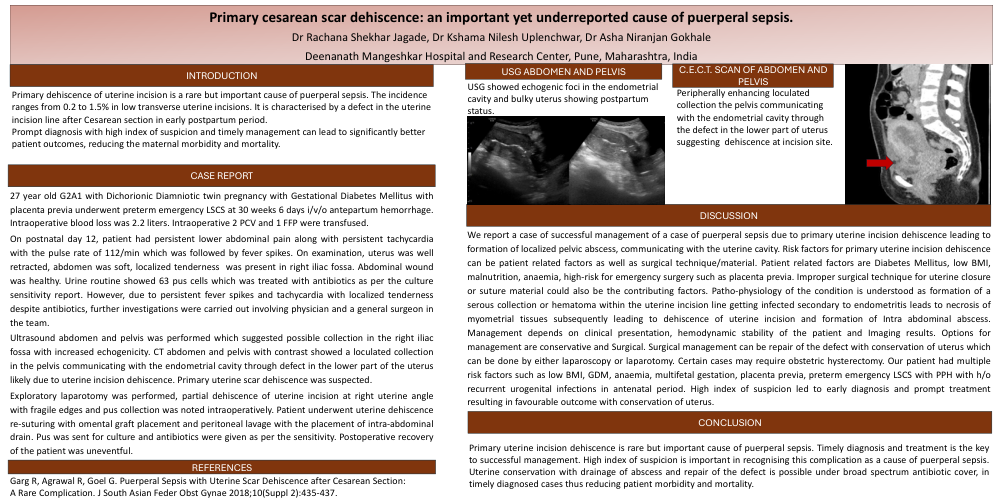
Ultrasound abdomen and pelvis was performed which suggested possible collection in the right iliac
fossa with increased echogenicity. CT abdomen and pelvis with contrast showed a loculated collection
in the pelvis communicating with the endometrial cavity through defect in the lower part of the uterus
likely due to uterine incision dehiscence. Primary uterine scar dehiscence was suspected.
Exploratory laparotomy was performed, partial dehiscence of uterine incision at right uterine angle
with fragile edges and pus collection was noted intraoperatively. Patient underwent uterine dehiscence
re-suturing with omental graft placement and peritoneal lavage with the placement of intra-abdominal
drain. Pus was sent for culture and antibiotics were given as per the sensitivity. Postoperative recovery
of the patient was uneventful.
DISCUSSION
We report a case of successful management of a case of puerperal sepsis due to primary uterine incision dehiscence leading to
formation of localized pelvic abscess, communicating with the uterine cavity. Risk factors for primary uterine incision dehiscence
can be patient related factors as well as surgical technique/material. Patient related factors are Diabetes Mellitus, low BMI,
malnutrition, anaemia, high-risk for emergency surgery such as placenta previa. Improper surgical technique for uterine closure
or suture material could also be the contributing factors. Patho-physiology of the condition is understood as formation of a
serous collection or hematoma within the uterine incision line getting infected secondary to endometritis leads to necrosis of
myometrial tissues subsequently leading to dehiscence of uterine incision and formation of Intra abdominal abscess.
Management depends on clinical presentation, hemodynamic stability of the patient and Imaging results. Options for
management are conservative and Surgical. Surgical management can be repair of the defect with conservation of uterus which
can be done by either laparoscopy or laparotomy. Certain cases may require obstetric hysterectomy. Our patient had multiple
risk factors such as low BMI, GDM, anaemia, multifetal gestation, placenta previa, preterm emergency LSCS with PPH with h/o
recurrent urogenital infections in antenatal period. High index of suspicion led to early diagnosis and prompt treatment
resulting in favourable outcome with conservation of uterus.
CONCLUSION
Primary uterine incision dehiscence is rare but important cause of puerperal sepsis. Timely diagnosis and treatment is the key
to successful management. High index of suspicion is important in recognising this complication as a cause of puerperal sepsis.
Uterine conservation with drainage of abscess and repair of the defect is possible under broad spectrum antibiotic cover, in
timely diagnosed cases thus reducing patient morbidity and mortality.
REFERENCES
Garg R, Agrawal R, Goel G. Puerperal Sepsis with Uterine Scar Dehiscence after Cesarean Section:
A Rare Complication. J South Asian Feder Obst Gynae 2018;10(Suppl 2):435-437.