2,281 posters, 63 videos, 56 audios, 43 topics, 18 sessions, 6,174 authors, 2,323 institutions
ePostersLive by SciGen Technologies S.A. All rights reserved.
RCOG World Congress 2025
June 23 - 25, 2025 | ExCeL London, UK
EP.1284
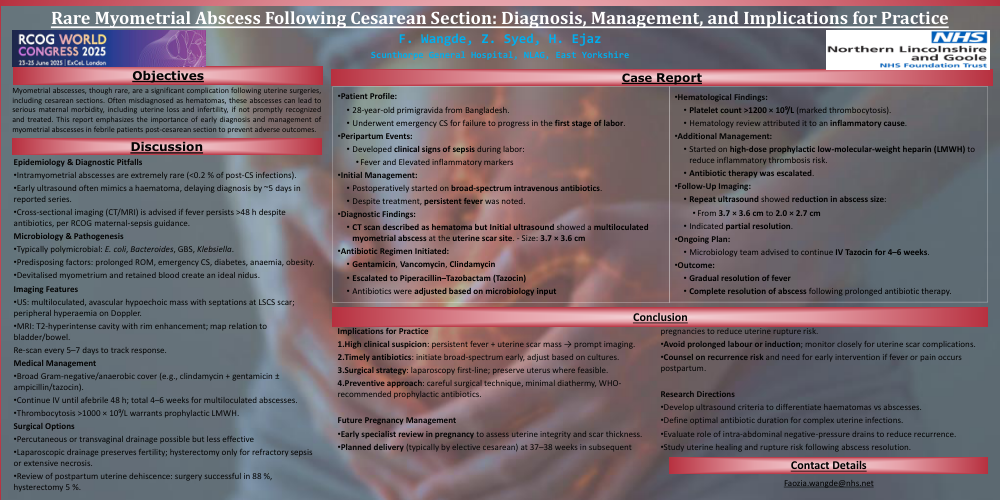
Rare Myometrial Abscess Following Cesarean Section: Diagnosis, Management, and Implications for Practice
Poster Presenter
Authors
Affiliations
Part of Topic
Hot topics (emerging research/issues) in obstetrics
Objectives:
Myometrial abscesses, though rare, are a significant complication following uterine surgeries,
including cesarean sections. Often misdiagnosed as hematomas, these abscesses can lead to
serious maternal morbidity, including uterine loss and infertility, if not promptly recognized
and treated. This report emphasizes the importance of early diagnosis and management of
myometrial abscesses in febrile patients post-cesarean section to prevent adverse outcomes.
Case report
•Patient Profile:
• 28-year-old primigravida from Bangladesh.
• Underwent emergency CS for failure to progress in the first stage of labor.
•Peripartum Events:
• Developed clinical signs of sepsis during labor:
• Fever and Elevated inflammatory markers
•Initial Management:
• Postoperatively started on broad-spectrum intravenous antibiotics.
• Despite treatment, persistent fever was noted.
•Diagnostic Findings:
• CT scan described as hematoma but Initial ultrasound showed a multiloculated
myometrial abscess at the uterine scar site. - Size: 3.7 × 3.6 cm
•Antibiotic Regimen Initiated:
• Gentamicin, Vancomycin, Clindamycin
• Escalated to Piperacillin–Tazobactam (Tazocin)
• Antibiotics were adjusted based on microbiology input
Hematological Findings:
• Platelet count >1200 × 10⁹/L (marked thrombocytosis).
• Hematology review attributed it to an inflammatory cause.
•Additional Management:
• Started on high-dose prophylactic low-molecular-weight heparin (LMWH) to
reduce inflammatory thrombosis risk.
• Antibiotic therapy was escalated.
•Follow-Up Imaging:
• Repeat ultrasound showed reduction in abscess size:
• From 3.7 × 3.6 cm to 2.0 × 2.7 cm
• Indicated partial resolution.
•Ongoing Plan:
• Microbiology team advised to continue IV Tazocin for 4–6 weeks.
•Outcome:
• Gradual resolution of fever
• Complete resolution of abscess following prolonged antibiotic therapy.
Discussion
Epidemiology & Diagnostic Pitfalls
•Intramyometrial abscesses are extremely rare (<0.2 % of post-CS infections).
•Early ultrasound often mimics a haematoma, delaying diagnosis by ~5 days in
reported series.
•Cross-sectional imaging (CT/MRI) is advised if fever persists >48 h despite
antibiotics, per RCOG maternal-sepsis guidance.
Microbiology & Pathogenesis
•Typically polymicrobial: E. coli, Bacteroides, GBS, Klebsiella.
•Predisposing factors: prolonged ROM, emergency CS, diabetes, anaemia, obesity.
•Devitalised myometrium and retained blood create an ideal nidus.
Imaging Features
•US: multiloculated, avascular hypoechoic mass with septations at LSCS scar;
peripheral hyperaemia on Doppler.
•MRI: T2-hyperintense cavity with rim enhancement; map relation to
bladder/bowel.
Re-scan every 5–7 days to track response.
Medical Management
•Broad Gram-negative/anaerobic cover (e.g., clindamycin + gentamicin ±
ampicillin/tazocin).
•Continue IV until afebrile 48 h; total 4–6 weeks for multiloculated abscesses.
•Thrombocytosis >1000 × 10⁹/L warrants prophylactic LMWH.
Surgical Options
•Percutaneous or transvaginal drainage possible but less effective
•Laparoscopic drainage preserves fertility; hysterectomy only for refractory sepsis
or extensive necrosis.
•Review of postpartum uterine dehiscence: surgery successful in 88 %,
hysterectomy 5 %.
Conclusion
1.High clinical suspicion: persistent fever + uterine scar mass → prompt imaging.
2.Timely antibiotics: initiate broad-spectrum early, adjust based on cultures.
3.Surgical strategy: laparoscopy first-line; preserve uterus where feasible.
4.Preventive approach: careful surgical technique, minimal diathermy, WHOrecommended
prophylactic antibiotics.
Future Pregnancy Management
•Early specialist review in pregnancy to assess uterine integrity and scar thickness.
•Planned delivery (typically by elective cesarean) at 37–38 weeks in subsequent
pregnancies to reduce uterine rupture risk.
•Avoid prolonged labour or induction; monitor closely for uterine scar complications.
•Counsel on recurrence risk and need for early intervention if fever or pain occurs
postpartum.
Research Directions
•Develop ultrasound criteria to differentiate haematomas vs abscesses.
•Define optimal antibiotic duration for complex uterine infections.
•Evaluate role of intra-abdominal negative-pressure drains to reduce recurrence.
•Study uterine healing and rupture risk following abscess resolution.