Loading...

2,281 posters, 63 videos, 56 audios, 43 topics, 18 sessions, 6,174 authors, 2,323 institutions

ePostersLive by SciGen Technologies S.A. All rights reserved.

RCOG World Congress 2025

June 23 - 25, 2025 | ExCeL London, UK

EP.1281

Unravelling Ogilvie Syndrome- A Rare but Critical Complication Post-Caesarean Section
Part of Topic

Hot topics (emerging research/issues) in obstetrics

Audio

Unravelling Ogilvie Syndrome- A Rare but Critical Complication Post-Caesarean Section

Dr. Abhinanda Pal1, Dr. Abayomi Alao1, Dr. Ananya Banerjee1. University Hospitals of Derby and Burton NHSFT


INTRODUCTION-
•Ogilvie syndrome or acute colonic pseudo-obstruction is a rare but potential life-threatening complication of caesarean section. 
•The incidence of ACPO following childbirth  is considered to be 1 in 1500 .
•It is characterized by colonic dilation in the absence of mechanical obstruction or anatomical anomaly.
• The exact pathophysiology remains uncertain, but it is believed to involve an imbalance between the sympathetic and parasympathetic tone leading to reduced colonic motility. 

CASE DESCRIPTION- 

•A 33-year-old, Para 5 lady presented 7 days post-elective Caesarean Section (CS) and sterilisation with abdominal distension, pain, loss of appetite and vomitting.

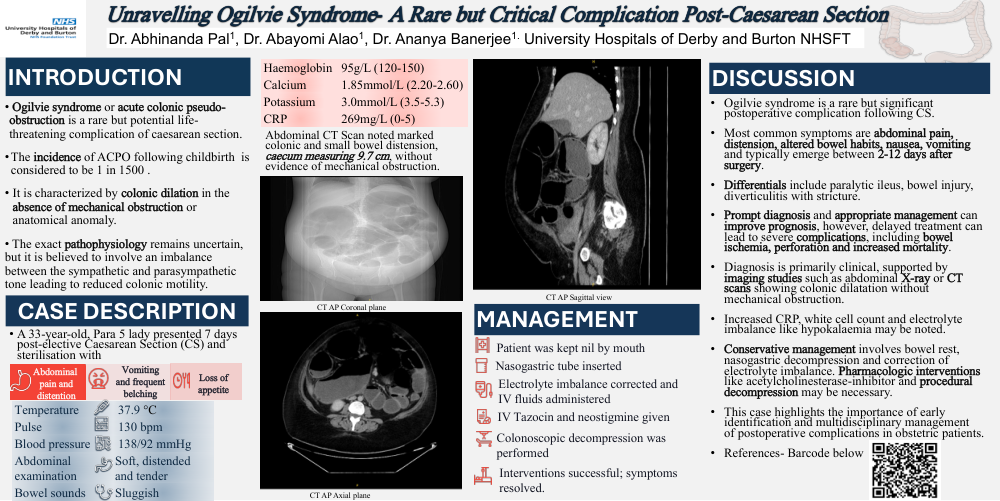
Her blood tests revealed hemoglobin level of 95g/L, Calcium 1.85 mmol/L, Potassium 3.0 mmol/L, C Reactive Protein was 269mg/l. Abdominal CT Scan noted marked colonic and small bowel distension, caecum measuring 9.7 cm, without evidence of mechanical obstruction. 

MANAGEMENT-

The patient was kept nil by mouth, NG tube was inserted, electrolyte imbalance was corrected. IV Tazocin and neostigmine was given and colonoscopic decompression was performed.

DISCUSSION-

•Ogilvie syndrome is a rare but significant postoperative complication following CS.

•Most common symptoms are abdominal pain, distension, altered bowel habits, nausea, vomiting and typically emerge between 2-12 days after surgery.

•Differentials include paralytic ileus, bowel injury, diverticulitis with stricture.

•Prompt diagnosis andappropriate management canimprove prognosis,however, delayed treatment can lead to severe complications, including bowel ischemia, perforation and increased mortality. 
•Diagnosis is primarily clinical, supported by imaging studies such as abdominal X-ray or CT scans showing colonic dilatation without mechanical obstruction. 
•Increased CRP, white cell count and electrolyte imbalance like hypokalaemia may be noted.
•Conservative management involves bowel rest, nasogastric decompression and correction of electrolyte imbalance. Pharmacologic interventions like acetylcholinesterase-inhibitor and procedural decompression may be necessary. 
•This case highlights the importance of early identification and multidisciplinary management of postoperativecomplications in obstetric patients.
Copyright © 2015-2026, ePostersLive® SciGen is a registered trademark of SciGen Technologies S.A. Patent pending.

This website and third-party tools we use rely on cookies for the best user experience. By selecting "I agree", you agree to cookie usage as described in our Privacy Policy.