2,281 posters, 63 videos, 56 audios, 43 topics, 18 sessions, 6,174 authors, 2,323 institutions
ePostersLive by SciGen Technologies S.A. All rights reserved.
RCOG World Congress 2025
June 23 - 25, 2025 | ExCeL London, UK
EP.0127
Reproductive outcomes following interstitial ectopic pregnancy at a tertiary referral centre
Poster Presenter
Authors
Affiliations
Part of Topic
Early pregnancy complications/early pregnancy and acute gynaecology
Reproductive Outcomes following Interstitial Pregnancies at a Tertiary Referral Centre
Zara Cotton - Speciality Trainee
Theofanis Manias - Gynaecology Consultant
Kenneth Ma - Gynaecology Consultant
Background
Interstitial Pregnancies (IP) are a rare kind of extra-uterine pregnancy. Developing within the interstitial portion of the fallopian tube, these pregnancies are associated with an increased risk of rupture, catastrophic haemorrhage and mortality.
There is sparse evidence on future pregnancy outcomes and recurrence rates following diagnosis and management of this rare pregnancy complication.
Aim
We conducted a retrospective analysis of reproductive outcomes of women diagnosed and managed with IPs at a tertiary referral centre.
Methods
24 cases of IP were prospectively identified over a seven-year period.
Data was collected retrospectively in all subsequent conceptions following diagnosis of IP.
Results
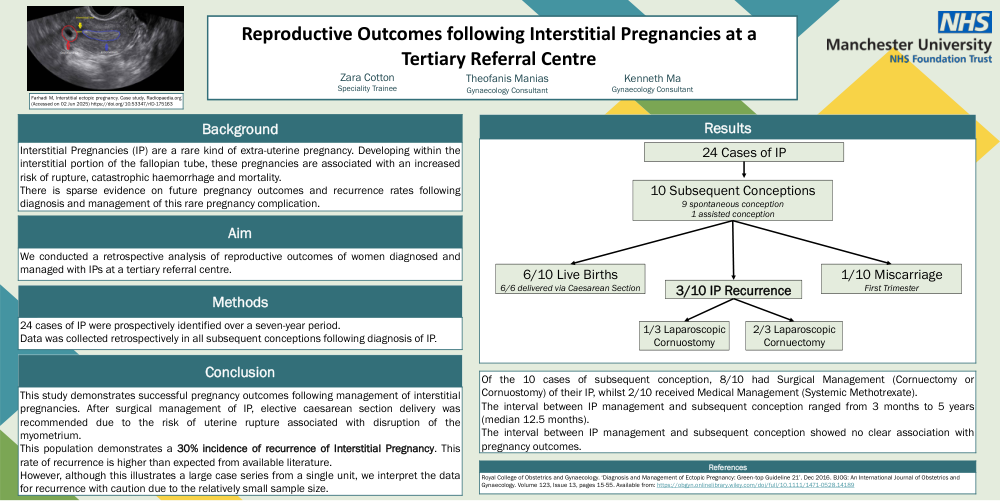
24 Cases of IP. 10 subsequent conceptions; 1/10 First trimester miscarriage, 6/10 delivered live births, 3/10 Recurrence of IP
Of the 10 cases of subsequent conception, 8/10 had Surgical Management (Cornuectomy or Cornuostomy) of their IP, whilst 2/10 received Medical Management (Systemic Methotrexate).
The interval between IP management and subsequent conception ranged from 3 months to 5 years (median 12.5 months).
The interval between IP management and subsequent conception showed no clear association with pregnancy outcomes.
Conclusion
This study demonstrates successful pregnancy outcomes following management of interstitial pregnancies. After surgical management of IP, elective caesarean section delivery was recommended due to the risk of uterine rupture associated with disruption of the myometrium.
This population demonstrates a 30% incidence of recurrence of Interstitial Pregnancy. This rate of recurrence is higher than expected from available literature.
However, although this illustrates a large case series from a single unit, we interpret the data for recurrence with caution due to the relatively small sample size.