2,281 posters, 63 videos, 56 audios, 43 topics, 18 sessions, 6,174 authors, 2,323 institutions
ePostersLive by SciGen Technologies S.A. All rights reserved.
RCOG World Congress 2025
June 23 - 25, 2025 | ExCeL London, UK
EP.1275
Uterine scar site rupture, a rare cause of secondary PPH-case report.
Part of Topic
Hot topics (emerging research/issues) in obstetrics
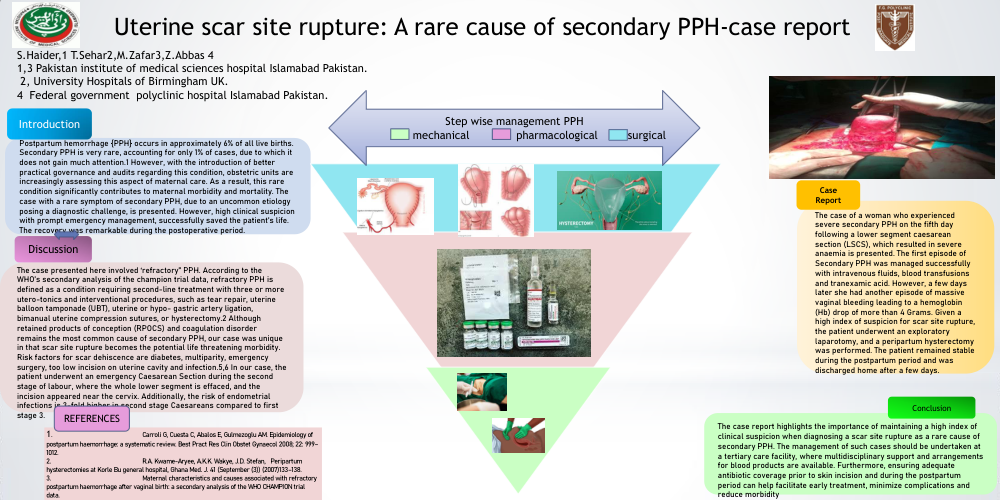
Uterine scar site rupture: A rare cause of secondary PPH-case report
S.Haider,1 T.Sehar2,M.Zafar1,Z.Abbas 3
1 Pakistan institute of medical sciences hospital Islamabad Pakistan. 2 University Hospitals of Birmingham UK. 3 Federal government polyclinic hospital Islamabad Pakistan
INTRODUCTION:
Postpartum hemorrhage {PPH} occurs in approximately 6% of all live births. Secondary PPH is very rare, accounting for only 1% of cases, due to which it does not gain much attention.1 However, with the introduction of better practical governance and audits regarding this condition, obstetric units are increasingly assessing this aspect of maternal care. As a result, this rare condition significantly contributes to maternal morbidity and mortality. The case with a rare symptom of secondary PPH, due to an uncommon etiology posing a diagnostic challenge, is presented. However, high clinical suspicion with prompt emergency management, successfully saved the patient’s life. The recovery was remarkable during the postoperative period.
CASE REPORT:
The case of a woman who experienced severe secondary PPH on the fifth day following a lower segment caesarean section (LSCS), which resulted in severe anaemia is presented. The first episode of Secondary PPH was managed successfully with intravenous fluids, blood transfusions and tranexamic acid. However, a few days later she had another episode of massive vaginal bleeding leading to a hemoglobin (Hb) drop of more than 4 Grams. Given a high index of suspicion for scar site rupture, the patient underwent an exploratory laparotomy, and a peripartum hysterectomy was performed. The patient remained stable during the postpartum period and was discharged home after a few days.
DISCUSSION:
The case presented here involved ‘refractory” PPH. According to the WHO’s secondary analysis of the champion trial data, refractory PPH is defined as a condition requiring second-line treatment with three or more utero-tonics and interventional procedures, such as tear repair, uterine balloon tamponade (UBT), uterine or hypo- gastric artery ligation, bimanual uterine compression sutures, or hysterectomy.2 Although retained products of conception (RPOCS) and coagulation disorder remains the most common cause of secondary PPH, our case was unique in that scar site rupture becomes the potential life threatening morbidity. Risk factors for scar dehiscence are diabetes, multiparity, emergency surgery, too low incision on uterine cavity and infection.5,6 In our case, the patient underwent an emergency Caesarean Section during the second stage of labour, where the whole lower segment is effaced, and the incision appeared near the cervix. Additionally, the risk of endometrial infections is 3-fold higher in second stage Caesareans compared to first stage 3.
CONCLUSION:
The case report highlights the importance of maintaining a high index of clinical suspicion when diagnosing a scar site rupture as a rare cause of secondary PPH. The management of such cases should be undertaken at a tertiary care facility, where multidisciplinary support and arrangements for blood products are available. Furthermore, ensuring adequate antibiotic coverage prior to skin incision and during the postpartum period can help facilitate early treatment, minimize complications and reduce morbidity