2,281 posters, 63 videos, 56 audios, 43 topics, 18 sessions, 6,174 authors, 2,323 institutions
ePostersLive by SciGen Technologies S.A. All rights reserved.
RCOG World Congress 2025
June 23 - 25, 2025 | ExCeL London, UK
EP.1269
Post-Caesarean Hospital Readmissions: A Study from a Single Tertiary Centre in UK
Poster Presenter
Authors
Ibtisam Salim, Javaria Malik, Roshni Patel, Alice Lessa, Rekha Remadevi, Assma Eshag
Affiliations
Part of Topic
Hot topics (emerging research/issues) in obstetrics
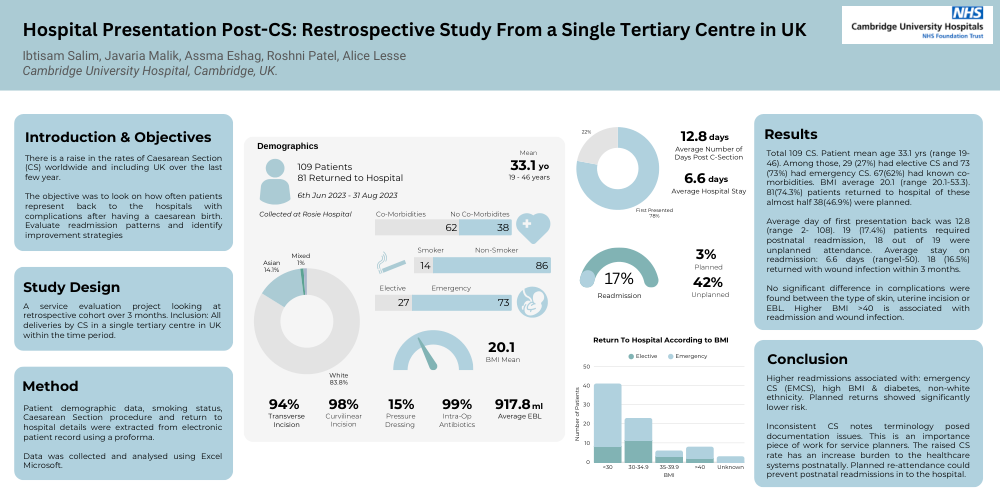
Hospital Presentation Post-CS: Restrospective Study From a Single Tertiary Centre in UK
Introduction & Objectives There is a raise in the rates of Caesarean Section (CS) worldwide and including UK over the last few year. The objective was to look on how often patients represent back to the hospitals with complications after having a caesarean birth. Evaluate readmission patterns and identify improvement strategies
Study Design: A service evaluation project looking at retrospective cohort over 3 months. Inclusion: All deliveries by CS in a single tertiary centre in UK within the time period.
Method: 62 38 14 86 Hospital Presentation Post-CS: Restrospective Study From a Single Tertiary Centre in UK Ibtisam Salim, Javaria Malik, Assma Eshag, Roshni Patel, Alice Lesse Cambridge University Hospital, Cambridge, UK. Study Design A service evaluation project looking at retrospective cohort over 3 months. Inclusion: All deliveries by CS in a single tertiary centre in UK within the time period.
Results: Total 109 CS. Patient mean age 33.1 yrs (range 19- 46). Among those, 29 (27%) had elective CS and 73 (73%) had emergency CS. 67(62%) had known comorbidities. BMI average 20.1 (range 20.1-53.3). 81(74.3%) patients returned to hospital of these almost half 38(46.9%) were planned. Average day of first presentation back was 12.8 (range 2- 108). 19 (17.4%) patients required postnatal readmission, 18 out of 19 were unplanned attendance. Average stay on readmission: 6.6 days (range1-50). 18 (16.5%) returned with wound infection within 3 months. No significant difference in complications were found between the type of skin, uterine incision or EBL. Higher BMI >40 is associated with readmission and wound infection.
Conclusions: Higher readmissions associated with: emergency CS (EMCS), high BMI & diabetes, non-white ethnicity. Planned returns showed significantly lower risk. Inconsistent CS notes terminology posed documentation issues. This is an importance piece of work for service planners. The raised CS rate has an increase burden to the healthcare systems postnatally. Planned re-attendance could prevent postnatal readmissions in to the hospital.