2,281 posters, 63 videos, 56 audios, 43 topics, 18 sessions, 6,174 authors, 2,323 institutions
ePostersLive by SciGen Technologies S.A. All rights reserved.
RCOG World Congress 2025
June 23 - 25, 2025 | ExCeL London, UK
EP.1268
Iatrogenicity during childbirth and obstetric violence
Poster Presenter
Part of Topic
Hot topics (emerging research/issues) in obstetrics
Iatrogenicity during childbirth and obstetric violence
Hadhami Rouiss, Soulaima Jenhani, Nesrine Souayah, Amira Lika(*), Ines Trabelsi(*), Chaouki Mbarki, Hajer Bettaieb
University of Tunis el Manar, Faculty of medicine, Gynecology and Obstetrics department, Ben Arous Regional Hospital, Tunis, Tunisia
(*)University of Tunis el Manar, Faculty of medicine, Department of anesthesiology and reanimation,, Ben Arous Regional Hospital, Tunis, Tunisia
Introduction :
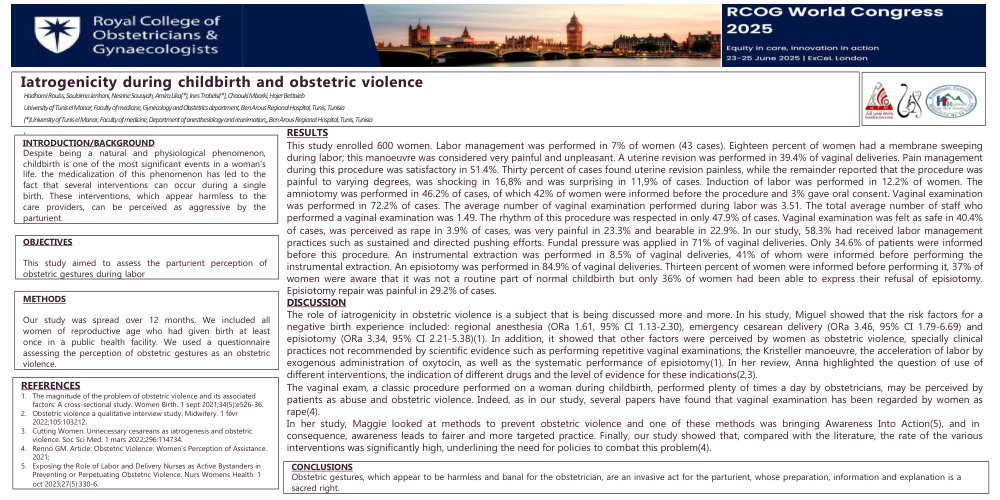
Despite being a natural and physiological phenomenon, childbirth is one of the most significant events in a woman's life. the medicalisation of this phenomenon has led to the fact that several interventions can occur during a single birth. These interventions, which appear harmless to the care providers, can be perceived as aggressive by the parturient.
Objective: to assess the parturient's perception of obstetric gestures during labour
Design: This was a descriptive, cross-sectional, multicentre study.
Methods: Our study was spread over 12 months. We included all women of reproductive age who had given birth at least once in a public health facility. We used a questionnaire assessing the perception of obstetric gestures as an obstetric violence.
Results:
This study enrolled 600 women. Labour management was performed in 7% of women (43 cases). Eighteen percent of women had a membrane sweeping during labour; this manoeuvre was considered very painful and unpleasant. A uterine revision was performed in 39.4% of vaginal deliveries. Pain management during this procedure was satisfactory in 51.4%. Thirty percent of cases found uterine revision painless, while the remainder reported that the procedure was painful to varying degrees, was shocking in 16,8% and was surprising in 11,9% of cases. Induction of labour was performed in 12.2% of women. The amniotomy was performed in 46.2% of cases, of which 42% of women were informed before the procedure and 3% gave oral consent. Vaginal examination was performed in 72.2% of cases. The average number of vaginal examination performed during labour was 3.51. The total average number of staff who performed a vaginal examination was 1.49. The rhythm of this procedure was respected in only 47.9% of cases. Vaginal examination was felt as safe in 40.4% of cases, was perceived as rape in 3.9% of cases, was very painful in 23.3% and bearable in 22.9%. In our study, 58.3% had received labor management practices such as sustained and directed pushing efforts. Fundal pressure was applied in 71% of vaginal deliveries. Only 34.6% of patients were informed before this procedure. An instrumental extraction was performed in 8.5% of vaginal deliveries, 41% of whom were informed before performing the instrumental extraction. An episiotomy was performed in 84.9% of vaginal deliveries. Thirteen percent of women were informed before performing it, 37% of women were aware that it was not a routine part of normal childbirth but only 36% of women had been able to express their refusal of episiotomy. Episiotomy repair was painful in 29.2% of cases.
Disussion
The role of iatrogenicity in obstetric violence is a subject that is being discussed more and more. In his study, Miguel showed that the risk factors for a negative birth experience included: regional anaesthesia (ORa 1.61, 95% CI 1.13-2.30), emergency secarean delivery (ORa 3.46, 95% CI 1.79-6.69) and episiotomy (ORa 3.34, 95% CI 2.21-5.38)(1). In addition, it showed that other factors were perceived by women as obstetric violence, specially clinical practices not recommended by scientific evidence such as performing repetitive vaginal examinations, the Kristeller manoeuvre, the acceleration of labour by exogenous administration of oxytocin, as well as the systematic performance of episiotomy(1). In her review, Anna highlighted the question of use of different interventions, the indication of different drugs and the level of evidence for these indications(2,3).
The vaginal exam, a classic procedure performed on a woman during childbirth, performed plenty of times a day by obstetricians, may be perceived by patients as abuse and obstetric violence. Indeed, as in our study, several papers have found that vaginal examination has been regarded by women as rape(4).
In her study, Maggie looked at methods to prevent obstetric violence and one of these methods was bringing Awareness Into Action(5), and in consequence, awareness leads to fairer and more targeted practice. Finally, our study showed that, compared with the literature, the rate of the various interventions was significantly high, underlining the need for policies to combat this problem(4).
Conclusions:
Obstetric gestures, which appear to be harmless and banal for the obstetrician, are an invasive act for the parturient, whose preparation, information and explanation is a sacred right.
Références
1. The magnitude of the problem of obstetric violence and its associated factors: A cross-sectional study. Women Birth. 1 sept 2021;34(5):e526‑36.
2. Obstetric violence a qualitative interview study. Midwifery. 1 févr 2022;105:103212.
3. Cutting Women: Unnecessary cesareans as iatrogenesis and obstetric violence. Soc Sci Med. 1 mars 2022;296:114734.
4. Rennó GM. Article: Obstetric Violence: Women’s Perception of Assistance. 2021;
5. Exposing the Role of Labor and Delivery Nurses as Active Bystanders in Preventing or Perpetuating Obstetric Violence. Nurs Womens Health. 1 oct 2023;27(5):330‑6.