2,281 posters, 63 videos, 56 audios, 43 topics, 18 sessions, 6,174 authors, 2,323 institutions
ePostersLive by SciGen Technologies S.A. All rights reserved.
RCOG World Congress 2025
June 23 - 25, 2025 | ExCeL London, UK
EP.1267
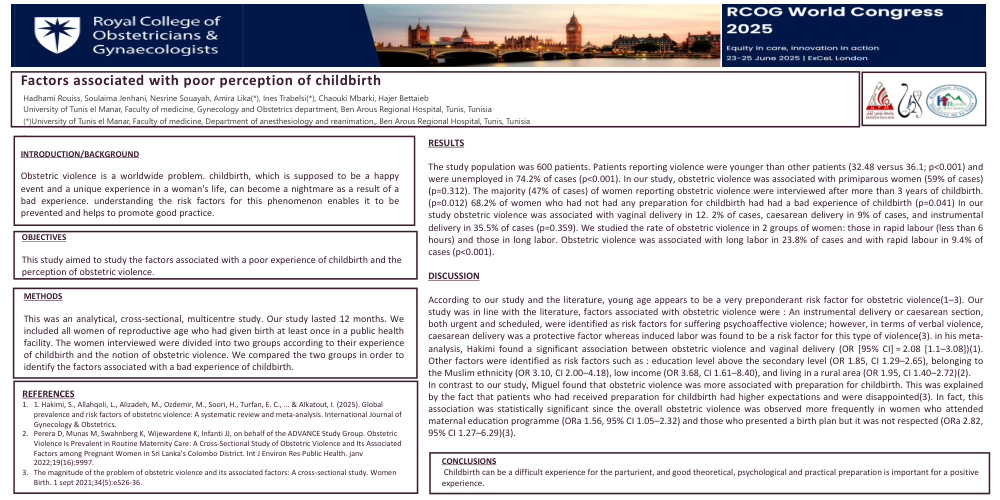
Factors associated with poor perception of childbirth
Poster Presenter
Part of Topic
Hot topics (emerging research/issues) in obstetrics
Factors associated with poor perception of childbirth
Hadhami Rouiss, Soulaima Jenhani, Nesrine Souayah, Amira Lika(*), Ines Trabelsi(*), Chaouki Mbarki, Hajer Bettaieb
University of Tunis el Manar, Faculty of medicine, Gynecology and Obstetrics department, Ben Arous Regional Hospital, Tunis, Tunisia
(*)University of Tunis el Manar, Faculty of medicine, Department of anesthesiology and reanimation,, Ben Arous Regional Hospital, Tunis, Tunisia
Introduction :
obstetric violence is a worldwide problem. childbirth, which is supposed to be a happy event and a unique experience in a woman's life, can become a nightmare as a result of a bad experience. understanding the risk factors for this phenomenon enables it to be prevented and helps to promote good practice.
Objective: To study the factors associated with a poor experience of childbirth and the perception of obstetric violence.
Design: This was an analytical, cross-sectional, multicentre study.
Method: Our study lasted 12 months. We included all women of reproductive age who had given birth at least once in a public health facility. The women interviewed were divided into two groups according to their experience of childbirth and the notion of obstetric violence. We compared the two groups in order to identify the factors associated with a bad experience of childbirth.
Results:
The study population was 600 patients. Patients reporting violence were younger than other patients (32.48 versus 36.1; p<0.001) and were unemployed in 74.2% of cases (p<0.001). In our study, obstetric violence was associated with primiparous women (59% of cases) (p=0.312). The majority (47% of cases) of women reporting obstetric violence were interviewed after more than 3 years of childbirth. (p=0.012) 68.2% of women who had not had any preparation for childbirth had had a bad experience of childbirth (p=0.041) In our study obstetric violence was associated with vaginal delivery in 12. 2% of cases, caesarean delivery in 9% of cases, and instrumental delivery in 35.5% of cases (p=0.359). We studied the rate of obstetric violence in 2 groups of women: those in rapid labour (less than 6 hours) and those in long labour. Obstetric violence was associated with long labour in 23.8% of cases and with rapid labour in 9.4% of cases (p<0.001).
Discussion :
According to our study and the literature, young age appears to be a very preponderant risk factor for obstetric violence(1–3). Our study was in line with the literature, factors associated with obtetric violence were : An instrumental delivery or caesarean section, both urgent and scheduled, were identified as risk factors for suffering psychoaffective violence; however, in terms of verbal violence, caesarean delivery was a protective factor whereas induced labour was found to be a risk factor for this type of violence(3). in his meta-analysis, Hakimi found a significant association between obstetric violence and vaginal delivery (OR [95% CI] = 2.08 [1.1–3.08])(1). Other factors were identified as risk factors such as : education level above the secondary level (OR 1.85, CI 1.29–2.65), belonging to the Muslim ethnicity (OR 3.10, CI 2.00–4.18), low income (OR 3.68, CI 1.61–8.40), and living in a rural area (OR 1.95, CI 1.40–2.72)(2).
In contrast to our study, Miguel found that obstetric violence was more associated with preparation for childbirth. This was explained by the fact that patients who had received preparation for childbirth had higher expectations and were disappointed(3). In fact, this association was statiticallly significant since the overall obstetric violence was observed more frequently in women who attended maternal education programme (ORa 1.56, 95% CI 1.05–2.32) and those who presented a birth plan but it was not respected (ORa 2.82, 95% CI 1.27–6.29)(3).
Conclusion:
Childbirth can be a difficult experience for the parturient, and good theoretical, psychological and practical preparation is important for a positive experience.
Références :
1. Hakimi, S., Allahqoli, L., Alizadeh, M., Ozdemir, M., Soori, H., Turfan, E. C., ... & Alkatout, I. (2025). Global prevalence and risk factors of obstetric violence: A systematic review and meta‐analysis. International Journal of Gynecology & Obstetrics.
2. Perera D, Munas M, Swahnberg K, Wijewardene K, Infanti JJ, on behalf of the ADVANCE Study Group. Obstetric Violence Is Prevalent in Routine Maternity Care: A Cross-Sectional Study of Obstetric Violence and Its Associated Factors among Pregnant Women in Sri Lanka’s Colombo District. Int J Environ Res Public Health. janv 2022;19(16):9997.
3. The magnitude of the problem of obstetric violence and its associated factors: A cross-sectional study. Women Birth. 1 sept 2021;34(5):e526‑36.