2,281 posters, 63 videos, 56 audios, 43 topics, 18 sessions, 6,174 authors, 2,323 institutions
ePostersLive by SciGen Technologies S.A. All rights reserved.
RCOG World Congress 2025
June 23 - 25, 2025 | ExCeL London, UK
EP.1261
Impact of heat on pregnancy outcomes- secondary analysis of Demographic Surveys Pakistan
Poster Presenter
Part of Topic
Hot topics (emerging research/issues) in obstetrics
Audio
Impact of heat on pregnancy outcomes- a secondary analysis of Demographic and Health Surveys (DHS) of Pakistan
Shehla M.Baqai, Farid Midhet, Fouzia Effendi Contact shehlabaqai15@gmail.com
Bahria University Health Sciences Karachi
Objective:
To investigate the impact of rising ambient temperature on pregnancy outcomes in Pakistan over a 25year period (1991-2017).
Research design:
We conducted a secondary analysis of the Pakistan DHS data from 1991, 2006 and 2017 (three rounds) and Pakistan Maternal Mortality Survey 2019.
Methods:
A secondary analysis of Pakistan Demographic and Health Survey (PDHS) data from 1991, 2006, and 2017. The study investigated the impact of rising ambient temperatures on pregnancy outcomes over a 25-year period. Pakistan Maternal Mortality Survey 2019 (PMMS) data on neonatal outcomes such as stillbirths, preterm births, and preeclampsia symptoms were analyzed in relation to seasonal and geographic heat exposure.
Results:
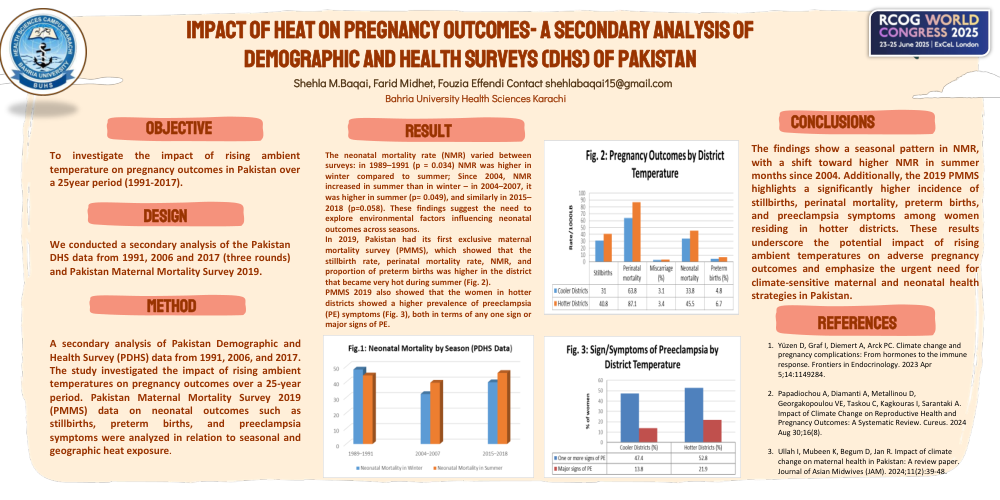
The neonatal mortality rate (NMR) varied between surveys: in 1989–1991 (p = 0.034) NMR was higher in winter compared to summer; Since 2004, NMR increased in summer than in winter – in 2004–2007, it was higher in summer (p= 0.049), and similarly in 2015–2018 (p=0.058). These findings suggest the need to explore environmental factors influencing neonatal outcomes across seasons.
In 2019, Pakistan had its first exclusive maternal mortality survey (PMMS), which showed that the stillbirth rate, perinatal mortality rate, NMR, and proportion of preterm births was higher in the district that became very hot during summer (Fig. 2).
PMMS 2019 also showed that the women in hotter districts showed a higher prevalence of preeclampsia (PE) symptoms (Fig. 3), both in terms of any one sign or major signs of PE.