2,281 posters, 63 videos, 56 audios, 43 topics, 18 sessions, 6,174 authors, 2,323 institutions
ePostersLive by SciGen Technologies S.A. All rights reserved.
RCOG World Congress 2025
June 23 - 25, 2025 | ExCeL London, UK
EP.1260
Screening of pregnant woman for perinatal depression within antenatal care
Poster Presenter
Authors
SHAHERZAD SOHAIL, Ayesha Shahid, Nazli Hameed, Maryam Khalid
Affiliations
Part of Topic
Hot topics (emerging research/issues) in obstetrics
Screening of Pregnant women for Perinatal Depression within Antenatal Care
Dr. Shaherzad Sohail , Prof. Dr. Nazli Hameed,Dr. Ayesha, Dr. Mariam Khalid
Introduction:
Pregnancy and the postnatal periods are psychologically distressing times for women due to large and varied range of physiological changes that are associated with these processes.[1] Unless dealt with in a timely manner, such distressing periods are likely to culminate in the development of life-long mental illnesses.
Globally maternal mental health problems are considered as a major public health challenge .Mental health is a state of mental well-being that enables people to cope with the stresses of life, realize their abilities, learn well and work well, and contribute to their community.
Unfortunately, despite being highly prevalent, maternal mental health problems remain significantly under-recognized and therefore under-treated.[2]
Improving mental health of women should be one of the top priorities of any nation. Depressive disorders are ranked fourth in terms of global burden of disease. It is estimated that 10–15% of women in developed countries and 20–40% of women in developing countries experience depression during pregnancy or after childbirth.[3] Although the worldwide prevalence of postnatal depression is around 13%, it stands between 28-63% in the Pakistani women.[4]
Women maternal mental health is deserving of special and urgent attention here in Pakistan. There is a dire need to develop appropriate protocols for early identification, treatment and prevention of adverse effects of antenatal depression particularly in low resource settings.
In our department we want to establish proper protocol for evaluation of women at risk of antenatal depression. So, we conducted this study to screen the women by using EPDS and to identify the risk factors responsible for the development of depression.
Objective:
The overarching goals of this study are as follows:
-
Screening woman in antenatal clinic for perinatal depression.
-
Identify potential risk factors for perinatal depression
Study Design: Cross-sectional study
Study Duration: 6 months : October 2024 – March 2025
Ethical Approval: SMDC-IRB/AL/2024-115
Inclusion Criteria: All Pregnant women age between 18 to 40 years presenting for antenatal care between 12 to 32 weeks of gestation coming to antenatal clinic during the study period.
Exclusion Criteria:Women diagnosed with psychotic illnesses, receiving antidepressants, benzodiazepines, mood stabilizers and anti-epileptic medications, or those who have poor pregnancy outcome in current pregnancy like intrauterine death or lethal congenital abnormality in foetus.
Scales : Whooley Questionnaire and Edinburgh Postnatal Depression Scale (EPDS)
-
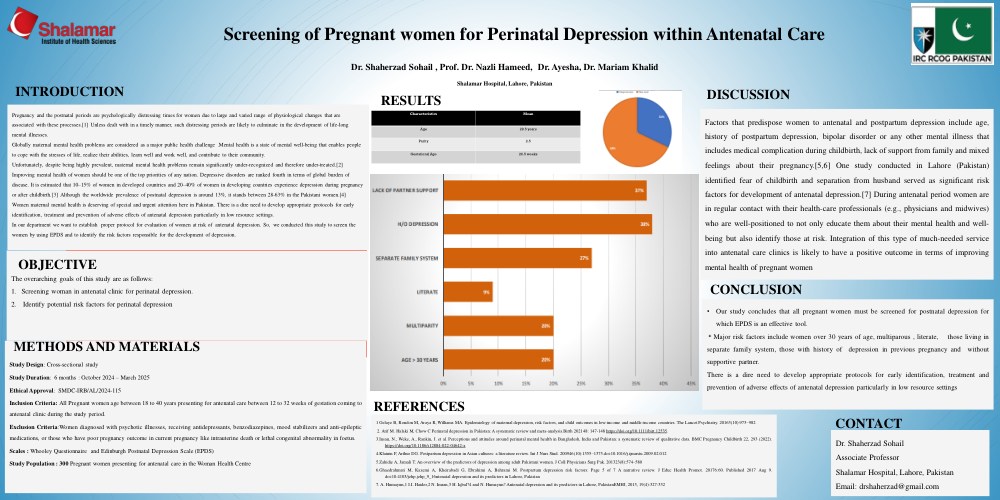
Our study concludes that all pregnant women must be screened for postnatal depression for which EPDS is an effective tool.
▪ Major risk factors include women over 30 years of age, multiparous , literate, those living in separate family system, those with history of depression in previous pregnancy and without supportive partner.
There is a dire need to develop appropriate protocols for early identification, treatment and prevention of adverse effects of antenatal depression particularly in low resource settings.