2,281 posters, 63 videos, 56 audios, 43 topics, 18 sessions, 6,174 authors, 2,323 institutions
ePostersLive by SciGen Technologies S.A. All rights reserved.
RCOG World Congress 2025
June 23 - 25, 2025 | ExCeL London, UK
EP.1256
Mentzer Index: Diagnosing Iron Deficiency Anemia and Beta Thalassemia in Pregnancy
Poster Presenter
Part of Topic
Hot topics (emerging research/issues) in obstetrics
Mentzer Index: Diagnosing Iron Deficiency Anemia and Beta Thalassemia in Pregnancy
Objectives:
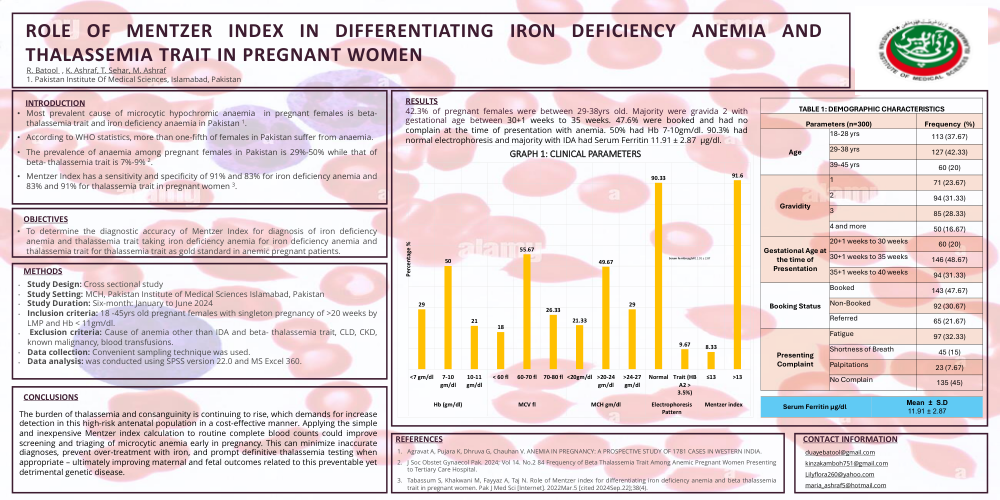
This study aims to assess the diagnostic accuracy of the Mentzer Index in differentiating iron deficiency anemia and beta-thalassemia trait in anemic pregnant women, conditions prevalent in Pakistan. Leveraging its high sensitivity and specificity (91%/83% for iron deficiency anemia; 83%/91% for beta-thalassemia), the index serves as a reliable diagnostic tool.
Design:
This is a cross-sectional, analytical study aimed at evaluating the diagnostic accuracy of the Mentzer Index in differentiating iron deficiency anemia (IDA) and beta-thalassemia trait among anemic pregnant women. The study involves data collection at a single point in time from a defined population to assess the prevalence and diagnostic parameters of interest. It utilizes a convenient sampling technique for participant selection and statistical analysis to determine the sensitivity and specificity of the Mentzer Index.
Methodology:
This cross-sectional study was conducted at the Maternal and Child Health Department, PIMS, Islamabad, over six months (January to June 2024). It included pregnant women aged 18-45 years with singleton pregnancies beyond 20 weeks and hemoglobin levels below 11 g/dL. Exclusion criteria comprised anemia due to conditions other than iron deficiency anemia or beta-thalassemia trait, chronic liver or kidney disease, malignancies, or prior blood transfusions. Data were collected using a convenient sampling technique and analyzed with SPSS version 22.0 and MS Excel 360.
Results:
The study revealed that 42.3% of pregnant women were aged 29-38 years, with most being gravida 2 and presenting between 30+1 to 35 weeks of gestation. Nearly half (47.6%) were booked patients, and 45% had no complaints, though fatigue (32.33%) was common. Hemoglobin levels ranged from 7-10 g/dL in 50% of cases, with 55.67% having MCV between 60-70 fl and 49.67% showing MCH of 20-24 g/dL. Electrophoresis showed 90.33% normal results, with 9.67% indicating beta-thalassemia trait. The Mentzer Index >13 in 91.6% confirmed iron deficiency anemia as the predominant condition and Mentzer Index <13 confirmed beta thalassemia.
Conclusion:
The burden of thalassemia and consanguinity is continuing to rise, which demands for increase detection in this high-risk antenatal population in a cost-effective manner. Applying the simple and inexpensive Mentzer index calculation to routine complete blood counts could improve screening and triaging of microcytic anemia early in pregnancy. This can minimize inaccurate diagnoses, prevent over-treatment with iron, and prompt definitive thalassemia testing when appropriate – ultimately improving maternal and fetal outcomes related to this preventable yet detrimental genetic disease.