2,281 posters, 63 videos, 56 audios, 43 topics, 18 sessions, 6,174 authors, 2,323 institutions
ePostersLive by SciGen Technologies S.A. All rights reserved.
RCOG World Congress 2025
June 23 - 25, 2025 | ExCeL London, UK
EP.1250
Complex relationship between the cervicovaginal environment, BMI and spontaneous preterm birth.
Poster Presenter
Part of Topic
Hot topics (emerging research/issues) in obstetrics
Network analysis reveals a complex relationship between the cervicovaginal
environment, body mass index (BMI), and spontaneous preterm birth (SPTB)
-
Flavia Flaviani2, Amirah Mohd Zaki1, Alicia Hadingham1, Jia Dai Mi1, Victoria Horrocks3, Natasha Hezelgrave1, Natalie Suff1, Paul Seed1, Andrew Shennan1, A. James Mason3, Rachel M. Tribe1
1Dept.of Women and Children’s Health, 2Dept. of Gene Therapy and Regenerative, and 3Institute of Pharmaceutical Science, King’s College London, London, United Kingdom.
Introduction
Studies report an association between vaginal health (Lactobacillus crispatus dominance) with term pregnancy, and a diverse microbiome or L. iners with SPTB [1-7]. However, some women who deliver at term (often those reporting African ancestry) present with a diverse microbiota/L iners dominance regardless of pregnancy outcome. A more in-depth investigation of the vaginal environment and clinical phenotyping is needed.
We interrogated the complex relationship between the cervico-vaginal fluid (CVF) metagenome, metabolome, inflammatory markers, BMI, and SPTB using network analysis. We undertook a validation study of our metabolite-based biomarker test for prediction of SPTB [1].
Results Network analyses
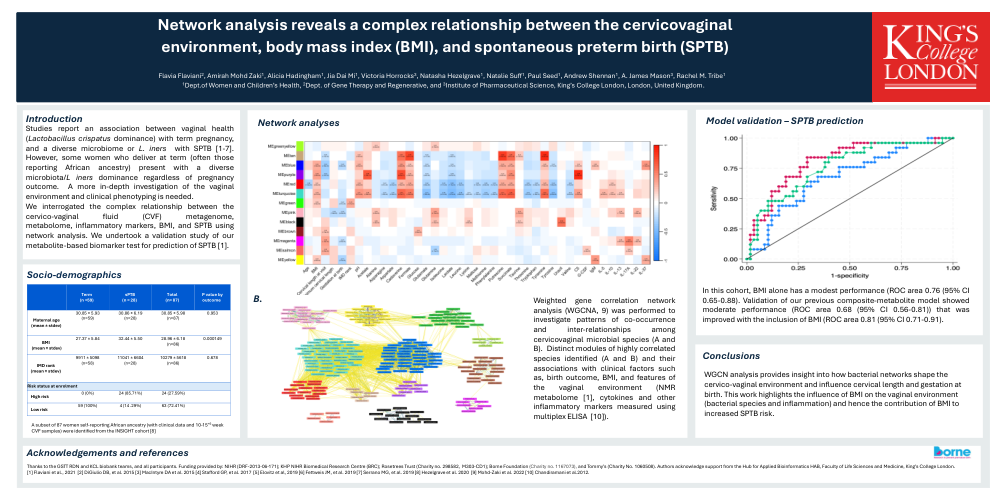
Weighted gene correlation network analysis (WGCNA, 9) was performed to investigate patterns of co-occurrence and inter-relationships among cervicovaginal microbial species (A and B). Distinct modules of highly correlated species identified (A and B) and their associations with clinical factors such as, birth outcome, BMI, and features of the vaginal environment (NMR metabolome [1], cytokines and other inflammatory markers measured using multiplex ELISA [10]).
Model validation – SPTB prediction
In this cohort, BMI alone has a modest performance (ROC area 0.76 (95% CI 0.65-0.88). Validation of our previous composite-metabolite model showed moderate performance (ROC area 0.68 (95% CI 0.56-0.81)) that was improved with the inclusion of BMI (ROC area 0.81 (95% CI 0.71-0.91).
Conclusions
WGCN analysis provides insight into how bacterial networks shape the cervico-vaginal environment and influence cervical length and gestation at birth. This work highlights the influence of BMI on the vaginal environment (bacterial species and inflammation) and hence the contribution of BMI to increased SPTB risk.
Acknowledgements and References
Thanks to the GSTT RDN and KCL biobank teams, and all participants. Funding provided by: NIHR (DRF-2013-06-171); KHP NIHR Biomedical Research Centre (BRC); Rosetrees Trust (Charity no. 298582, M303-CD1); Borne Foundation (Charity no. 1167073), and Tommy’s (Charity No. 1060508). Authors acknowledge support from the Hub for Applied Bioinformatics HAB, Faculty of Life Sciences and Medicine, King’s College London.
[1] Flaviani et al., 2021 [2] DiGiulio DB, et al. 2015 [3] MacIntyre DA et al. 2015 [4] Stafford GP, et al. 2017 [5] Elovitz et al, 2019 [6] Fettweis JM, et al. 2019 [7] Serrano MG, et al. 2019 [8] Hezelgrave et al. 2020 [9] Mohd-Zaki et al. 2022 [10] Chandiramani et al.2012.