2,281 posters, 63 videos, 56 audios, 43 topics, 18 sessions, 6,174 authors, 2,323 institutions
ePostersLive by SciGen Technologies S.A. All rights reserved.
RCOG World Congress 2025
June 23 - 25, 2025 | ExCeL London, UK
PP.0064
Learning from Obstetric Anal Sphincter Injury Claims within the NHS in England
Part of Topic
Hot topics (emerging research/issues) in obstetrics
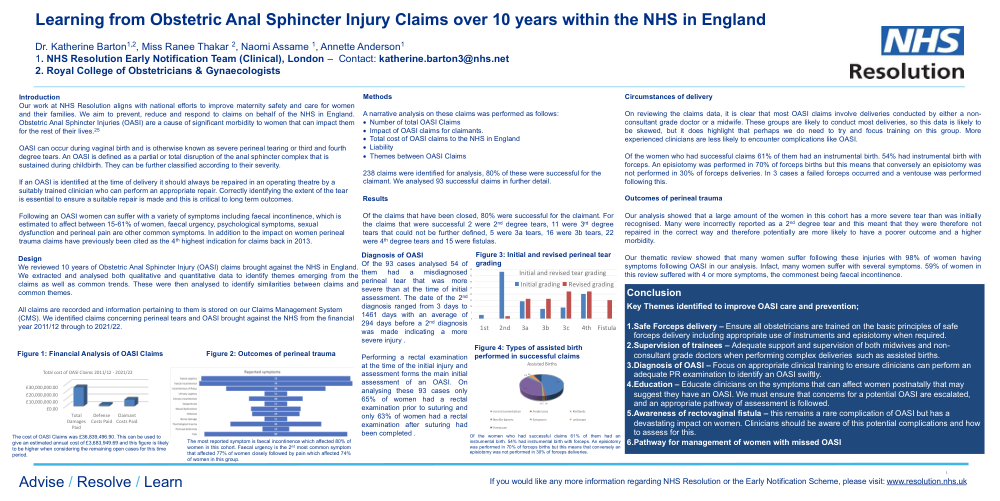
Objective: Identification of themes for all OASI and perineal tear claims brought against the NHS in England over a 10-year period. These themes were evaluated to identify areas of future focus to allow us to improve the health and experience of women suffering with an OASI.
Obstetric anal sphincter injury (OASI) can occur during childbirth, most are diagnosed and repaired at the time of injury. But for some women they can cause significant distressing symptoms.
Design: All OASI and perineal tear claims brought against the NHS in England between the financial years of 2011/12 and 2021/22 that were notified to NHS Resolution were reviewed. We performed a narrative analysis on these claims using qualitative and quantitative data and examined the costs, themes, and impact OASI had on the women.
Method: We identified 238 claims for further analysis. Of these, 38 were closed with no damages paid, and 149 were closed with damages paid. 51 claims were open and, therefore, were not analysed any further. We analysed in detail 93 claims that were submitted after 1 January 2017.
Results: Many women presented with symptoms in the postnatal period but experienced a delay in diagnosis with the average being 294 days. The most reported symptom these women experienced following OASI was faecal incontinence (80%.) Faecal urgency is the 2nd most common symptom (77%) closely followed by perineal pain (74%.) Of the women who brought claims where damages were paid 61% had an assisted vaginal birth (54% had a forceps birth). An episiotomy was performed in 70% of forceps births. 65% of women had a rectal examination prior to suturing and 63% post suturing.
The total cost of OASI Claims during this time was £36.8 million This figure does not include additional investigations, treatment and hospital stays meaning the economic burden of OASI is significantly higher. In 39% of cases the claim pertained to failure to diagnose an OASI.
Conclusion: Training of healthcare professionals to assess the perineum and perform a digital rectal examination remains the main way to ensure that OASI is detected following delivery. Further training is needed to ensure earlier detection of OASI as an earlier primary repair leads to better long-term outcomes. OASI is a significant risk factor for the development of anal incontinence, which has an impact on quality of life and has significant medicolegal implications and contributes greatly to healthcare costs