2,281 posters, 63 videos, 56 audios, 43 topics, 18 sessions, 6,174 authors, 2,323 institutions
ePostersLive by SciGen Technologies S.A. All rights reserved.
RCOG World Congress 2025
June 23 - 25, 2025 | ExCeL London, UK
EP.0124
Ginger for pregnancy: A GRADE-assessed systematic review and meta-analysis of clinical trials.
Poster Presenter
Part of Topic
Early pregnancy complications/early pregnancy and acute gynaecology
Ginger for pregnancy: A GRADE-assessed systematic review and meta-analysis of clinical trials
Authors: Yassin M. El-Shnawy1, Yomna W. Mahmoud1, Mohamed Ramadan S.1, Nader Y. Khalafallah1, Mariam S. Abdulhafiz1, Yara Ali Eltobgi1, Omar Gamal H.1
1 = Kasr al Ainy Faculty of Medicine, Cairo University, Cairo, Egypt
BACKGROUND & OBJECTIVE:
Ginger (Zingiber officinale) is a flowering plant; its root is widely used as a food spice and is believed to have many therapeutic effects. To evaluate the therapeutic benefits of ginger in alleviating symptoms of nausea and vomiting of pregnancy, reducing postpartum pain and improving glycemic control in gestational diabetes mellitus (GDM).
METHODOLOGY:
This review was conducted according to the Preferred Reporting Items for Systematic reviews and Meta-Analyses (PRISMA) guidelines. PubMed, Scopus, Cochrane Library and Google Scholar were searched for clinical trials evaluating the efficacy of ginger in nausea and vomiting of pregnancy, postpartum pain and GDM. Nausea score, vomiting score, combined nausea and vomiting score, fasting blood sugar, blood sugar 2 hours post-prandial, insulin reduction and pain score were used in meta-analysis and represented by forest plots. Outcomes not suitable for meta-analysis were qualitatively analyzed and summarized.
RESULTS:
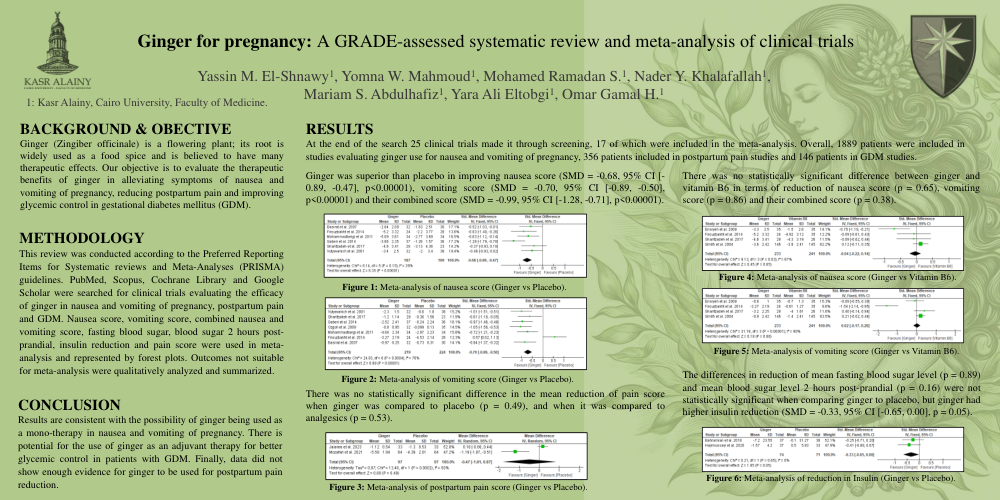
From the four databases searched 371 records were identified. After title and abstract screening, then duplicates removal and finally full-text screening only 25 clinical trials were selected, 17 of which were included in the meta-analysis. 9 studies had a low risk of bias, 5 studies had some concerns and 11 studies had a high risk of bias. Overall, 1889 patients were included in studies evaluating ginger use for nausea and vomiting of pregnancy, 356 patients included in postpartum pain studies and 146 patients in GDM studies. Ginger was superior than placebo in improving nausea score (SMD = -0.68, 95% CI [-0.89, -0.47], p<0.00001), vomiting score (SMD = -0.70, 95% CI [-0.89, -0.50], p<0.00001) and their combined score (SMD = -0.99, 95% CI [-1.28, -0.71], p<0.00001). There was no statistically significant difference between ginger and vitamin B6 in terms of reduction of nausea score (p = 0.65), vomiting score (p = 0.86) and their combined score (p = 0.38). There was no statistically significant difference in the mean reduction of pain score when ginger was compared to placebo (p = 0.49), and when it was compared to analgesics (p = 0.53). The difference in reduction of mean fasting blood sugar level (p = 0.89) and mean blood sugar level 2 hours post-prandial (p = 0.16) was not statistically significant when comparing ginger to placebo, but ginger had higher insulin reduction (SMD = -0.33, 95% CI [-0.65, 0.00], p = 0.05).
CONCLUSION:
Results suggest the possibility of ginger being used as a mono-therapy in nausea and vomiting of pregnancy. There is potential for the use of ginger as an adjuvant therapy for better glycemic control in patients with GDM. Finally, data did not show enough evidence for ginger to be used for postpartum pain reduction.