2,281 posters, 63 videos, 56 audios, 43 topics, 18 sessions, 6,174 authors, 2,323 institutions
ePostersLive by SciGen Technologies S.A. All rights reserved.
RCOG World Congress 2025
June 23 - 25, 2025 | ExCeL London, UK
EP.1238
Endocrine disrupting chemicals in Pregnancy and correlation with household and cooking Products
Poster Presenter
Part of Topic
Hot topics (emerging research/issues) in obstetrics
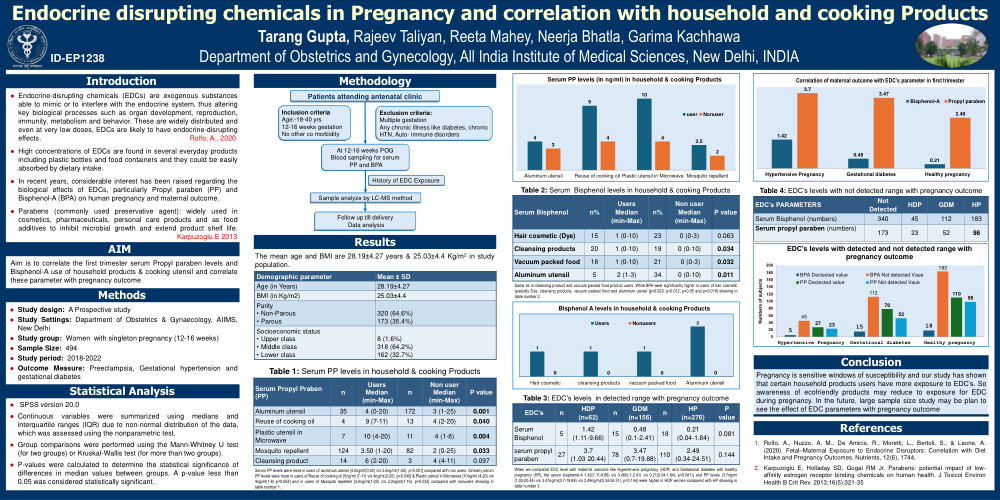
Objective - Endocrine-disrupting chemicals (EDCs) are exogenous substances able to mimic or to interfere with the endocrine system, thus altering key biological processes such as organ development, reproduction, immunity, metabolism and behavior. High concentrations of EDCs are found in several everyday products including plastic bottles and food containers and they could be easily absorbed by dietary intake. In recent years, considerable interest has been raised regarding the biological effects of EDCs, particularly Propyl prabean (PP) and Bisphenol-A (BPA) on human pregnancy and maternal outcome. Aim is to correlate the first trimester serum PP levels and use of household products & cooking utensil and correlate first trimester BPA and PP with pregnancy outcome.
Design: A prospective study
Methods- This study is carried in department of Obstetrics & Gynaecology, AIIMS and New Delhi. Total 494 pregnant women were recruited, Serum PP and BPA were measured at 12-16 weeks of gestation by Liquid chromatography- mass spectroscopy (LC-Ms) method in BITS Pilani, Rajasthan and these women followed till delivery to get maternal outcome. Women who use household products (like- Mosquito repellent), cooking utensil (like aluminium Pressure cooker, reuse cooking oil), plastic uses in Microwave and Aluminium utensil) Users will compared with Not User women
Results- The mean age and BMI are 28.19±4.27 years & 25.03±4.4 Kg/M2. Serum PP levels were more in users of aluminum utensil [4.0ng/ml(0-20) vs 3.0ng/ml(1-25), p=0.011] compared with non users. Similarly serum PP levels were more in users of Reuse of cooking oil [9ng/ml (7-11) vs 4ng/ml(2-20), p=0.015] & Plastic utensil in Microwave [10ng/ml(4-20) vs 4ng/ml(1-8) p=0.004] and in users of Mosquito repellent [4.0ng/ml(1-20) vs 2.0ng/ml(1-19), p=0.033] compared with nonusers. Same as in cleansing product and vacuum packed food product users. While BPA were significantly higher in users of hair cosmetic, cleansing products, vacuum packed food and aluminum utensil [p=0.029, p=0.012, p=0.05 and p=0.019]. When we compared EDC level with maternal outcome like Hypertensive pregnancy (HDP) and Gestational diabetes with healthy pregnancy (HP), the serum bisphenol-A 1.42(1.11-9.66)vs0.48(0.1-2.41) v/s 0.21(0.04-1.84); p=0.081)) and PP levels (3.7ng/ml(1.03-20.44)vs 3.47ng/ml(0.7-19.88) v/s 2.49ng/ml(0.34-24.51); p=0.144) were higher in HDP women compared with HP.
Conclusion- Pregnancy is sensitive windows of susceptibility and our study has shown that certain household products users have more exposure to EDC’s. So awareness of ecofriendly products may reduce to exposure for EDC during pregnancy. In the future, large sample size study may be planning to see the effect of EDC parameters with pregnancy outcome.