2,281 posters, 63 videos, 56 audios, 43 topics, 18 sessions, 6,174 authors, 2,323 institutions
ePostersLive by SciGen Technologies S.A. All rights reserved.
RCOG World Congress 2025
June 23 - 25, 2025 | ExCeL London, UK
EP.1235
Who is Birthing Outside of Clinical Guidance?
Poster Presenter
Part of Topic
Hot topics (emerging research/issues) in obstetrics
Objectives
Background
Legislation in the UK fully supports women’s choices during pregnancy, including their right to decline treatment, or have care outside of guidelines1. However, Maternity and Newborn Safety Investigations (MNSI) have recently identified that birthing outside of guidance is a key theme in multiple investigations which they have undertaken2. Some of the reasons for this include lack of guidance for staff, lack of individualised care plans for patients, lack of discussion around “acceptable limits of care” and pregnant women not fully understanding the risks associated with the choices they were making.
Many reasons have been suggested as to why women may choose to birth outside of guidelines, including birth trauma, over-reliance on clinical guidelines as opposed to considering the woman as a whole3, fear and anxiety around over-medicalisation2.
Methodology
Patients for this project were identified by the personalised care midwife. We identified over a three-month period, between July and September 2024, to gather a significant number of participants. Once the patients had been identified, the electronic maternity records system, Badgernet, was used to gain further information regarding the women. The data was then analysed using a mixture of content and thematic analysis to determine patterns and common themes within the data.
Results
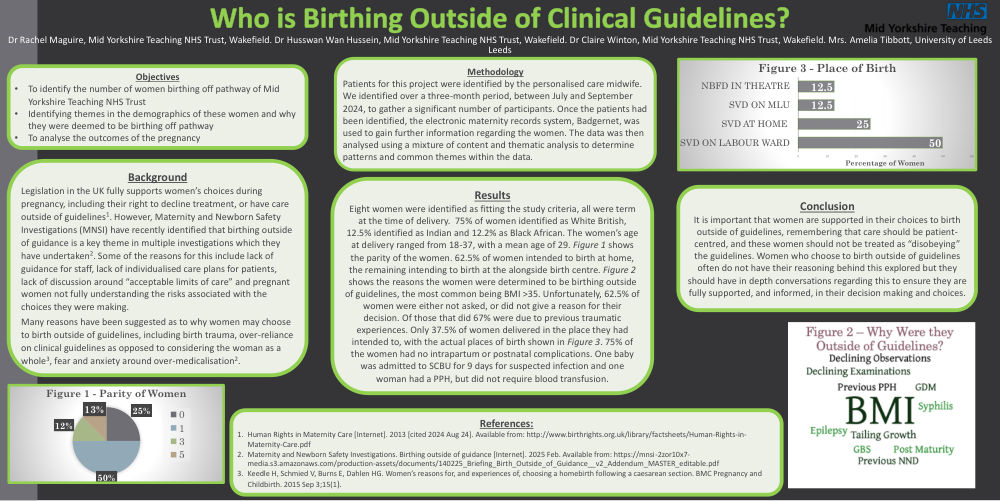
Eight women were identified as fitting the study criteria, all were term at the time of delivery. 75% of women identified as White British, 12.5% identified as Indian and 12.2% as Black African. The women’s age at delivery ranged from 18-37, with a mean age of 29. Figure 1 shows the parity of the women. 62.5% of women intended to birth at home, the remaining intending to birth at the alongside birth centre. Figure 2 shows the reasons the women were determined to be birthing outside of guidelines, the most common being BMI >35. Unfortunately, 62.5% of women were either not asked, or did not give a reason for their decision. Of those that did 67% were due to previous traumatic experiences. Only 37.5% of women delivered in the place they had intended to, with the actual places of birth shown in Figure 3. 75% of the women had no intrapartum or postnatal complications. One baby was admitted to SCBU for 9 days for suspected infection and one woman had a PPH, but did not require blood transfusion.
Conclusion
It is important that women are supported in their choices to birth outside of guidelines, remembering that care should be patient-centred, and these women should not be treated as “disobeying” the guidelines. Women who choose to birth outside of guidelines often do not have their reasoning behind this explored but they should have in depth conversations regarding this to ensure they are fully supported, and informed, in their decision making and choices.
References: