2,281 posters, 63 videos, 56 audios, 43 topics, 18 sessions, 6,174 authors, 2,323 institutions
ePostersLive by SciGen Technologies S.A. All rights reserved.
RCOG World Congress 2025
June 23 - 25, 2025 | ExCeL London, UK
PP.0052
A study investigating the feasibility of a 'Time-to-Transition Caesarean Birth'
Poster Presenter
Authors
Rebecca Martin, Naomi Mallinson, Abi Loose, Christina Laxton, Charles Roehr, Joanna Crofts
Affiliations
Part of Topic
Hot topics (emerging research/issues) in obstetrics
A study investigating the feasibility of a “Time-to-Transition Caesarean Birth”
Introduction
By 2030 the global Caesarean Birth (CB) rate is projected to be nearing 30% with 38 million CB being performed worldwide per annum.1
Transient tachypnea of the newborn (TTN) is a significant risk associated with caesarean birth The risk of neonatal respiratory morbidity is increased by 95% in neonates delivered by planned caesarean compared to vaginal birth.2
Intervention
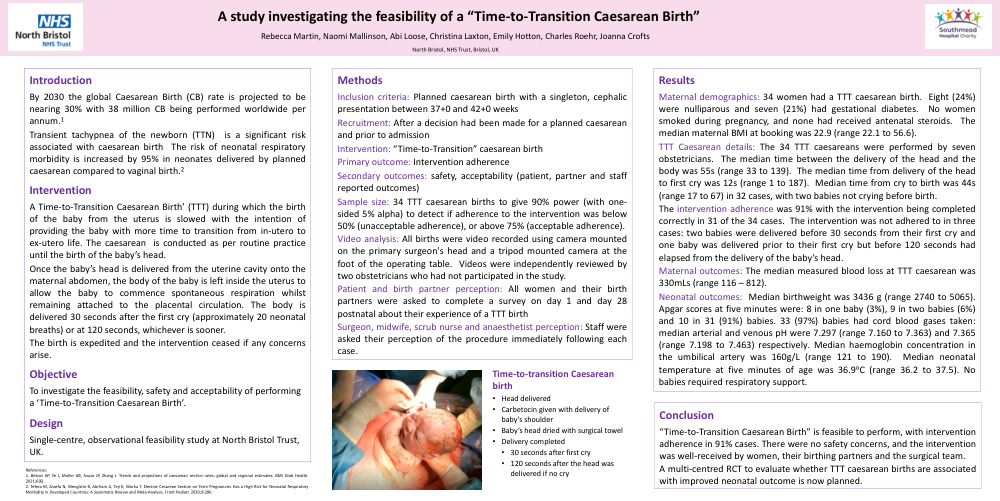
A Time-to-Transition Caesarean Birth’ (TTT) during which the birth of the baby from the uterus is slowed with the intention of providing the baby with more time to transition from in-utero to ex-utero life. The caesarean is conducted as per routine practice until the birth of the baby’s head.
Once the baby’s head is delivered from the uterine cavity onto the maternal abdomen, the body of the baby is left inside the uterus to allow the baby to commence spontaneous respiration whilst remaining attached to the placental circulation. The body is delivered 30 seconds after the first cry (approximately 20 neonatal breaths) or at 120 seconds, whichever is sooner.
The birth is expedited and the intervention ceased if any concerns arise.
Objective
To investigate the feasibility, safety and acceptability of performing a ‘Time-to-Transition Caesarean Birth’.
Design
Single-centre, observational feasibility study at North Bristol Trust, UK.