2,281 posters, 63 videos, 56 audios, 43 topics, 18 sessions, 6,174 authors, 2,323 institutions
ePostersLive by SciGen Technologies S.A. All rights reserved.
RCOG World Congress 2025
June 23 - 25, 2025 | ExCeL London, UK
EP.1228
The impact of modern obstetrics on the evolution of human birthweight
Poster Presenter
Authors
Affiliations
Part of Topic
Hot topics (emerging research/issues) in obstetrics
The impact of modern obstetrics on the evolution of human birthweight
Layla Ettinghausen, Ashley Moffett
Objective
- We set out to explore how medical advancements have influenced the dynamics of birthweight.
- Advances in prenatal care, caesarean sections (CS) and neonatal interventions have significantly improved maternal and neonatal outcomes.
- We hypothesise that this reduction in differential mortality has relaxed stabilising selection, leading to increased birthweights at both extremes.
Design and Method
- We reviewed literature on the evolutionary maintenance of birthweight, clinical risks associated with extreme birthweights, and population level data on how medical interventions have influenced birth outcomes over time.
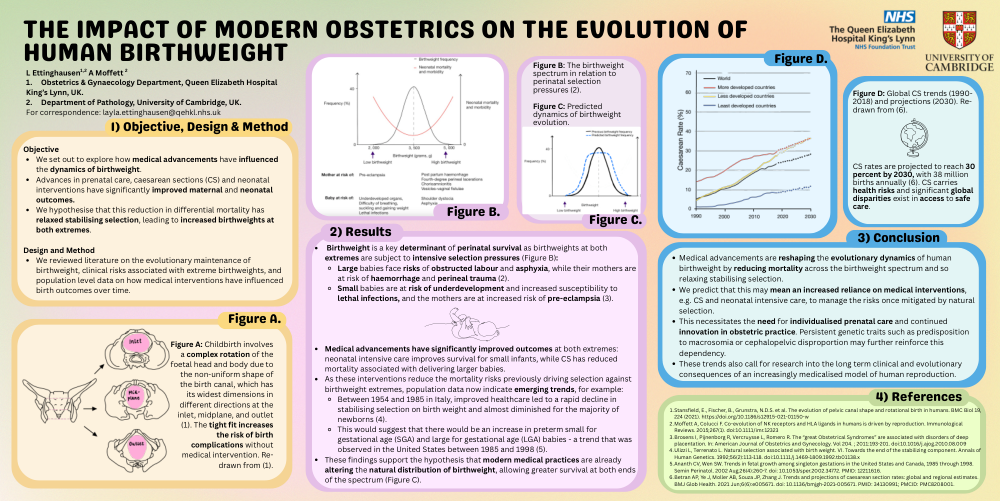
- Birthweight is a key determinant of perinatal survival as birthweights at both extremes are subject to intensive selection pressures (Figure B):
- Large babies face risks of obstructed labour and asphyxia, while their mothers are at risk of haemorrhage and perineal trauma (2).
- Small babies are at risk of underdevelopment and increased susceptibility to lethal infections, and the mothers are at increased risk of pre-eclampsia (3).
- Medical advancements have significantly improved outcomes at both extremes: neonatal intensive care improves survival for small infants, while CS has reduced mortality associated with delivering larger babies.
- As these interventions reduce the mortality risks previously driving selection against birthweight extremes, population data now indicate emerging trends, for example:
- Between 1954 and 1985 in Italy, improved healthcare led to a rapid decline in stabilising selection on birth weight and almost diminished for the majority of newborns (4).
- This would suggest that there would be an increase in preterm small for gestational age (SGA) and large for gestational age (LGA) babies - a trend that was observed in the United States between 1985 and 1998 (5).
- These findings support the hypothesis that modern medical practices are already altering the natural distribution of birthweight, allowing greater survival at both ends of the spectrum (Figure C).
- Medical advancements are reshaping the evolutionary dynamics of human birthweight by reducing mortalityacross the birthweight spectrum and so relaxing stabilising selection.
- We predict that this may mean an increased reliance on medical interventions, e.g. CS and neonatal intensive care, to manage the risks once mitigated by natural selection.
- This necessitates the need for individualised prenatal care and continued innovation in obstetric practice. Persistent genetic traits such as predisposition to macrosomia or cephalopelvic disproportion may further reinforce this dependency.
- These trends also call for research into the long term clinical and evolutionary consequences of an increasingly medicalised model of human reproduction.
Figure B: The birthweight spectrum in relation to perinatal selection pressures (2)
Figure C: Predicted dynamics of birthweight evolution.
Figure D: Global CS trends (1990-2018) and projections (2030). Re-drawn from (6).
CS rates are projected to reach 30 percent by 2030, with 38 million births annually (6). CS carries health risks and significant global disparities exist in access to safe care.