2,281 posters, 63 videos, 56 audios, 43 topics, 18 sessions, 6,174 authors, 2,323 institutions
ePostersLive by SciGen Technologies S.A. All rights reserved.
RCOG World Congress 2025
June 23 - 25, 2025 | ExCeL London, UK
EP.1226
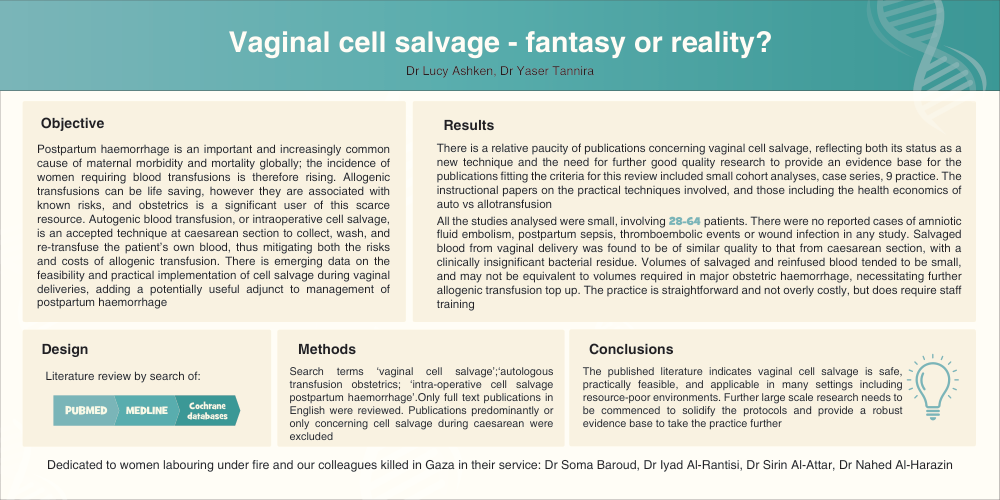
Vaginal cell salvage - fantasy or reality?
Poster Presenter
Authors
Affiliations
Part of Topic
Hot topics (emerging research/issues) in obstetrics
Vaginal cell salvage - fantasy or reality?
Objective
Postpartum haemorrhage is an important and increasingly common cause of maternal morbidity and mortality globally; the incidence of women requiring blood transfusions is therefore rising. Allogenic transfusions can be life saving, however they are associated with known risks, and obstetrics is a significant user of this scarce resource. Autogenic blood transfusion, or intraoperative cell salvage, is an accepted technique at caesarean section to collect, wash, and re-transfuse the patient’s own blood, thus mitigating both the risks and costs of allogenic transfusion. There is emerging data on the feasibility and practical implementation of cell salvage during vaginal deliveries, adding a potentially useful adjunct to management of postpartum haemorrhage.
Design
Literature review by search of PUBMED, MEDLINE and Cochrane databases.
Methods
Search terms ‘vaginal cell salvage’; ‘autologous transfusion obstetrics; ‘intra-operative cell salvage postpartum haemorrhage’. Only full text publications in English were reviewed. Publications predominantly or only concerning cell salvage during caesarean were excluded.
Results
There is a relative paucity of publications concerning vaginal cell salvage, reflecting both its status as a new technique and the need for further good quality research to provide an evidence base for the practice. The 9 publications fitting the criteria for this review included small cohort analyses, case series, instructional papers on the practical techniques involved, and those including the health economics of auto vs allotransfusion.
All the studies analysed were small, involving 28-64 patients. There were no reported cases of amniotic fluid embolism, postpartum sepsis, thromboembolic events or wound infection in any study. Salvaged blood from vaginal delivery was found to be of similar quality to that from caesarean section, with a clinically insignificant bacterial residue. Volumes of salvaged and reinfused blood tended to be small, and may not be equivalent to volumes required in major obstetric haemorrhage, necessitating further allogenic transfusion top up. The practice is straightforward and not overly costly, but does require staff training.
Conclusions
The published literature indicates vaginal cell salvage is safe, practically feasible, and applicable in many settings including resource-poor environments. Further large scale research needs to be commenced to solidify the protocols and provide a robust evidence base to take the practice further.