2,281 posters, 63 videos, 56 audios, 43 topics, 18 sessions, 6,174 authors, 2,323 institutions
ePostersLive by SciGen Technologies S.A. All rights reserved.
RCOG World Congress 2025
June 23 - 25, 2025 | ExCeL London, UK
EP.1217
The impact of working on labour ward on paediatricians’ personal birth choices
Poster Presenter
Part of Topic
Hot topics (emerging research/issues) in obstetrics
The impact of working on labour ward on paediatricians’ personal birth choices
Introduction:
It is recognised that traumatic birth events can have negative psychological sequalae for healthcare professionals on the labour ward, but little is known about the impact this has on their personal family planning and birth choices.
Methods:
Resident paediatric doctors in North West London, with current or recent experience of working in neonatology, were invited to complete an anonymous questionnaire and/or a semi-structured interview, over a seven month period in 2024.
Results:
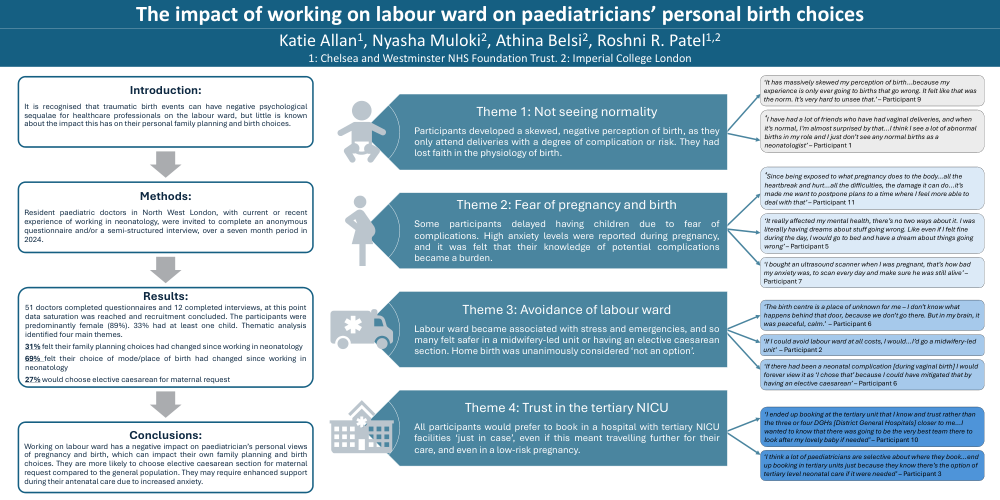
51 doctors completed questionnaires and 12 completed interviews, at this point data saturation was reached and recruitment concluded. The participants were predominantly female (89%). 33% had at least one child. Thematic analysis identified four main themes.
51 doctors completed questionnaires and 12 completed interviews, at this point data saturation was reached and recruitment concluded. The participants were predominantly female (89%). 33% had at least one child. Thematic analysis identified four main themes.
•31% felt their family planning choices had changed since working in neonatology
•69% felt their choice of mode/place of birth had changed since working in neonatology
•27% would choose elective caesarean for maternal request
•Theme 1: Not seeing normality
•Participants developed a skewed, negative perception of birth, as they only attend deliveries with a degree of complication or risk. They had lost faith in the physiology of birth.
•Theme 2: Fear of pregnancy and birth
•Some participants delayed having children due to fear of complications. High anxiety levels were reported during pregnancy, and it was felt that their knowledge of potential complications became a burden.
•Theme 3: Avoidance of labour ward
•Labour ward became associated with stress and emergencies, and so many felt safer in a midwifery-led unit or having an elective caesarean section. Home birth was unanimously considered ‘not an option’.
•Theme 4: Trust in the tertiary NICU
•All participants would prefer to book in a hospital with tertiary NICU facilities ‘just in case’, even if this meant travelling further for their care, and even in a low-risk pregnancy.
Conclusions:
Working on labour ward has a negative impact on paediatrician’s personal views of pregnancy and birth, which can impact their own family planning and birth choices. They are more likely to choose elective caesarean section for maternal request compared to the general population. They may require enhanced support during their antenatal care due to increased anxiety.
Working on labour ward has a negative impact on paediatrician’s personal views of pregnancy and birth, which can impact their own family planning and birth choices. They are more likely to choose elective caesarean section for maternal request compared to the general population. They may require enhanced support during their antenatal care due to increased anxiety.