2,281 posters, 63 videos, 56 audios, 43 topics, 18 sessions, 6,174 authors, 2,323 institutions
ePostersLive by SciGen Technologies S.A. All rights reserved.
RCOG World Congress 2025
June 23 - 25, 2025 | ExCeL London, UK
EP.1216
Antenatal steroids outcome in term elective caesarean delivery prior to 39 weeks
Poster Presenter
Authors
Mohammed Mouhajer, Amy Skinner, Richard Macaso, Sarah Faith, Jordan Rudd
Affiliations
Part of Topic
Hot topics (emerging research/issues) in obstetrics
Antenatal Steroids Outcome in Term Elective Caesarean Delivery prior to 39 weeks
M. Mouhajer¹, S. Faith², J.Rudd³, A. Skinner⁴, R. Makaso⁵
1, 2 & 3: MEDWAY NHS FOUNDATION TRUST, OBSTETRICS AND GYNAECOLOGY, KENT, UNITED KINGDOM
4 & 5: MEDWAY NHS FOUNDATION TRUST, NEONATOLOGY, KENT, UNITED KINGDOM
INTRODUCTION
Maternal administration of antenatal corticosteroids (DEX) before anticipated preterm birth is one of the most important interventions to improve neonatal outcomes. When a planned caesarean birth (ELCS) is being undertaken at term, but before 39+0 weeks’ gestation, corticosteroids may be considered to reduce the risk of neonatal respiratory morbidity. There is some recent evidence that they may be associated with developmental delay, and this has affected acceptance of the use of antenatal steroids, coupled with the uncertainties of benefit in reducing respiratory distress syndrome (RDS).
AIM
To assess the level of uptake of DEX use for foetal lung maturity in ELCS at gestations 37 & 38 weeks and assess impact on rates of neonatal admission for RDS.
METHOD
A retrospective review of patients delivered by ELCS at our unit between gestations of 37+0 to 38+6 weeks over a period of 18 months. Data was collected from our electronic records and analysed to ascertain those that received DEX as well as subsequent foetal outcome of admission for RDS.
RESULTS
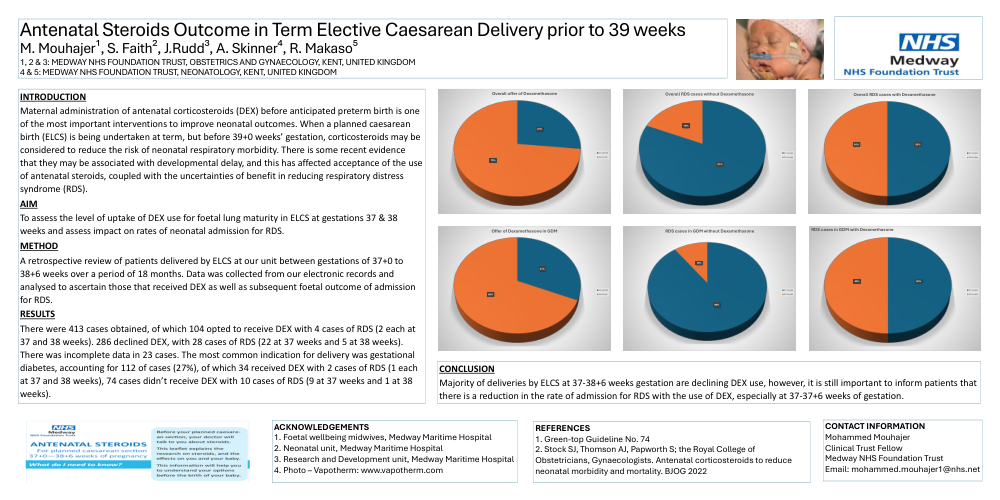
There were 413 cases obtained, of which 104 opted to receive DEX with 4 cases of RDS (2 each at 37 and 38 weeks). 286 declined DEX, with 28 cases of RDS (22 at 37 weeks and 5 at 38 weeks). There was incomplete data in 23 cases. The most common indication for delivery was gestational diabetes, accounting for 112 of cases (27%), of which 34 received DEX with 2 cases of RDS (1 each at 37 and 38 weeks), 74 cases didn’t receive DEX with 10 cases of RDS (9 at 37 weeks and 1 at 38 weeks).
CONCLUSION
Majority of deliveries by ELCS at 37-38+6 weeks gestation are declining DEX use, however, it is still important to inform patients that there is a reduction in the rate of admission for RDS with the use of DEX, especially at 37-37+6 weeks of gestation.