2,281 posters, 63 videos, 56 audios, 43 topics, 18 sessions, 6,174 authors, 2,323 institutions
ePostersLive by SciGen Technologies S.A. All rights reserved.
RCOG World Congress 2025
June 23 - 25, 2025 | ExCeL London, UK
EP.1215
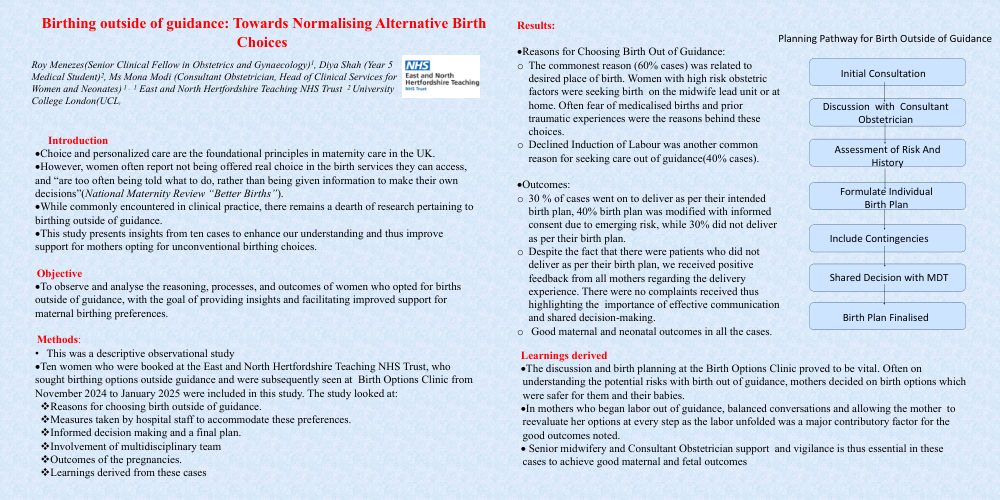
Birthing Outside Of Guidance: Towards Normalising Alternative Birth Choices
Poster Presenter
Authors
Affiliations
Senior Clinical Fellow in Obstetrics and Gynecology, Lister Hospital, East and North Hertfordshire NHS Trust, Senior Clinical Fellow, Department of Obstetrics & Gynaecology, Lister Hospital, East and North Hertfordshire NHS Trust, Medical Student (Year 5), University College London, Consultant Obstetrician, Head of Clinical Services for Women and Neonates, Lister Hospital, East and North Hertfordshire NHS Trust
Part of Topic
Hot topics (emerging research/issues) in obstetrics
Birthing outside of guidance: Towards Normalising Alternative Birth Choices
Roy Menezes(Senior Clinical Fellow in Obstetrics and Gynaecology)1, Diya Shah (Year 5 Medical Student)2, Ms Mona Modi (Consultant Obstetrician, Head of Clinical Services for Women and Neonates) 1 . 1 East and North Hertfordshire Teaching NHS Trust 2 University College London(UCL)
Introduction
Objective
Design: Descriptive observational study
Methods:
Results:
The commonest reason (60% cases) for seeking birth outside of guidance was related to desired place of birth with women with high risk obstetric factors( previous Caesarean Section or breech presentation) seeking birth on the midwife lead unit or at home. Often a fear of medicalised births and prior traumatic experiences on the consultant lead unit were the reasons behind these choices.
Declined Induction of Labour was another common cause of seeking care out of guidance(40% cases).
Detailed discussions were conducted between women & consultant obstetricians and midwives. Individualised birth plans were formulated for all the cases, incorporating evidence-based information and acknowledging increased risks.
Significantly the discussions included contingencies so there were clear parameters for acceptable care pathways when the situation changes, or an emergency occurred.
Learnings derived