2,281 posters, 63 videos, 56 audios, 43 topics, 18 sessions, 6,174 authors, 2,323 institutions
ePostersLive by SciGen Technologies S.A. All rights reserved.
RCOG World Congress 2025
June 23 - 25, 2025 | ExCeL London, UK
EP.1207
Maternal Serum Cell-Free Fetal DNA as a Predictor of Preeclampsia Severity
Poster Presenter
Authors
Eslam Elkoumy, Ali Mobarak, Eman Farid, Neveen Youssef, Ahmed Elshazly
Affiliations
MUST University_ Faculty of Medicine _Obstetrics and Gynecology Department, Beni Suef University_ Faculty of Medicine _Obstetrics and Gynecology Department, Beni Suef University_ Faculty of Medicine _Clinical pathology Department
Part of Topic
Hot topics (emerging research/issues) in obstetrics
background:
Prediction and diagnosis of PE are usually nonspecific as it is mainly based on nonspecific signs which are proteinuria and hypertension makes both prediction and diagnosis difficult especially in females suffering from preexisting diseases as cardiac or renal ones (Hagmann et al., 2012, Phipps et al., 2019).So, there was an urgent need for potential simple easy noninvasive methods to identify females having risk for the development of PE early in their current pregnancy. Such methods could offer a better chance for giving prophylactic therapy and providing thorough close follow up for those females. This could minimize the risk of fetal and maternal morbidity and mortality. So, evaluating the use of different biomarkers of PE is very important (Shahid et al., 2022, Yu et al., 2024).
The aim:
To assess the level of circulating maternal serum cell free fetal DNA and its relation to severity of preeclampsia in Egyptian Females.
Design and Methods:
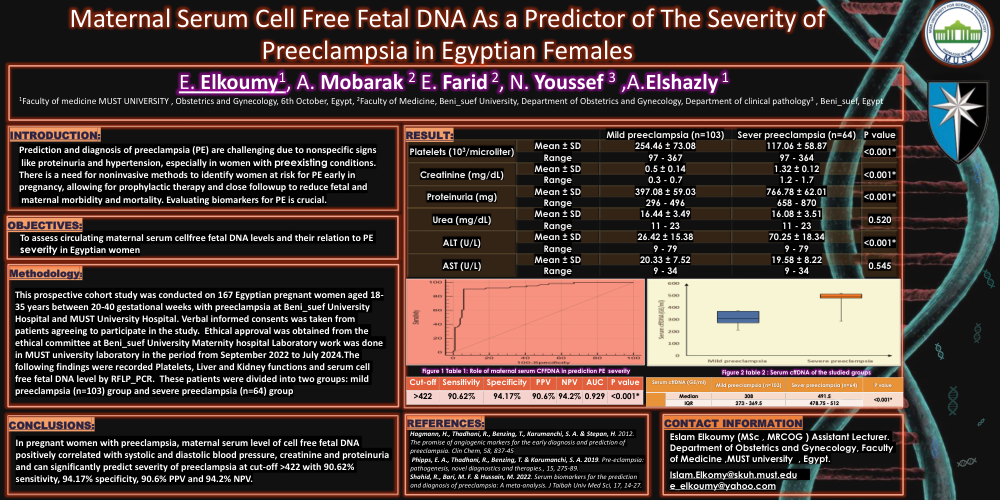
This prospective cohort study was conducted on 167 Egyptian pregnant women aged 18-35 years between 20-40 gestational weeks with preeclampsia at Beni_suef University Hospital and MUST University Hospital. Verbal informed consents was taken from patients agreeing to participate in the study. Ethical approval was obtained from the ethical committee at Beni_suef University Maternity hospital Laboratory work was done in MUST university laboratory in the period from September 2022 to July 2024.The following findings were recorded Platelets, Liver and Kidney functions and serum cell free fetal DNA level by RFLP_PCR. These patients were divided into two groups: mild preeclampsia (n=103) group and severe preeclampsia (n=64) group
Results.:
There was a positive correlation between maternal serum cell free fetal DNA and (systolic blood pressure, diastolic blood pressure, creatinine and proteinuria).
Maternal serum cell free fetal DNA can significantly predict severity of preeclampsia (AUC = 0.929) at cut-off >422 with 90.62% sensitivity, 94.17% specificity, 90.6% PPV and 94.2% NPV.
The platelets ranged from 97 to 367 103/microliter with a mean value (± SD) of 201.8 (±95.32) 103/microliter. The hematocrit ranged from 34 to 47 % with a mean value (± SD) of 40.4 (±4.22) %.
The urea ranged from 11 to 23 mg/dL with a mean value (± SD) of 16.3 (±3.49) mg/dL. The creatinine ranged from 0.3 to 1.7 mg/dL with a mean value (± SD) of 0.81 (±0.42) mg/dL. The proteinuria ranged from 296 to 870 mg with a mean value (± SD) of 538.8 (±190) mg. The ALT ranged from 9 to 79 U/L with a mean value (± SD) of 43.2 (±27.02) U/L. The AST ranged from 9 to 34 U/L with a mean value (± SD) of 20 (±7.78) U/L.
Platelets was significantly lower in patients with severe preeclampsia than patients with mild preeclampsia. Creatinine, proteinuria and ALT were significantly higher in patients with severe preeclampsia than patients with mild preeclampsia. Urea and AST were insignificantly different between both groups
Conclusions:
In pregnant women with preeclampsia, maternal serum level of cell free fetal DNA positively correlated with systolic blood pressure, diastolic blood pressure, creatinine and proteinuria and can significantly predict severity of preeclampsia at cut-off >422 with 90.62% sensitivity, 94.17% specificity, 90.6% PPV and 94.2% NPV.