2,281 posters, 63 videos, 56 audios, 43 topics, 18 sessions, 6,174 authors, 2,323 institutions
ePostersLive by SciGen Technologies S.A. All rights reserved.
RCOG World Congress 2025
June 23 - 25, 2025 | ExCeL London, UK
EP.0120
Audit of Miscarriage Management: Comparing Practices Before and After 2023 FIGO Guideline
Poster Presenter
Authors
Claudia Scerri, Angelica Galea, Carla Scicluna, Sumaya El Sadi, Mandy Collict
Affiliations
Part of Topic
Early pregnancy complications/early pregnancy and acute gynaecology
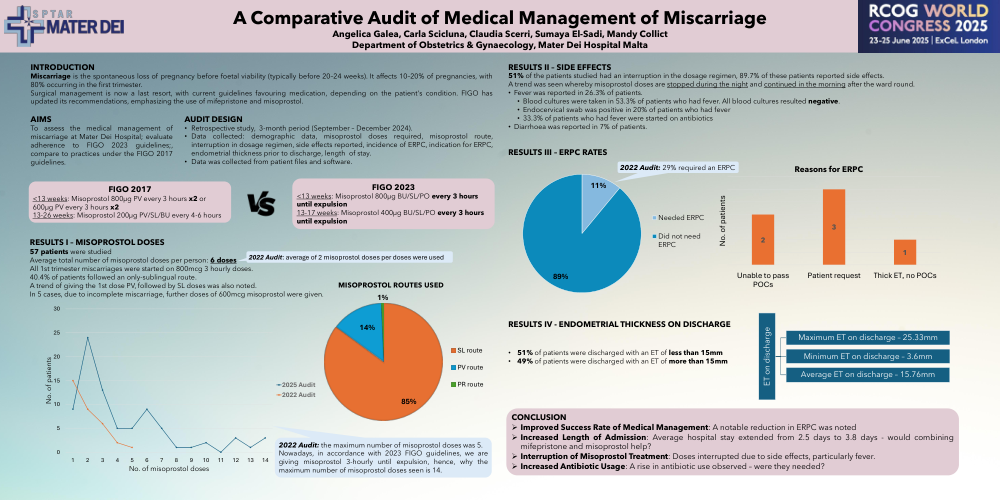
INTRODUCTION Miscarriage is the spontaneous loss of pregnancy before foetal viability (typically before 20–24 weeks). It affects 10–20% of pregnancies, with 80% occurring in the first trimester. Surgical management is now a last resort, with current guidelines favouring medication, depending on the patient's condition. FIGO has updated its recommendations, emphasizing the use of mifepristone and misoprostol
AIMS To assess the medical management of miscarriage at Mater Dei Hospital; evaluate adherence to FIGO 2023 guidelines;, compare to practices under the FIGO 2017 guidelines
AUDIT DESIGN • Retrospective study, 3-month period (September – December 2024). • Data collected: demographic data, misoprostol doses required, misoprostol route, interruption in dosage regimen, side effects reported, incidence of ERPC, indication for ERPC, endometrial thickness prior to discharge, length of stay. • Data was collected from patient files and software.
RESULTS I – MISOPROSTOL DOSES 57 patients were studied Average total number of misoprostol doses per person: 6 doses All 1st trimester miscarriages were started on 800mcg 3 hourly doses. 40.4% of patients followed an only-sublingual route. A trend of giving the 1st dose PV, followed by SL doses was also noted. In 5 cases, due to incomplete miscarriage, further doses of 600mcg misoprostol were given.
RESULTS II – SIDE EFFECTS 51% of the patients studied had an interruption in the dosage regimen, 89.7% of these patients reported side effects. A trend was seen whereby misoprostol doses are stopped during the night and continued in the morning after the ward round. • Fever was reported in 26.3% of patients. • Blood cultures were taken in 53.3% of patients who had fever. All blood cultures resulted negative. • Endocervical swab was positive in 20% of patients who had fever • 33.3% of patients who had fever were started on antibiotics • Diarrhoea was reported in 7% of patients. AUDIT DESIGN • Retrospective study, 3-month period (September – December 2024). • Data collected: demographic data, misoprostol doses required, misoprostol route, interruption in dosage regimen, side effects reported, incidence of ERPC, indication for ERPC, endometrial thickness prior to discharge, length of stay. • Data was collected from patient files and software. FIGO 2023 <13 weeks: Misoprostol 800µg BU/SL/PO every 3 hours until expulsion 13-17 weeks: Misoprostol 400µg BU/SL/PO every 3 hours until expulsion FIGO 2017 <13 weeks: Misoprostol 800µg PV every 3 hours x2 or 600µg PV every 3 hours x2 13-26 weeks: Misoprostol 200µg PV/SL/BU every 4-6 hours RESULTS I – MISOPROSTOL DOSES 57 patients were studied Average total number of misoprostol doses per person: 6 doses All 1st trimester miscarriages were started on 800mcg 3 hourly doses. 40.4% of patients followed an only-sublingual route. A trend of giving the 1st dose PV, followed by SL doses was also noted. In 5 cases, due to incomplete miscarriage, further doses of 600mcg misoprostol were given. 2022 Audit: average of 2 misoprostol doses per doses were used 85% 14% 1% MISOPROSTOL ROUTES USED SL route PV route PR route 0 5 10 15 20 25 30 1 2 3 4 5 6 7 8 9 10 11 12 13 14 No. of patients No. of misoprostol doses 2025 Audit 2022 Audit 2022 Audit: the maximum number of misoprostol doses was 5. Nowadays, in accordance with 2023 FIGO guidelines, we are giving misoprostol 3-hourly until expulsion, hence, why the maximum number of misoprostol doses seen is 14. RESULTS III – ERPC RATES 11% 89% Needed ERPC Did not need ERPC 2 3 1 Unable to pass POCs Patient request Thick ET, no POCs No. of patients Reasons for ERPC AIMS To assess the medical management of miscarriage at Mater Dei Hospital; evaluate adherence to FIGO 2023 guidelines;, compare to practices under the FIGO 2017 guidelines. CONCLUSION ➢ Improved Success Rate of Medical Management: A notable reduction in ERPC was noted ➢ Increased Length of Admission: Average hospital stay extended from 2.5 days to 3.8 days - would combining mifepristone and misoprostol help? ➢ Interruption of Misoprostol Treatment: Doses interrupted due to side effects, particularly fever. ➢ Increased Antibiotic Usage: A rise in antibiotic use observed – were they needed? RESULTS IV - ENDOMETRIAL THICKNESS ON DISCHARGE • 51% of patients were discharged with an ET of less than 15mm • 49% of patients were discharged with an ET of more than 15mm ET on discharge Maximum ET on discharge – 25.33mm Minimum ET on discharge – 3.6mm Average ET on discharge – 15.76mm 2022 Audit: 29% requ