2,281 posters, 63 videos, 56 audios, 43 topics, 18 sessions, 6,174 authors, 2,323 institutions
ePostersLive by SciGen Technologies S.A. All rights reserved.
RCOG World Congress 2025
June 23 - 25, 2025 | ExCeL London, UK
EP.1204
BEAD Feasibility Study: Baby head ElevAtion Device at Full Dilatation Caesarean Section
Poster Presenter
Authors
Jordon Wimsett, Charlotte Oyston, Meghan Hill, Erena Browne, Jane Alsweiler, Robin Cronin, John Thompson, Matthew Drake, Karaponi Okesene-Gafa, Lynn Sadler
Affiliations
Te Toka Tumai Auckland Hospital, Department of Obstetrics, Gynaecology and Reproductive Sciences, University of Auckland, Te Whatu Ora Waikato Hospital, Te Whatu Ora Counties Manukau, Middlemore Hospital
Part of Topic
Hot topics (emerging research/issues) in obstetrics
BEAD Feasibility Study: Baby head ElevAtion Device at Full Dilatation Caesarean Section
Jordon Wimsett1,2, Charlotte Oyston2,3, Meghan Hill2,3,Robin Cronin2,3, Erena Browne4, Jane Alwseiler1,5, John Thompson5, Karaponi Okesene-Gafa3,6, Matthew Drake1, Lynn Sadler1
1Te Toka Tumai Auckland Hospital, Health New Zealand, Auckland, New Zealand; 2Department of Obstetrics, Gynaecology, and Reproductive Sciences, University of Auckland, Auckland, New Zealand; 3Te Whatu Ora Counties Manukau, Health New Zealand, Auckland, New Zealand; 4Te Whatu Ora Waikato, Health New Zealand, Hamilton, New Zealand; 5Dept of Paediatrics: Child and Youth Health, University of Auckland, Auckland, New Zealand 6Pacific Health, University of Auckland
Objectives
Design
Double-blinded, randomised placebo-controlled feasibility study at two New Zealand hospitals.
Qualitative studies within the trial were used to understand patient and clinician experience.
Method
Mixed method survey with patients and semi-structured interviews with clinicians.
RCT process:
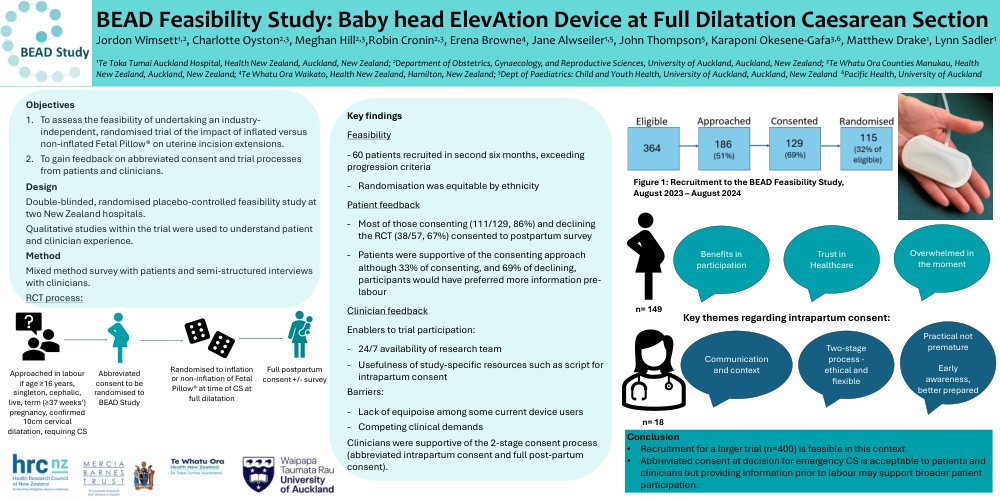
- Approached in labour if age ≥16 years, singleton, cephalic, live, term (≥37 weeks’) pregnancy, confirmed 10cm cervical dilatation, requiring CS
- Abbreviated consent to be randomised to BEAD Study
- Randomised to inflation or non-inflation of Fetal Pillow® at time of CS at full dilatation
- Full postpartum consent +/- survey
Key findings
Feasibility
- 60 patients recruited in second six months, exceeding progression criteria
Patient feedback
Clinician feedback
Enablers to trial participation:
Barriers:
Clinicians were supportive of the 2-stage consent process (abbreviated intrapartum consent and full post-partum consent).
Conclusion