2,281 posters, 63 videos, 56 audios, 43 topics, 18 sessions, 6,174 authors, 2,323 institutions
ePostersLive by SciGen Technologies S.A. All rights reserved.
RCOG World Congress 2025
June 23 - 25, 2025 | ExCeL London, UK
EP.1203
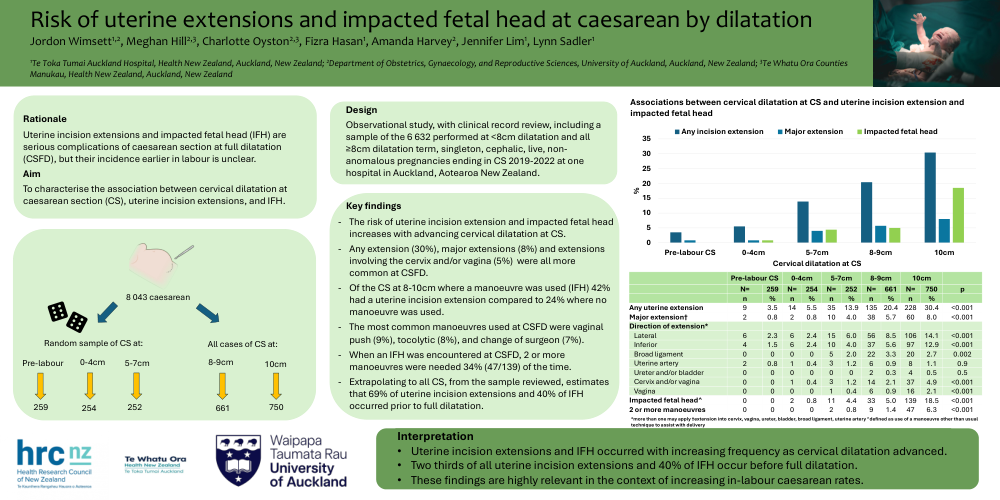
Risk of uterine extensions and impacted fetal head at caesarean, by dilatation
Part of Topic
Hot topics (emerging research/issues) in obstetrics
Risk of uterine extensions and impacted fetal head at caesarean by dilatation
Jordon Wimsett1,2, Meghan Hill2,3, Charlotte Oyston2,3, Fizra Hasan1, Amanda Harvey2, Jennifer Lim1, Lynn Sadler1
1Te Toka Tumai Auckland Hospital, Health New Zealand, Auckland, New Zealand; 2Department of Obstetrics, Gynaecology, and Reproductive Sciences, University of Auckland, Auckland, New Zealand; 3Te Whatu Ora Counties Manukau, Health New Zealand, Auckland, New Zealand
Rationale
Uterine incision extensions and impacted fetal head (IFH) are serious complications of caesarean section at full dilatation (CSFD), but their incidence earlier in labour is unclear.
Aim
To characterise the association between cervical dilatation at caesarean section (CS), uterine incision extensions, and IFH.
Design
Observational study, with clinical record review, including a sample of the 6 632 performed at <8cm dilatation and all ≥8cm dilatation term, singleton, cephalic, live, non-anomalous pregnancies ending in CS 2019-2022 at one hospital in Auckland, Aotearoa New Zealand.
Key findings
Interpretation