2,281 posters, 63 videos, 56 audios, 43 topics, 18 sessions, 6,174 authors, 2,323 institutions
ePostersLive by SciGen Technologies S.A. All rights reserved.
RCOG World Congress 2025
June 23 - 25, 2025 | ExCeL London, UK
EP.1201
VBAC RATE AUDIT CONDUCTED IN MCH PIMS ISLAMABAD VS GLOBAL RATE.
Poster Presenter
Part of Topic
Hot topics (emerging research/issues) in obstetrics
Objectives:
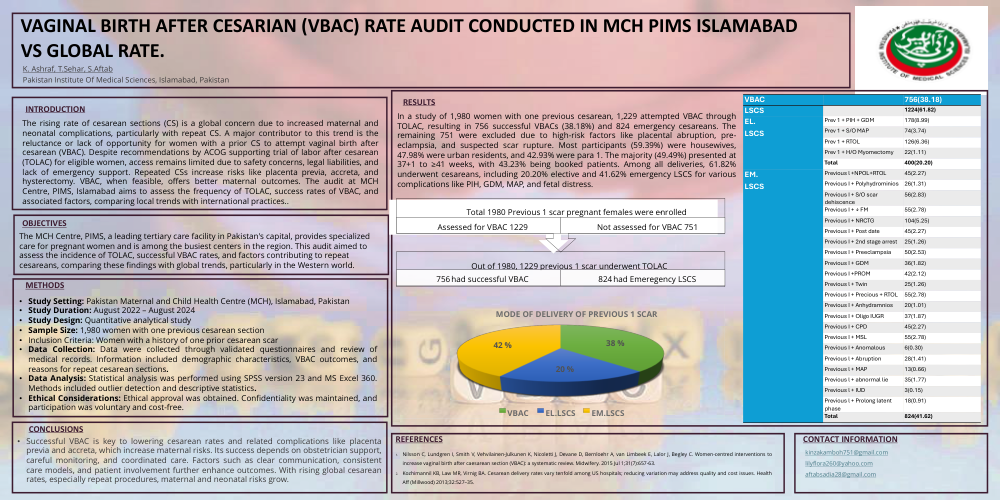
The MCH Centre, PIMS, a leading tertiary care facility in Pakistan's capital, provides specialized care for pregnant women and is among the busiest centers in the region. This audit aimed to assess the incidence of TOLAC, successful VBAC rates, and factors contributing to repeat cesareans, comparing these findings with global trends, particularly in the Western world.
Design:
The quantitative study examines VBAC incidence and factors leading to repeat cesareans. VBAC is critical for lowering cesarean rates and associated complications like placenta previa and accreta. Success depends on obstetrician support, monitoring, and teamwork. Improving VBAC rates requires prioritizing VBAC, fostering communication, and ensuring clinician collaboration with consistent care models and patient agreements. These efforts address the global rise in cesarean rates and related adverse maternal and neonatal outcomes.
Methodology:
The two-year study at Pakistan's Maternal and Child Health Centre (August 2022–August 2024) included 1,980 women with one previous cesarean scar. Using validated questionnaires and medical records, it analyzed demographic data, VBAC outcomes, and repeat cesarean causes. SPSS Version 23 and MS Excel 360 were used for data analysis, including outlier detection and descriptive statistics. Ethical approval ensured confidentiality, and participation was free of cost.
Results:
In a study of 1,980 women with one previous cesarean, 1,229 attempted VBAC through TOLAC, resulting in 756 successful VBACs (38.18%) and 824 emergency cesareans. The remaining 751 were excluded due to high-risk factors like placental abruption, pre-eclampsia, and suspected scar rupture. Most participants (59.39%) were housewives, 47.98% were urban residents, and 42.93% were para 1. The majority (49.49%) presented at 37+1 to ≥41 weeks, with 43.23% being booked patients. Among all deliveries, 61.82% underwent cesareans, including 20.20% elective and 41.62% emergency LSCS for various complications like PIH, GDM, MAP, and fetal distress.
Conclusion:
Successful VBAC (vaginal birth after cesarean) is crucial to reduce cesarean sections and their complications, such as placenta previa and accreta, which increase maternal morbidity and mortality. Achieving VBAC requires continuous support from obstetricians, vigilant monitoring, and a collaborative, unified approach among healthcare professionals. Factors like effective communication, consistent care models, and patient agreements enhance VBAC success. Rising cesarean rates significantly impact global maternity care, with repeat cesareans posing heightened risks for adverse maternal and neonatal outcomes. While this study highlights key insights, its small size limits generalizability. Future audits and interventions are essential to improve VBAC rates and outcomes.