2,281 posters, 63 videos, 56 audios, 43 topics, 18 sessions, 6,174 authors, 2,323 institutions
ePostersLive by SciGen Technologies S.A. All rights reserved.
RCOG World Congress 2025
June 23 - 25, 2025 | ExCeL London, UK
EP.1198
Women's Perspectives on Pregnancy-Related Care
Poster Presenter
Authors
Affiliations
Part of Topic
Hot topics (emerging research/issues) in obstetrics
Women's Perspectives on Pregnancy-Related Care
Authors: Miss Sangeeta Agnihotri, Dr Maliha Banu, Dr Yee Neng Adaylia Faith Loo
Barts Health NHS Trust, London, United Kingdom
Background:
National guidelines recommend the use of supplementation during pregnancy to reduce adverse outcomes1. Key supplements recommended include folic acid (FA), iron and aspirin1, 2. Women from certain population groups in particular those with less access to and engagement with formal health services are at increased risk of complications during pregnancy3. Limited awareness and confidence regarding these recommendations can affect making informed decisions and compliance. Engaging with at-risk populations in culturally appropriate settings may help to bridge the knowledge gap and improve access to antenatal care and women's health services4. This study involved a pregnancy-related care workshop and was set up with permission, in a confidential space within a local mosque.
Objective:
The aim of this study was to assess the awareness and confidence in both the timing and indication of FA, iron & aspirin in pregnancy amongst women from a population group known to be at high risk of pregnancy-related complications with reduced engagement in formal health services3,5.
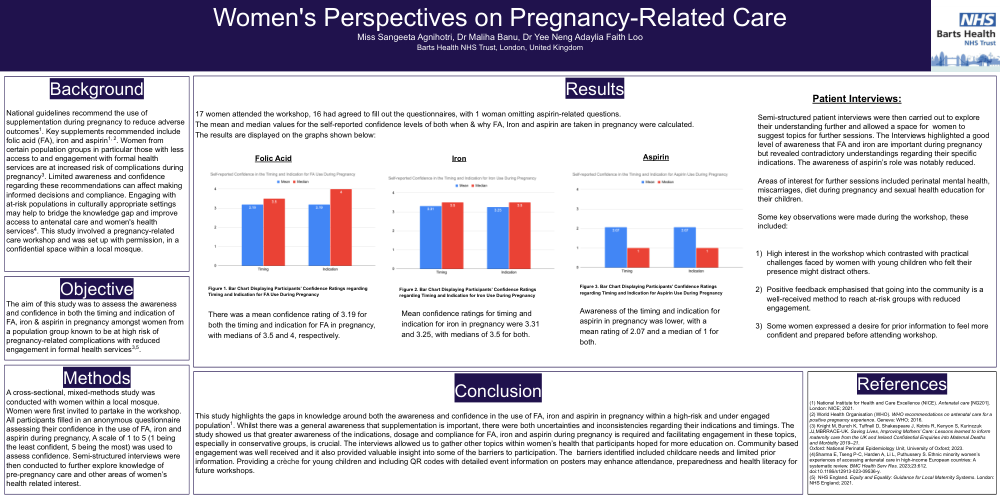
17 women attended the workshop, 16 had agreed to fill out the questionnaires, with 1 woman omitting aspirin-related questions.
The mean and median values for the self-reported confidence levels of both when & why FA, Iron and aspirin are taken in pregnancy were calculated.
There was a mean confidence rating of 3.19 for both the timing and indication for FA in pregnancy, with medians of 3.5 and 4, respectively.
Mean confidence ratings for timing and indication for iron in pregnancy were 3.31 and 3.25, with medians of 3.5 for both.
Awareness of the timing and indication for aspirin in pregnancy was lower, with a mean rating of 2.07 and a median of 1 for both.
Semi-structured patient interviews were then carried out to explore their understanding further and allowed a space for women to suggest topics for further sessions. The Interviews highlighted a good level of awareness that FA and iron are important during pregnancy but revealed contradictory understandings regarding their specific indications. The awareness of aspirin’s role was notably reduced.
Areas of interest for further sessions included perinatal mental health, miscarriages, diet during pregnancy and sexual health education for their children.
Some key observations were made during the workshop, these included:
-
High interest in the workshop which contrasted with practical challenges faced by women with young children who felt their presence might distract others.
-
Positive feedback emphasised that going into the community is a well-received method to reach at-risk groups with reduced engagement.
-
Some women expressed a desire for prior information to feel more confident and prepared before attending workshop.
Conclusion:
This study highlights the gaps in knowledge around both the awareness and confidence in the use of FA, iron and aspirin in pregnancy within a high-risk and under engaged population1. Whilst there was a general awareness that supplementation is important, there were both uncertainties and inconsistencies regarding their indications and timings. The study showed us that greater awareness of the indications, dosage and compliance for FA, iron and aspirin during pregnancy is required and facilitating engagement in these topics, especially in conservative groups, is crucial. The interviews allowed us to gather other topics within women’s health that participants hoped for more education on. Community based engagement was well received and it also provided valuable insight into some of the barriers to participation. The barriers identified included childcare needs and limited prior information. Providing a crèche for young children and including QR codes with detailed event information on posters may enhance attendance, preparedness and health literacy for future workshops.
References:
(1) National Institute for Health and Care Excellence (NICE). Antenatal care [NG201]. London: NICE; 2021.
(2) World Health Organisation (WHO). WHO recommendations on antenatal care for a positive pregnancy experience. Geneva: WHO; 2016.
(3) Knight M, Bunch K, Tuffnell D, Shakespeare J, Kotnis R, Kenyon S, Kurinczuk JJ,MBRRACE-UK. Saving Lives, Improving Mothers’ Care: Lessons learned to inform maternity care from the UK and Ireland Confidential Enquiries into Maternal Deaths and Morbidity 2019–21.
Oxford: National Perinatal Epidemiology Unit, University of Oxford; 2023.
(4)Sharma E, Tseng P-C, Harden A, Li L, Puthussery S. Ethnic minority women’s experiences of accessing antenatal care in high-income European countries: A systematic review. BMC Health Serv Res. 2023;23:612. doi:10.1186/s12913-023-09536-y.
(5) NHS England. Equity and Equality: Guidance for Local Maternity Systems. London: NHS England; 2021.